Digital tech contributes over 1 trillion VND to economy: conference

The digital technology sector has contributed more than 1.075 trillion VND (41 billion USD) to GDP, an increase of 10% year-on-year, with estimated profits of over 371 billion VND, reflecting strong operational efficiency.

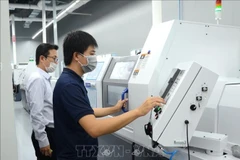
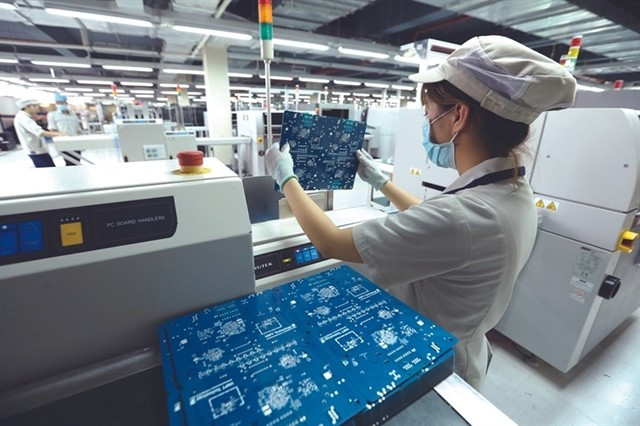
Workers at a VNPT factory at the Hoa Lac Hi-tech Park in Hanoi (Photo: VNA)

Hanoi (VNS/VNA) – Total revenue of the digital technology industry in 2025 is estimated at 198 billion USD, up 26% compared to 2024 and 16% higher than the annual plan, heard participants at a recent conference organised by the Ministry of Science and Technology to review the industry's milestones this year and set objectives for 2026.

The sector has contributed more than 1.075 trillion VND (41 billion USD) to GDP, an increase of 10% year-on-year, with estimated profits of over 371 billion VND, reflecting strong operational efficiency.

Addressing the conference, Minister Nguyen Manh Hung said 2025 is a pivotal year, marking the merger of the Ministry of Information and Communications and the Ministry of Science and Technology to form the Ministry of Science and Technology, with expanded responsibilities and higher development demands.

He stressed that the merger is not simply an organisational consolidation, but an effort to generate synergy, positioning science and technology, innovation and digital transformation as three core drivers of national development.

Emphasising the need for fundamental renewal in advisory work, the minister said units must move away from managing procedures towards managing tasks and results, and shift from “doing on behalf” to supporting and enabling the system to operate more effectively. Advisory work, he added, should be closely aligned with reality, avoid formalism, and focus on practical impact in support of national development.

At the conference, the ministry presented the allocation of an additional 25 trillion VND package, proposing 16.716 trillion VND for ministries, sectors and localities. It also prepared the 2026 state budget plan and estimates, with a total outlay of 95 trillion VND, which were approved by the National Assembly.

Through its task monitoring system, the ministry tracked 3,382 tasks assigned by the Government, the Prime Minister and the ministry’s leadership, up 40% compared to 2024. It coordinated preparations for the minister’s participation in National Assembly sessions, resolved all voters’ petitions, and responded to 355 recommendations from localities and businesses.

In the information technology sector, semiconductor development was identified as a key national priority. The systematic rollout of the Strategy for Vietnam’s Semiconductor Industry Development to 2030, with a vision to 2050, together with the issuance of organisational regulations and the establishment of the National Centre for Semiconductor Chip Prototyping Support, was highlighted as an important step in strengthening domestic technological capacity and supporting local enterprises.

At the same time, efforts to develop the market and digital technology enterprises have been intensified through the publication of the “List of Major Problems in Science, Technology, Innovation and Digital Transformation”, aimed at promoting localisation and increasing Vietnamese value content in technology products.

Export turnover of hardware and electronics in 2025 is estimated at 178 billion USD, an increase of 35% compared to 2024 and equivalent to 112% of the annual plan, maintaining its position as a major national export category. The number of operating digital technology enterprises is estimated at 80,052, up 10% year-on-year.

Deputy Minister Bui Hoang Phuong said 2025 is a year of particular significance, involving heavy workloads, high requirements and many unprecedented tasks. Following the merger, the ministry prioritised organisational stability, staff welfare and the rapid completion of the legal framework.

In the first ten months of the year, the ministry reviewed, drafted, amended and revised ten laws, along with numerous decrees and circulars, and served as the focal point for implementing Resolution No. 57-NQ/TW, which involved new tasks under tight timelines and demanding requirements./.

VNA

See more

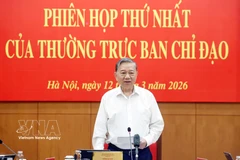
Party General Secretary To Lam speaks at the first meeting in 2026 of the Central Steering Committee for the Development of Science, Technology, Innovation and Digital Transformation on March 12. (Photo: VNA)

Party chief urges stronger, result-oriented implementation of Resolution 57

Turning science, technology, innovation and digital transformation into the main drivers of a new growth model requires substantial efforts. In the coming period, the focus must shift from merely carrying out tasks to delivering tangible and measurable outcomes, while concentrating resources on addressing strategic national challenges, said Party General Secretary To Lam.

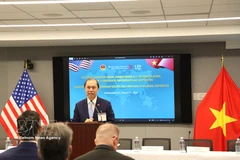
Vietnamese Ambassador to the US Nguyen Quoc Dung addresses the forum. (Photo: VNA)

High-level forum advances Vietnam–US technological cooperation

The ambassador highlighted that Vietnam and the US are highly complementary. Vietnam offers a dynamic economy, a young and increasingly skilled workforce and rapidly growing innovation ecosystem, while the US offers frontier technologies, world class research institutions, capital and leading global companies.

Participants at the first meeting of the National Steering Committee on Semiconductor Industry Development in 2026 (Photo: VNA)

Vietnam becomes vital player in global semiconductor value chain: Deputy PM

Vietnamese companies have also gradually joined the global value chain by improving their capabilities in chip design, production and related services. Notably, a semiconductor chip manufacturing plant project developed by the Viettel Military Industry and Telecoms Group (Viettel) has already commenced.

Young voters in Ho Chi Minh City scan an QR code to participate in an online quiz about the Election Law. (Photo: VNA)

Digital technology helps enhance transparency, trust in elections

The use of technology in this election is not merely a short-term measure but reflects Ho Chi Minh City’s broader commitment to comprehensive digital transformation and smart urban governance, reinforcing public trust in the democratic process and administration.

Information about candidates for the Khanh Hoa provincial People's Council for the 2026-2031 term is published on digital information channels, making it convenient for voters to explore. (Photo: VNA)

Technology breakthrough ensures voters' access, rights

Digital platforms such as the national population database and the VNeID application have been widely applied to streamline election management and improve accuracy in voter registration, helping citizens exercise their civic rights more conveniently.

Mang But commune area in Quang Ngai province. (Photo: VNA)

3.9-magnitude earthquake recorded in Mang But, Quang Ngai

According to the Vietnam Earthquake Information and Tsunami Warning Centre under the Institute of Earth Sciences, the tremor occurred at 11:35:06 (Hanoi time) with coordinates of 14.864 degrees North latitude and 108.210 degrees East longitude, at a depth of about 8.1 km. The event was assessed as having a level-0 disaster risk.

Illustrative photo: AFP

AI Law takes effect, anchors national governance framework

Taken together, the new AI Law and its implementation roadmap not only complete Vietnam’s legal architecture for AI, but also lay a structured foundation for risk management, innovation and ecosystem development, aiming to ensure coherent and effective enforcement in the years ahead.

Viettel Networks and Ericsson sign their cooperation agreement on the sidelines of the Mobile World Congress 2026. (MWC 2026)

Viettel Networks, Ericsson partner to advance autonomous telecom networks

Under a newly signed cooperation agreement, Ericsson will provide network automation platforms and artificial intelligence (AI) technologies while working with Viettel to conduct real-world trials. The collaboration marks a new step forward, combining Viettel’s large-scale network operation expertise with Ericsson’s strengths in automation solutions and advanced technologies.

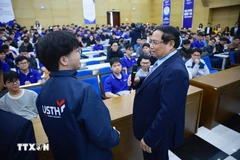
Prime Minister Pham Minh Chinh speaks with students at Hanoi University of Science and Technology (Photo: VNA)

Resolution 57: Developing high-quality sci-tech human resources key to master strategic technologies

After one year of implementing Resolution No. 57-NQ/TW of the Politburo, alongside notable achievements, the Central Steering Committee for science and technology development, innovation, and digital transformation has identified persistent shortcomings and bottlenecks requiring urgent attention - most notably a shortage of high-quality human resources in strategic technology fields.