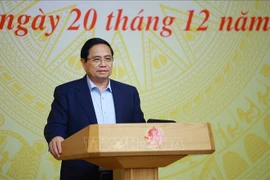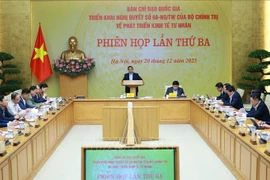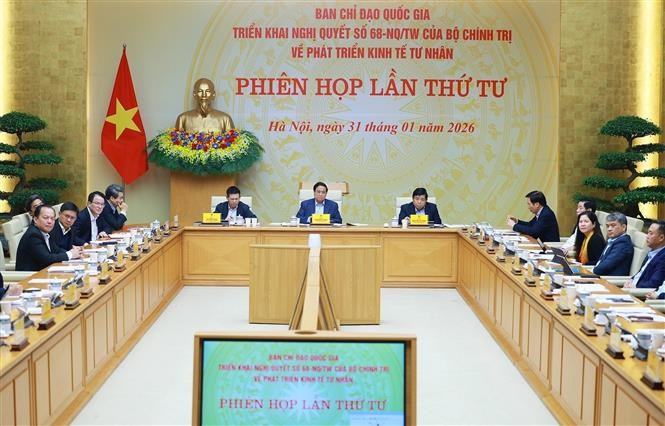
Hanoi (VNA) – Prime Minister Pham Minh Chinh called for accelerated digitalisation, greening efforts, resource optimisation, smart governance, and balanced interests among private firms while chairing the fourth session of the National Steering Committee for the implementation of the Politburo’s Resolution 68-NQ/TW on private sector development in Hanoi on January 31.
Ministries, agencies, and local authorities must foster open mechanisms and streamlined administrative procedures, deliver synchronous and seamless infrastructure, cultivate smart workforce and governance, pool all possible resources for private firms, and share trials and tribulations faced by them.
Private firms, in turn, were assigned to spearhead sci-tech, innovation, digital transformation, green transition, and economic restructuring; workforce training, job creation, social welfare; institutional and mechanism building, alongside full compliance with legal regulations; fostering a culture of integrity and humanity in production and trade; and pooling all resources for national development.
Praising the momentum generated since Resolution 68’s launch eight months ago, PM Chinh declared that it has propelled the private sector to its rightful place as the economy’s most critical growth engine while instilling renewed confidence among enterprises, entrepreneurs, and society at large in both the sector and the nation itself.
As Vietnam sets its sights on double-digit growth and a trajectory of rapid yet sustainable development, the private sector must rise to the occasion with matching vigour, playing its pivotal role in building a strong, civilised, prosperous, and happy country that steadily advances toward socialism, he said.
The PM instructed ministries, agencies, and local authorities to sustain their pursuit of the resolution, in line with the 14th National Party Congress’s and the Politburo’s resolutions, especially those concerning the private sector.
Endorsing proposals to entrust major, challenging, and breakthrough tasks to private firms, including the settlement of long-stalled projects to unleash development resources, he assigned specific responsibilities to ministries and agencies. These include a thorough review of legal regulations governing private-sector activities to ensure Party’s guidelines are enshrined in law; amendments to the Law on support for enterprises; upgrades to the monitoring system for Resolution 68 implementation; and revisions to the Law on Handling of Administrative Violations to fully translate the Politburo’s guidelines into enforceable legislation.
The Government leader also requested a review of domestic market development schemes and national trade promotion programmes, with practical and effective orientations and solutions for the next phase; and a a careful examination of the Civil Law and Land Law to propose relevant tasks.
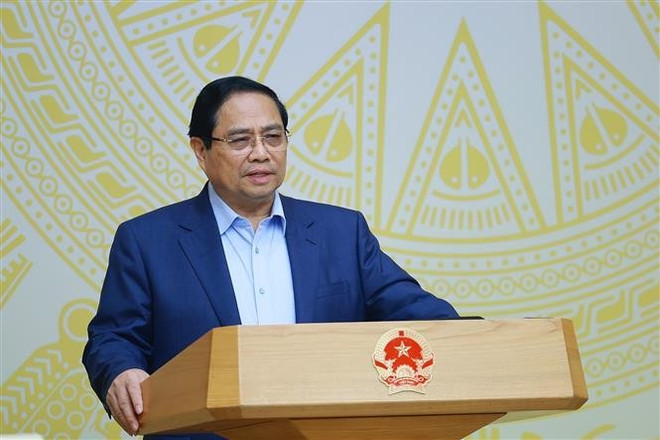
He urged enterprises to support one another, with larger firms assisting smaller ones in integrating into their ecosystems, enabling business households to evolve into small enterprises, small enterprises into medium-sized ones, medium-sized into large, and large enterprises into globally competitive players.
To propel Resolution 68 forward, the Government assigned 69 tasks to ministries, agencies, and local authorities. To date, 41 out of 43 tasks for 2025 have been completed.
Since May 2025, Vietnam has averaged around 18,000 new enterprise registrations per month, while more than 8,300 others resumed operations. By late 2025, the nationwide total of active enterprises surpassed 1 million.
On the stock market, the VN-Index closed near 1,785 points at year-end, with average daily trading value around 29.5 trillion VND (1.14 billion USD); market capitalisation approached 10 quadrillion VND, equivalent to roughly 70% of 2025 GDP.
Total exports-imports reached 930 billion USD in 2025, placing Vietnam among the world’s top 25 trading economies.
Particularly noteworthy, state budget revenue from the non-state sector in 2025 was estimated at over 497 trillion VND, or 134% of the target and 127% higher year-on-year. Revenue from household and individual businesses surged more than 36%, recording the highest growth rate observed throughout the 2021–2025 period./.