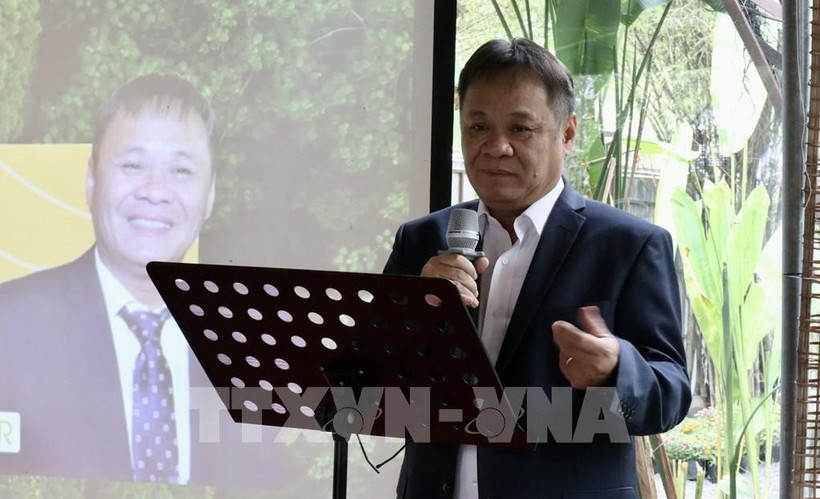
Ho Chi Minh City (VNA) – Meeting sustainable development requirements is no longer optional but a mandatory condition for Vietnamese wooden furniture and wood products to retain their position in global supply chains, experts said at a seminar held in Ho Chi Minh City on January 29.
Vo Quang Ha, Chairman of the Ho Chi Minh City Structure Architecture Wood Association (SAWA), noted that, of more than 17 billion USD in Vietnam’s wood and wood product exports, raw materials and sawn timber account for only about 4–5 billion USD, while the rest comes from furniture and interior products. This highlights the significant potential for value-added growth in the sector.
However, Ha stressed that export expansion must be accompanied by responsible forest management and a long-term vision, supported by clear policy orientation and appropriate mechanisms to engage all stakeholders.
Developing large-timber plantations was identified as a key solution to increasing value added. Large timber generates higher economic returns for forest growers, provides greater economic value and enables longer carbon sequestration, contributing to climate change mitigation. Instead of early harvesting for low-value products such as wood chips, forest owners should be encouraged to extend rotation periods to support deep processing. Residual wood can be utilised for engineered wood products, while plantation timber in Vietnam has the potential to be processed into construction materials. Internationally, engineered wood has already been applied in high-rise buildings and large-scale, environmentally friendly projects.
To Xuan Phuc, Executive Director of Forest Trends’ Forest Products Trade Policy Programme, said global wood markets are rapidly shifting from voluntary to mandatory requirements on legality and sustainability. While voluntary certification schemes such as Forest Stewardship Council (FSC) and Programme for the Endorsement of Forest Certification (PEFC) were once the main tools to ensure sustainability, major consumer markets have since introduced binding regulations, including the EU’s Forest Law Enforcement, Governance and Trade (FLEGT) Voluntary Partnership Agreements (VPA), the US Lacey Act and Australia’s Illegal Logging Prohibition Act.
Since the 2010s, market demands have continued to rise, with legality seen as a necessary but insufficient condition. Consumers and importers increasingly require deforestation-free supply chains, respect for community rights, labour standards, and contributions to emission reduction and climate change response. Many large corporations have committed to sourcing only sustainable wood products with transparent supply chains.
Vietnam’s key export markets apply different levels of requirements, but the overall trend is tightening. The US, accounting for over half of Vietnam’s wooden furniture exports, focuses strongly on legal origin and high-risk timber imports. Although the EU represents a smaller market share, it leads regulatory innovation, notably with the EU Deforestation Regulation (EUDR), which requires traceability and proof of deforestation-free production. Compliance is considered feasible as most exports to the EU already hold FSC or PEFC certification.
Meanwhile, China remains a relatively stable market with lower requirements, mainly importing wood chips. Japan and the Republic of Korea continue to demand pellets, chips and plywood, though with stricter criteria on legality and climate impact. Overall, trade regulations are increasingly shaping forest governance and supply chains in producing countries like Vietnam.
Phuc noted that with over 1.1 million forest-growing households, fragmented landholdings and complex supply chains, Vietnam’s wood industry needs a more comprehensive approach. Key solutions include expanding certified forest areas, enhancing supply chain transparency, supporting smallholders’ livelihoods and reducing reliance on high-risk imported timber.
From a policy perspective, the State’s leading role was underscored through public procurement policies prioritising legal and sustainable wood products, helping reduce trade risks, stimulate the domestic market and improve forest growers’ livelihoods. The private sector is also expected to proactively implement sustainability commitments in response to evolving global consumption trends.
Addressing wood use in construction, Lu Thi Hong, Deputy Director of the Institute for Building Materials under the Ministry of Construction, said wood is increasingly recognised as a renewable, low-carbon material supporting green transition goals.
She recommended restructuring technical standards to integrate quality, origin, sustainability and carbon emissions, while incorporating life cycle assessment and environmental product declarations to align with green building standards and national emission reduction strategies./.
See more
Hanoi’s agricultural exports surpass 2 billion USD in 2025
Of the total, key agricultural and food products accounted for about 1.4 billion USD, representing the largest share of the sector’s export turnover. The result reflects the effectiveness of Hanoi’s efforts to expand overseas markets, improve quality standards, strengthen traceability systems and promote international-standard production models to meet increasingly stringent import requirements.
First Spring Fair to be organised in cost-effective, efficient manner
The notice commends the efforts of the Ministry of Industry and Trade (MoIT), relevant ministries, agencies, localities, and Vingroup for coordinating to develop the organisation plan, agreeing on the event dates from February 2 – 13.
VinFast unveils e-motorbike strategy with seven premium, sport models
Hoang Ha, CEO of VinFast’s electric motorbike business in Vietnam, said the revamped portfolio aims to “redefine” the country’s electric motorbike market by turning the vehicles into expressions of individuality, passion and social responsibility.
Ample room remains open for railway industry enterprises
A highlight of the scheme is the ambition to develop a modern, integrated railway industry capable of independently designing, manufacturing, and maintaining metro lines and inter-regional railways with design speeds below 200 km/h, while gradually mastering high-speed railway technologies with design speeds of 200 km/h or higher. The roadmap is structured in three phases.
Reference exchange rate continues to drop on January 30
The State Bank of Vietnam set the daily reference exchange rate at 25,074 VND/USD on January 30, down 9 VND from the previous day.
Inflationary risk persists as Vietnam targets CPI below 4.5% in 2026: experts
Given Vietnam’s inflation control in 2025, economists expect inflation in 2026 to remain moderate, averaging about 3.5%. Still, higher international logistics and transport costs could keep driving up production expenses and commodity prices, she noted.
Spring Fair 2026 to feature around 3,000 standard booths
The first Glorious Spring Fair 2026 will serve as a direct link between manufacturers, distributors, and consumers, helping to cut down unnecessary middle steps. As a result, businesses are expected to cut operating and consignment costs by around 15-20%, enabling both enterprises and consumers to benefit from more competitive prices at the event.
27 outstanding Vietnamese suppliers honoured
Amid the ongoing restructuring of global supply chains, Vietnamese suppliers must move beyond the role of simple production links to become strategic partners with technological capability, innovation capacity and value-chain governance aligned with sustainable development.
Vietnam garment firms secure orders through Q1
Market analysts said that although global demand remains relatively stable, the sector continues to struggle with higher input costs, including wages and logistics, while selling prices remain under pressure due to weak bargaining power.
Deputy Minister hopeful for US tariff talks next week
Vietnam encourages US companies to scale up production and business in the country while simultaneously offering all possible support for US products to enter the Vietnamese market.
Spring Fair 2026: E-commerce poised for a green transition
The E-commerce Forum 2026 will will highlight new developments in e-commerce governance under the forthcoming E-commerce Law, which establishes a comprehensive legal framework covering all market participants and emerging business models.
MoIT provides update on oil discovery off Vietnam's coast
Deputy Minister of Industry and Trade Nguyen Sinh Nhat Tan described the discovery as a very positive development for Vietnam’s energy sector, adding that the ministry will work closely with relevant units to carry out further evaluation and verification.
Retail petrol prices rise in January 29 adjustment
The Ministry of Finance and the Ministry of Industry and Trade announced the latest fuel price adjustment, effective from 3:00 pm on January 29, with most oil and petrol products seeing increases.
New Zealand – Vietnam Business Council launched in Auckland
The council is committed to promoting effective cooperation and generating concrete benefits for its member enterprises while working closely with partners to organise forums, conferences, and business dialogues on trade and investment promotion, technology sharing and transfer, digital transformation, and e-commerce.
Bac Ninh pledges support for JA Solar to resume photovoltaic cell technology project
Within its delegated authority, the province is committed to addressing business difficulties and obstacles in the fastest and most effective manner, for the shared development of both enterprises and the locality, a local official said.
Ho Chi Minh City consults on strategy for International Financial Centre
Ho Chi Minh City aims to rank among the world’s top 75 financial centres under the Global Financial Centres Index (GFCI) by 2035, with the longer-term goal of reaching the top 50 by 2045.
AI, messaging to shape Vietnam's social commerce in 2026
Vietnam has long ranked among the world’s leading countries for business-to-consumer interactions via chat and Meta now sees the market entering what it calls “conversational commerce in the AI era.”
Khanh Hoa eyes renewable energy hub status following Resolution 70
The Ministry of Industry and Trade’s Institute of Energy (IOE) ranks the province among the nation’s top locations for renewables, highlighting stable year-round solar radiation and the country’s longest annual sunshine duration, spanning 2,500 to 3,100 hours.
Spring Fair 2026 to promote Vietnamese goods, Tet traditions
By eliminating intermediary stages and linking producers, distributors and consumers more directly, the fair is expected to deliver more competitive prices than those on the wider market, and also improve transparency and strengthen consumer confidence in domestic products, particularly as interest in quality and traceability continues to rise.
FPT announces semiconductor testing, packaging plant
The establishment of the advanced semiconductor chip testing and packaging factory demonstrates FPT’s commitment to implementing Resolution 57 on breakthroughs in science and technology development, innovation and national digital transformation, and the National Strategy for Semiconductor Industry Development.