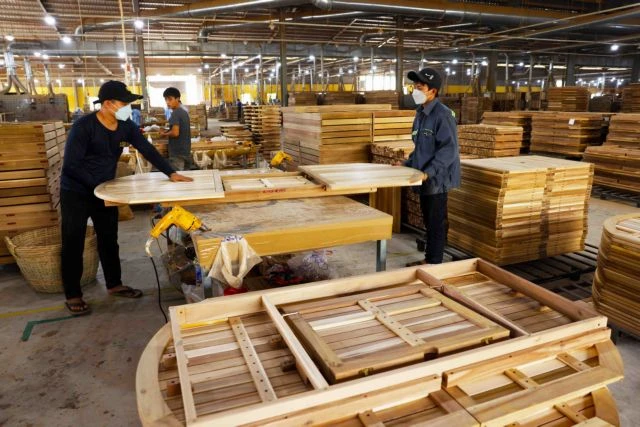
Hanoi (VNS/VNA) - The UK-Vietnam Free Trade Agreement (UVFTA) is one of the key drivers boosting the growth of Vietnam’s timber and wood product exports to the UK, industry experts have said.
According to the Vietnam Timber and Forest Products Association (VIFORES), exports to the UK are expected to be worth 230 million USD this year, up from 195 million USD last year. In the first 10 months this year, they were worth 182.1 million USD.
The association said the trade deal, which took effect in 2021, has positively impacted the wood industry due to preferential tax rates that will move towards zero% in five years for all wood products.
Vietnam’s timber and wood products hold a competitive advantage over those from other countries exported to the UK, it said.
Ngo Sy Hoai, VIFORES’ deputy chairman and general secretary, said while exports to the UK are modest compared to overall exports (estimated at 16 billion USD this year), the UK is an important export market of Vietnam’s wooden products in Europe, accounting for 40% of the country’s exports to the EU27.
"We view the UK market as a gateway to Europe. If we can export extensively to the UK, we can confidently enter other markets, as the UK has stringent requirements regarding quality, design, and environmental standards.
“Vietnamese businesses have met these requirements successfully, with no safety warnings from this market."
According to the Ministry of Industry and Trade’s import-export department, more than 90% of wood products exported to the UK were furniture, a high-value item for the industry.
Increasing furniture exports to the UK could significantly contribute to the industry's growth in the coming years, it said.
The department underscored that globally, the UK ranks among the top five importers of wooden furniture. However, Vietnamese furniture products have a very small share of that market, meaning considerable opportunities remain for Vietnamese exporters.
The UK’s accession to the Comprehensive and Progressive Trans-Pacific Partnership (CPTPP) in 2024 would pave the way for even more opportunities, it said.
Strict requirements
Despite these opportunities, the department and Hoai caution about challenges when exporting to the market since it has strict environmental and quality requirements.
To overcome them and grab opportunities arising due to the UKVFTA, the department said Vietnamese wood exporters should adopt appropriate strategies and understand the UK market.
They should focus on quality and design and on improving production technologies to meet the stringent requirements there.
They need to embrace a comprehensive transition towards sustainability, adopt digital marketing tools to enhance promotion and participate in trade fairs, particularly in the UK, to showcase their products and find new customers, it added.
According to Hoai, to further leverage the trade deal, Vietnamese businesses need to focus on product design and developing their brands.
Exports of wooden products with proprietary designs account for less than 10%, he said.
This has disadvantages and added value remained modest, he pointed out, saying businesses should promote products with their own designs to improve value.
Encouragingly, some leading firms have invested in design and marketing, taking advantage of technological advancements in the digital era, he said.
While the UK is no longer part of the EU, many of the bloc’s regulations still apply in the UK.
For instance, the EU Deforestation Regulation is expected to be enforced similarly in the UK. Businesses must prepare to meet traceability and accountability requirements to ensure their products do not cause deforestation or forest degradation, he said.
At a recent seminar, Vu Viet Thanh of the Ministry of Industry and Trade's European-American market department advised Vietnamese businesses exporting to the UK to thoroughly research market information and their potential partners to avoid fraud and scams.
They themselves need to ensure supply chain transparency and product traceability, he warned.
According to experts, British businesses look for diverse and reliable sources for furniture supply.
By continuing to leverage the benefits of the UKVFTA, Vietnamese manufacturers could solidify their market position in the UK, they added.
Thanh said, to help Vietnamese businesses effectively leverage free trade agreements, the European-American market department would strengthen dissemination of information and training to raise awareness among the business community of sustainable development, green production and brand building.
The department would persuade trade partners to remove barriers to market access, provide support and guidance to businesses for adapting quickly and effectively to changes in market requirements and standards and intensify trade promotion, particularly by leveraging distribution channels, to take Vietnamese goods to sourcing groups worldwide./.