Ample room remains open for railway industry enterprises

A highlight of the scheme is the ambition to develop a modern, integrated railway industry capable of independently designing, manufacturing, and maintaining metro lines and inter-regional railways with design speeds below 200 km/h, while gradually mastering high-speed railway technologies with design speeds of 200 km/h or higher. The roadmap is structured in three phases.

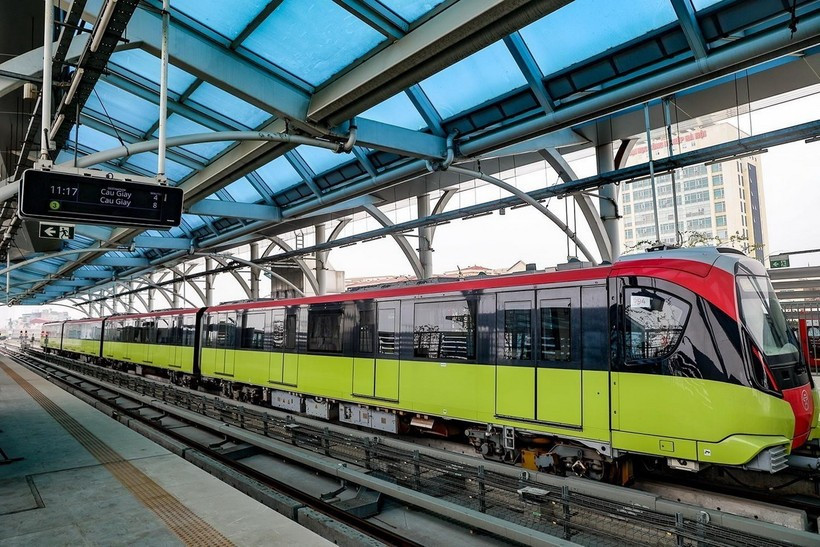
Nhon-Hanoi Station metro line. A series of planned investments in national and urban railway infrastructure over the next 15 years is expected to generate enormous demand for railway industrial products. (Photo: VNA)

Hanoi (VNA) - A series of planned investments in national and urban railway infrastructure over the next 15 years is expected to generate enormous demand for railway industrial products, estimated at more than 2.2 quadrillion VND (84.6 billion USD), opening up significant opportunities for enterprises in the sector.

The Government has recently issued important guidance for the draft Scheme on the Development of Vietnam’s Railway Industry, which is being formulated under the leadership of the Ministry of Industry and Trade. According to Official Dispatch No. 692/VPCP-CN, Deputy Prime Minister Bui Thanh Son instructed the Ministers of Construction; Justice; and Education and Training, the State Bank of Vietnam, and the Acting Minister of Industry and Trade to urgently review the draft scheme and submit their opinions to the Ministry of Industry and Trade.

A highlight of the scheme is the ambition to develop a modern, integrated railway industry capable of independently designing, manufacturing, and maintaining metro lines and inter-regional railways with design speeds below 200 km/h, while gradually mastering high-speed railway technologies with design speeds of 200 km/h or higher. The roadmap is structured in three phases.

By 2030, Vietnamese enterprises are expected to undertake domestic design and manufacturing of equipment for six metro line projects, with localisation rates reaching 50% in consultancy and project management, 30% in locomotives, 50% in carriages and materials, 40% in traction power systems, 40% in signaling and train control systems, 85% in rails and turnouts, and 60% in maintenance activities.

By 2035, domestic firms are likely to supply equipment for six metro line projects and two inter-regional railway projects. Localisation rates for rail systems with design speeds of up to 200 km/h are targeted at 50% for locomotives, 80% for carriages and materials, 70% for traction power systems, 60% for signaling and control systems, 95% for rails and turnouts, and 80% for maintenance and repair. For high-speed railways, Vietnamese enterprises will progressively assume responsibility for maintenance and repairs and participate in the global high-speed railway value chain, with an orientation toward exports.

By 2050, full self-reliance is envisioned for carriages, materials, equipment, and traction power systems for railways below 200 km/h, alongside 90% localisation in signaling systems and 70% in locomotives. For high-speed railways, domestic enterprises are expected to supply 50% of trainsets and equipment, 70% of signaling systems, and fully undertake maintenance and repair, while expanding exports of railway industrial products.

According to calculations by the Ministry of Industry and Trade, if railway network development proceeds as planned, the total market value for railway industry products and services could exceed 2.33 quadrillion VND by 2050 over the lifecycle of railway projects. Even capturing one-third of this market over the next 20 - 25 years would provide a major boost not only for railway enterprises but also for Vietnam’s broader mechanical engineering and metallurgical industries.

However, as of the end of 2025, only 35 factories nationwide were engaged in railway manufacturing, maintenance, and repair, most of them within the ecosystem of the Vietnam Railways Corporation. Despite this base, the sector remains fragmented, technologically outdated, and heavily dependent on imported equipment and components.

To address these constraints, the Ministry of Industry and Trade has proposed strong policy and financial support measures, including localisation mechanisms for selected railway projects, preferential credit through the Vietnam Development Bank, and enhanced technology transfer requirements.

Industry representatives stressed that, alongside financial incentives, early participation in major railway construction projects is essential to build a skilled workforce and ensure effective technology transfer from the outset.

Without a sufficiently trained human resources base, even large-scale investment in modern equipment will not be enough to accelerate the development of Vietnam’s railway industry at the pace envisioned, experts warned./.

VNA
See more

Hanoi records more than 2 billion USD in agricultural export revenue in 2025 (Photo: VNA)

Hanoi’s agricultural exports surpass 2 billion USD in 2025

Of the total, key agricultural and food products accounted for about 1.4 billion USD, representing the largest share of the sector’s export turnover. The result reflects the effectiveness of Hanoi’s efforts to expand overseas markets, improve quality standards, strengthen traceability systems and promote international-standard production models to meet increasingly stringent import requirements.

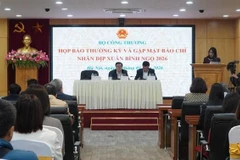
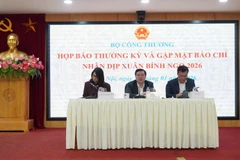
At the Ministry of Industry and Trade's press conference held in Hanoi on January 29 (Photo: hanoimoi.vn)

Spring Fair 2026 to feature around 3,000 standard booths

The first Glorious Spring Fair 2026 will serve as a direct link between manufacturers, distributors, and consumers, helping to cut down unnecessary middle steps. As a result, businesses are expected to cut operating and consignment costs by around 15-20%, enabling both enterprises and consumers to benefit from more competitive prices at the event.

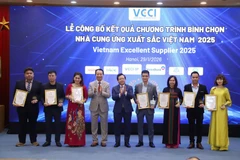
Twenty-seven companies are honoured as Vietnam excellent suppliers at a ceremony held in Hanoi on January 29. (Photo: VNA)

27 outstanding Vietnamese suppliers honoured

Amid the ongoing restructuring of global supply chains, Vietnamese suppliers must move beyond the role of simple production links to become strategic partners with technological capability, innovation capacity and value-chain governance aligned with sustainable development.

Vietnamese textile and garment firms optimise production and management to enhance product competitiveness. (Photo: VNA)

Vietnam garment firms secure orders through Q1

Market analysts said that although global demand remains relatively stable, the sector continues to struggle with higher input costs, including wages and logistics, while selling prices remain under pressure due to weak bargaining power.

The First Glorious Spring Fair 2026 is scheduled to take place over five days, from February 4–8, 2026, at the Vietnam Exposition Centre (VEC) in Dong Anh commune, Hanoi. (Photo: VNA)

Spring Fair 2026: E-commerce poised for a green transition

The E-commerce Forum 2026 will will highlight new developments in e-commerce governance under the forthcoming E-commerce Law, which establishes a comprehensive legal framework covering all market participants and emerging business models.

Oil and gas drilling rigs of Vietsovpetro at the Bach Ho field (Illustrative photo: VNA)

MoIT provides update on oil discovery off Vietnam's coast

Deputy Minister of Industry and Trade Nguyen Sinh Nhat Tan described the discovery as a very positive development for Vietnam’s energy sector, adding that the ministry will work closely with relevant units to carry out further evaluation and verification.

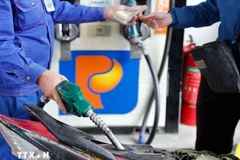
A motorcyle is refilled at a Petrolimex station in Hanoi. (Photo: VNA)

Retail petrol prices rise in January 29 adjustment

The Ministry of Finance and the Ministry of Industry and Trade announced the latest fuel price adjustment, effective from 3:00 pm on January 29, with most oil and petrol products seeing increases.

Vietnamese Ambassador to New Zealand Phan Minh Giang speaks at the launch of the New Zealand – Vietnam Business Council on January 28. (Photo: VNA)

New Zealand – Vietnam Business Council launched in Auckland

The council is committed to promoting effective cooperation and generating concrete benefits for its member enterprises while working closely with partners to organise forums, conferences, and business dialogues on trade and investment promotion, technology sharing and transfer, digital transformation, and e-commerce.

Vinh Truong hamlet in Phuoc Dinh commune, Khanh Hoa province is located within the planned area for the Ninh Thuan 1 nuclear power plant. (Photo: VNA)

Khanh Hoa eyes renewable energy hub status following Resolution 70

The Ministry of Industry and Trade’s Institute of Energy (IOE) ranks the province among the nation’s top locations for renewables, highlighting stable year-round solar radiation and the country’s longest annual sunshine duration, spanning 2,500 to 3,100 hours.

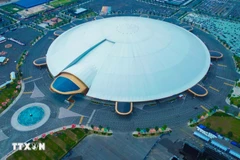
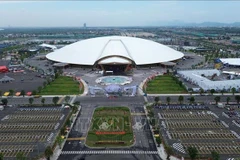
The Vietnam Exposition Centre (VEC), the venue of the Spring Fair 2026 (Photo: VNA)

Spring Fair 2026 to promote Vietnamese goods, Tet traditions

By eliminating intermediary stages and linking producers, distributors and consumers more directly, the fair is expected to deliver more competitive prices than those on the wider market, and also improve transparency and strengthen consumer confidence in domestic products, particularly as interest in quality and traceability continues to rise.

FPT semiconductor chip (Photo: VNA)

FPT announces semiconductor testing, packaging plant

The establishment of the advanced semiconductor chip testing and packaging factory demonstrates FPT’s commitment to implementing Resolution 57 on breakthroughs in science and technology development, innovation and national digital transformation, and the National Strategy for Semiconductor Industry Development.