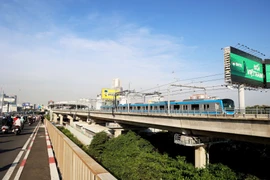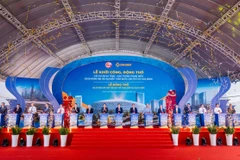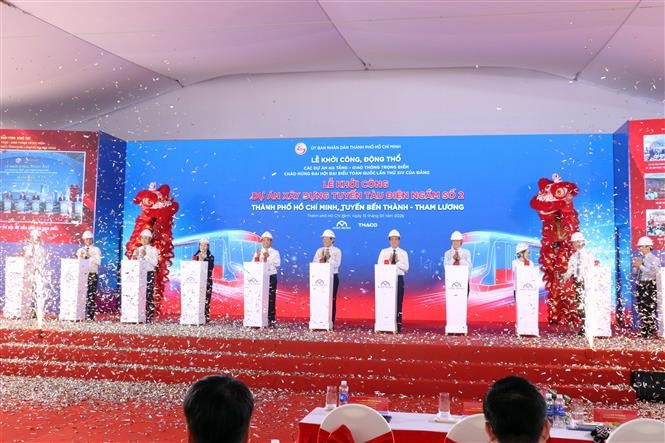
HCM City (VNA) – The Ho Chi Minh City People's Committee and investors on January 15 launched three major transport infrastructure projects, namely the Ben Thanh–Tham Luong metro line, Phu My 2 Bridge and Can Gio Bridge, creating new connectivity axes for the city’s northwest and southern coastal areas.
The Phu My 2 Bridge and Can Gio Bridge projects are implemented under public–private partnership agreements, with construction planned from 2026 to 2029.
The Phu My 2 Bridge is 6.3 km in length and will feature eight lanes, requiring an investment of 23.2 trillion VND (approximately 883 million USD). It will link Ho Chi Minh City to Dong Nai province and Long Thanh International Airport, helping to reduce congestion on current major routes.
The Can Gio Bridge, stretching about 6.3 km with six lanes and an investment of over 13.2 trillion VND, will replace the Binh Khanh ferry. This project aims to open up new development opportunities toward the sea, enhance tourism, the marine economy, and logistics, while safeguarding the environment of the Can Gio Mangrove Biosphere Reserve.
On the same day, construction officially began on Metro Line No. 2 (Ben Thanh–Tham Luong) under public investment, with a total capital of about 55.18 trillion VND. Phase one covers 11.3 km, including 9.3 km underground, with 11 stations and a depot, linking the city centre with the northwest.
Metro Line No. 2 is a core radial axis of the urban railway system and the first project to apply special mechanisms under National Assembly Resolution No. 188/2025/QH15. It is expected to play a leading role in transit-oriented development, improve public transport capacity, and set technical standards for the city’s metro network.
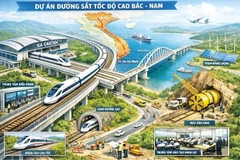
Under the approved plan, Ho Chi Minh City will develop 27 urban railway lines with a total length of about 1,024 km, forming the backbone of its public transport system and supporting sustainable urban growth./.