Internal strength crucial for building export resilience

In the new era, strengthening domestic capacity will be crucial to ensuring that Vietnam’s exports grow not only rapidly, but also sustainably, contributing meaningfully to the country’s development aspirations in the new era.

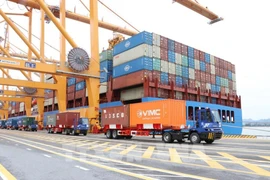
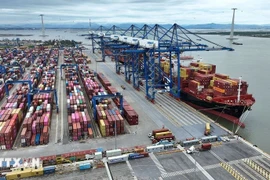
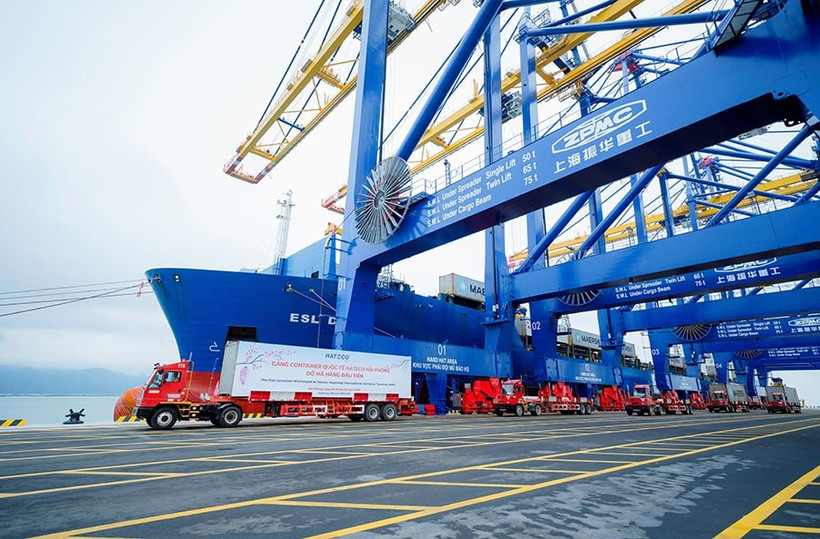
Handling export cargo at Lach Huyen Port, Hai Phong city. (Photo: hanoimoi.vn)

Hanoi (VNA) – Vietnam’s exports continued to post record figures in 2025, with total turnover estimated at 470 billion USD, reaffirming their role as a key pillar of the national economy.

However, growing challenges, from heavy reliance on the foreign-invested sector and low domestic value added to mounting pressure from supply-chain “greening” and global trade fragmentation are prompting the need for a decisive shift toward export growth driven by internal strength and sustainability.

Nguyen Anh Son, Director of the Agency for Foreign Trade under the Ministry of Industry and Trade (MoIT), said that the 2020–2025 period marked a pivotal phase for Vietnam’s trade development. Despite global shocks such as the COVID-19 pandemic, geopolitical tensions and supply chain disruptions, exports maintained an average annual growth of 10%. Export turnover rose from 281.5 billion USD in 2020 to approximately 475 billion USD in 2025.

Vietnam has also sustained a trade surplus for 10 consecutive years since 2016, averaging around 20 billion USD annually during 2020–2025 and peaking at 28 billion USD in 2023. The number of export items earning over 1 billion USD in revenue, including eight posting over 10 billion USD, increased from 31 to 36, reflecting greater production and export diversification.

In 2025, Vietnam ranked among the world’s top 15 exporters, underscoring its deepening integration into regional and global supply chains.

Nevertheless, the MoIT said, structural weaknesses persist, posing great challenges to the goal of medium- and long-term sustainable development. Globally, slower economic recovery, prolonged geopolitical conflicts, trade fragmentation, rising protectionism and stricter technical standards related to environment, labour, traceability and social responsibility are narrowing traditional export growth space. In particular, supply-chain greening has become a mandatory requirement, placing pressure on exporters, especially small and medium-sized enterprises with limited finanial, technological, and governance resources.

Domestically, exports remain heavily dependent on the FDI sector, which accounts for about 70–75% of total turnover. Domestic firms have yet to engage deeply in high value-added stages such as design, branding and distribution, while reliance on imported materials and components remains high. This leaves exports vulnerable to external shocks and limits domestic value creation.

In terms of markets, the US remains the largest importer of Vietnamese goods, accounting for 32.3% of total turnover, while China is the biggest exporter to Vietnam as it makes up about 40% of the latter's total imports. The heavy dependence on the US for export and China for import create considerable risks, particularly amid increasingly fierce stategic competition among world powers.

As Vietnam targets double-digit economic growth in the coming years, exports will remain a key driver.

However, Tran Thanh Hai, Deputy Director of the Agency for Foreign Trade, noted this role can only be sustained through a shift from quantitative to qualitative growth, focusing on higher value added, technological content, locally made materials and components, and economic self-reliance.

Vietnam should step up developing foundational and core industries with sustainable and long-term value while restructuring agriculture towards modernity linked with deep processing and brand building. Enhancing material self-sufficiency by promoting scientific research, mastering technology, and developing support industries is considered a key measure to increase domestic value, ease dependence on imports, and improve the resilience of supply chains, he added.

Efforts should also focus on diversifying export markets, capitalising on existing free trade agreements, negotiating new deals, expanding to potential markets such as the Middle East, Africa and South America, and promoting cross-border e-commerce, according to Hai.

Meeting sustainability standards in terms of environment, labour, social responsibility, and corporate governance is no longer optional but essential to enhancing competitiveness, reducing trade risks, and ensuring long-term growth, said Dr. Nguyen Thi Thu Trang, an expert in law and international economic integration.

In the new era, strengthening domestic capacity will be crucial to ensuring that Vietnam’s exports grow not only rapidly, but also sustainably, contributing meaningfully to the country’s development aspirations in the new era./.

source
See more

Garment production for export at the Thai Nguyen Garment Company. (Photo: VNA)

Spring Fair 2026 strengthens Vietnam – India cooperation

The seminar aimed to help the Indian business community gain a clearer understanding of the scale, role and potential of the Spring Fair 2026 one of Vietnam’s major trade promotion events hosted by the Government and the Ministry of Industry and Trade.

VinFast Evo battery-swap electric motorbike (Photo: VNA)

VinFast rolls out four new electric motorbike models

The automaker introduced three battery-swappable models, Evo, Feliz II and Viper, designed for different customer segments. It also launched the Amio, a compact pedal-assisted model that does not require a driving licence, aimed primarily at students and short-distance urban commuters.

Production activities at a centrifugal concrete pillar manufacturing plant (Photo: VNA)

Rising FDI, investor optimism reinforce Vietnam’s appeal for inflows

Commenting on Vietnam’s FDI performance in 2025, Dr. Nguyen Quoc Viet, a public policy expert at the University of Economics under the Vietnam National University, Hanoi, said that the strong growth in disbursed capital, particularly additional funding for ongoing projects, reflects sustained confidence among international investors.

An illustration of the North-South high-speed railway project (Image created by AI)

Vietnam fast-tracks key national railway projects

With the completion of a key legal framework, Vietnam's major national railway projects have kicked off the new year of 2026 with an accelerated implementation phase, notably the North-South high-speed railway and the Lao Cai-Hanoi-Hai Phong railway line

The signing ceremony of a cooperation agreement between Star Fintech and Lao Airlines in Vientiane on January 14 (Photo: VNA)

Vietnamese firm provides digital airline ticket payment services in Laos

Under the agreement, payments for Lao Airlines tickets will be made through the Umoney e-wallet provided by Star Fintech. The partnership marks an important step forward in Laos’ aviation digital transformation roadmap, while helping remove long-standing monopolistic barriers in the country’s airline payment system.

A corner of Ho Chi Minh City (Photo: VNA)

Vietnam gears up for full-force growth push in 2026

A growth path for 2026 has been outlined in line with the National Assembly’s resolution setting a target of more than 10% expansion. Under this scenario, gross domestic product (GDP) would need to rise 9.1% in the first quarter and 10.2% in the second.

OCOP products are displayed at the Autumn Fair 2025 (Photo: VNA)

Domestic demand drives OCOP expansion

The domestic market has seen a shift in consumer awareness. While locally made goods were once viewed as secondary choices, improvements in quality and transparency have helped OCOP products become a preferred option in many households.

A Vietjet Air aircraft (Photo: VNA)

Vietjet remains among world’s safest airlines

Vietjet Air has consistently maintained AirlineRatings’ highest safety rating of seven out of seven stars since 2018, underscoring its sustained efforts to ensure safe and reliable journeys for passengers.

Illustrative photo (Photo: VNA)

Vietjet to transport apricot, peach blossoms on Lunar New Year occasion

Vietjet Air will transport apricot and peach blossoms on domestic flights from/to Ho Chi Minh City, Hanoi, Da Nang, Da Lat and Hai Phong from January 15 to February 28 on the occasion of the Lunar New Year (Tet) festival, at 450,000 VND (17.13 USD) per bundle (excluding taxes and fees).

The National Spring Fair 2026 will take place at the Vietnam Exposition Centre from February 2 to 8. (Photo: VNA)

National Spring Fair 2026 to boost trade, strengthen value chains

The proactive engagement of Vietnam’s trade offices overseas is also expected to contribute to the success of the fair. From mid-January, these offices have launched coordinated promotion and matchmaking efforts, inviting foreign partners to attend the fair as a gateway to Vietnam’s market, manufacturing capacity and investment environment.

The Song Khoai Industrial Park (Quang Ninh province) attracts numerous enterprises for investment and production, creating jobs for local workers. (Photo: VNA)

Quang Ninh removes bottlenecks to attract 3 billion USD in FDI

Chairman of the provincial People’s Committee Bui Van Khang said that Quang Ninh aims to draw 101 non-state budget domestic investment projects with total registered capital of nearly 569 trillion VND (21.6 billion USD), and 3 billion USD in FDI capital in 2026.