Vietnam fast-tracks key national railway projects

With the completion of a key legal framework, Vietnam's major national railway projects have kicked off the new year of 2026 with an accelerated implementation phase, notably the North-South high-speed railway and the Lao Cai-Hanoi-Hai Phong railway line

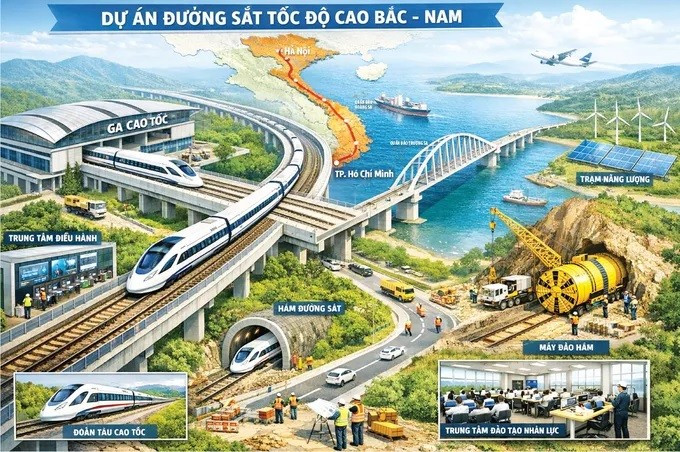
An illustration of the North-South high-speed railway project (Image created by AI)

Hanoi (VNA) – Entering 2026, with the completion of a basic legal framework, Vietnam’s key national railway projects are moving into an accelerated implementation phase, notably the North–South high-speed railway and the Lao Cai–Hanoi–Hai Phong railway line.

Legal framework completed

Immediately after the National Assembly approved the investment policy for these flagship projects, the Ministry of Construction (MoC) and relevant ministries and agencies moved quickly to finalise the legal framework. To date, four related laws have been promulgated, including the revised Railway Law, the Construction Law, the Law on Planning and the Law on Investment.

These were followed by a series of resolutions, decrees and guiding circulars. For the first time, Vietnam has issued standards and technical regulations specifically for high-speed rail, including nine construction technical regulations, 219 sector-specific national standards, 37 general standards, and 146 standards aligned with European and international benchmarks.

Deputy Director of the Vietnam Railway Authority Nguyen Tien Thinh said relevant agencies have comprehensively reviewed the mechanisms and policies authorised by the National Assembly to ensure they are applied in the most appropriate and effective manner. At the same time, efforts are under way to develop special mechanisms for investment in urban railway systems in Hanoi and Ho Chi Minh City to address pressing challenges in modern urban development.

According to Thinh, the overarching goal is to establish special and exceptional mechanisms that simplify administrative procedures and shorten project preparation and construction timelines. Beyond infrastructure investment, the policies also aim to promote technology transfer and the development of a domestic railway industry, enabling Vietnam to gradually master core technologies in line with long-term and sustainable development objectives.

Investment preparation

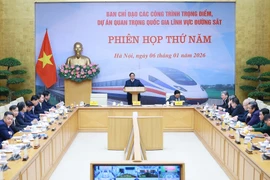
At the fifth meeting of the Steering Committee for key national railway projects in early January, Prime Minister Pham Minh Chinh stressed the need to shift decisively from institutional building to implementation.

For the North–South high-speed railway, the Government has instructed the MoC to complete the selection of an international consultant in January and urgently appoint a consultant to prepare the feasibility study for submission to the Prime Minister by mid-January.

Deputy Minister of Construction Bui Xuan Dung said authorities are reviewing domestic and international standards, global experience and Vietnam’s practical conditions to identify the most suitable technology options.

Minister of Construction Tran Hong Minh has ordered relevant units to urgently complete reports on special mechanisms, investment models and investor selection criteria, with the aim of commencing construction by the end of 2026. Minh has also assigned the Thang Long Project Management Board as the project owner, replacing the Railway Project Management Board, and tasking it with overall responsibility for project quality, progress and costs.

For the Lao Cai–Hanoi–Hai Phong railway line, component project 1, covering connecting lines to stations, has already broken ground. Component project 2, focusing on the main railway infrastructure, is accelerating feasibility study preparations, with approval targeted for June. Under the plan, the signing of an agreement on rail connection and construction of a cross-border railway bridge with China will be completed in March, appraisal finalised in July, and construction launched by year’s end.

Relevant localities are urgently determining boundary markers, extracting cadastral records, and preparing compensation and site clearance plans. The Ministry of Finance has been tasked with balancing and allocating sufficient capital, including loan options, to prevent funding shortages from delaying progress.

Human resources preparation is also being prioritised. A scheme for training and developing Vietnam’s railway workforce to 2035, with a vision to 2045, is under way, with hundreds of engineers and experts receiving training at home and abroad./.
VNA

See more

Garment production for export at the Thai Nguyen Garment Company. (Photo: VNA)

Spring Fair 2026 strengthens Vietnam – India cooperation

The seminar aimed to help the Indian business community gain a clearer understanding of the scale, role and potential of the Spring Fair 2026 one of Vietnam’s major trade promotion events hosted by the Government and the Ministry of Industry and Trade.

VinFast Evo battery-swap electric motorbike (Photo: VNA)

VinFast rolls out four new electric motorbike models

The automaker introduced three battery-swappable models, Evo, Feliz II and Viper, designed for different customer segments. It also launched the Amio, a compact pedal-assisted model that does not require a driving licence, aimed primarily at students and short-distance urban commuters.

Handling export cargo at Lach Huyen Port, Hai Phong city. (Photo: hanoimoi.vn)

Internal strength crucial for building export resilience

In the new era, strengthening domestic capacity will be crucial to ensuring that Vietnam’s exports grow not only rapidly, but also sustainably, contributing meaningfully to the country’s development aspirations in the new era.

Production activities at a centrifugal concrete pillar manufacturing plant (Photo: VNA)

Rising FDI, investor optimism reinforce Vietnam’s appeal for inflows

Commenting on Vietnam’s FDI performance in 2025, Dr. Nguyen Quoc Viet, a public policy expert at the University of Economics under the Vietnam National University, Hanoi, said that the strong growth in disbursed capital, particularly additional funding for ongoing projects, reflects sustained confidence among international investors.

The signing ceremony of a cooperation agreement between Star Fintech and Lao Airlines in Vientiane on January 14 (Photo: VNA)

Vietnamese firm provides digital airline ticket payment services in Laos

Under the agreement, payments for Lao Airlines tickets will be made through the Umoney e-wallet provided by Star Fintech. The partnership marks an important step forward in Laos’ aviation digital transformation roadmap, while helping remove long-standing monopolistic barriers in the country’s airline payment system.

A corner of Ho Chi Minh City (Photo: VNA)

Vietnam gears up for full-force growth push in 2026

A growth path for 2026 has been outlined in line with the National Assembly’s resolution setting a target of more than 10% expansion. Under this scenario, gross domestic product (GDP) would need to rise 9.1% in the first quarter and 10.2% in the second.

OCOP products are displayed at the Autumn Fair 2025 (Photo: VNA)

Domestic demand drives OCOP expansion

The domestic market has seen a shift in consumer awareness. While locally made goods were once viewed as secondary choices, improvements in quality and transparency have helped OCOP products become a preferred option in many households.

A Vietjet Air aircraft (Photo: VNA)

Vietjet remains among world’s safest airlines

Vietjet Air has consistently maintained AirlineRatings’ highest safety rating of seven out of seven stars since 2018, underscoring its sustained efforts to ensure safe and reliable journeys for passengers.

Illustrative photo (Photo: VNA)

Vietjet to transport apricot, peach blossoms on Lunar New Year occasion

Vietjet Air will transport apricot and peach blossoms on domestic flights from/to Ho Chi Minh City, Hanoi, Da Nang, Da Lat and Hai Phong from January 15 to February 28 on the occasion of the Lunar New Year (Tet) festival, at 450,000 VND (17.13 USD) per bundle (excluding taxes and fees).

The National Spring Fair 2026 will take place at the Vietnam Exposition Centre from February 2 to 8. (Photo: VNA)

National Spring Fair 2026 to boost trade, strengthen value chains

The proactive engagement of Vietnam’s trade offices overseas is also expected to contribute to the success of the fair. From mid-January, these offices have launched coordinated promotion and matchmaking efforts, inviting foreign partners to attend the fair as a gateway to Vietnam’s market, manufacturing capacity and investment environment.

The Song Khoai Industrial Park (Quang Ninh province) attracts numerous enterprises for investment and production, creating jobs for local workers. (Photo: VNA)

Quang Ninh removes bottlenecks to attract 3 billion USD in FDI

Chairman of the provincial People’s Committee Bui Van Khang said that Quang Ninh aims to draw 101 non-state budget domestic investment projects with total registered capital of nearly 569 trillion VND (21.6 billion USD), and 3 billion USD in FDI capital in 2026.

Average economic growth of 6.3% per year, together with an estimated 8.02% expansion in 2025, has placed Vietnam among the world’s most dynamic economies. (Photo: VNA)

Indonesian scholar praises Vietnam as model of sustainable, inclusive growth

These achievements so far stem from the consistent leadership of the Communist Party of Vietnam, the spirit of self-reliance and resilience, and strong national solidarity, laying a solid foundation for the country’s strategic development goals towards 2030 and the vision to 2045, according to a senior researcher at the Centre for Southeast Asian Studies.