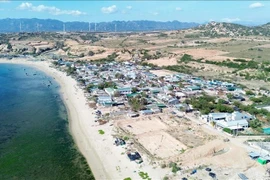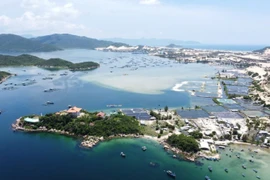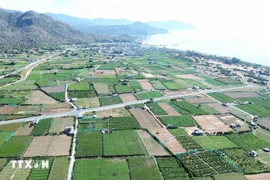
Khanh Hoa (VNA) – The Politburo’s Resolution No. 70-NQ/TW, issued on August 20, 2025, is seen as a “golden opportunity” for the south-central province of Khanh Hoa to leverage its advantages, toward the goal of becoming a national hub for renewable energy.
The resolution, which targets national energy security till 2030, with a vision to 2045, introduces “breakthrough” policies designed to facilitate renewable energy, emissions reduction, and environmental protection projects.
Vast wind, solar resources
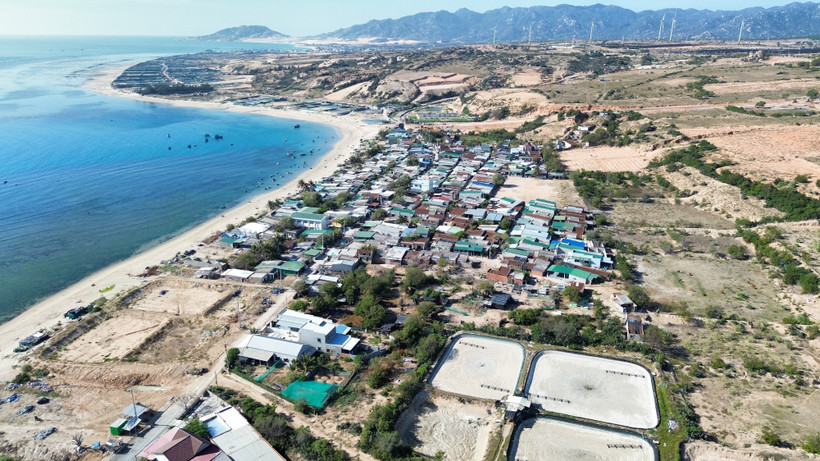
Following the merger with Ninh Thuan province, Khanh Hoa now boasts a new development space.
According to the World Bank, southern Khanh Hoa holds the country’s greatest potential for wind and solar power generation. Average wind speeds at an altitude of 65m reach 7.25m per second, with remarkably low storm activity and consistent winds ranging from 6.4 to 9.6 m per second for up to ten months of the year, which promise stable output for wind turbines.
The Ministry of Industry and Trade’s Institute of Energy (IOE) ranks the province among the nation’s top locations for renewables, highlighting stable year-round solar radiation and the country’s longest annual sunshine duration, spanning 2,500 to 3,100 hours.
Studies by the Institute of Energy (IOE) under the Ministry of Industry and Trade also rank Khanh Hoa among the top locations for renewables, citing year-round stable solar radiation and the nation’s highest annual sunshine duration, ranging from 2,500 to 3,100 hours.
The province’s strategic geographical location adds to its appeal. Situated at the convergence of National Highway 1, North – South Expressway, North – South Railway and National Highway 27 linking to the Central Highlands, Khanh Hoa acts as a vital gateway connecting the southeastern key economic region, the Central Highlands and the south-central coastal zone.
Prof. Dr Tran Tho Dat from the National Economics University stressed that the combination of dry, hot climate, abundant sunshine, reliable wind patterns and vast tracts of suitable land give Khanh Hoa a clear competitive edge for large-scale clean energy projects, particularly in solar power, as well as onshore and offshore wind power.
Nguyen Van Nhut, Director of the provincial Department of Industry and Trade, reported that the southern part of the province is now home to 57 operational renewable energy projects with a total installed capacity of more than 3,749 MW. These facilities delivered roughly 8.7 billion kWh to the national grid last year, or about 6.69% of Vietnam’s total renewable output of 130 billion kWh.
Beyond renewables, nuclear power is viewed as a long-term strategic option to ensure national energy security. Khanh Hoa is the only province selected for two nuclear power plants, Ninh Thuan 1 and Ninh Thuan 2, with a combined capacity of 4,000 MW, to be constructed across 1,135 ha in Phuoc Dinh and Vinh Hai communes. These projects are considered “century-scale” endeavours tied to the 100th anniversary of the Communist Party of Vietnam and the 85th anniversary of the Socialist Republic of Vietnam in 2030.
Strategic energy reserves
Under the revised Power Development Plan VIII, Khanh Hoa is expected to add nearly 17GW of new capacity, lifting the province’s total installed base to around 24 GW. Authorities are focusing on solar radiation, wind resources, and existing transmission backbone in the south-central region to bring online roughly 8,000 MW of additional projects between 2025 and 2035.
The 2025–2030 pipeline features 22 wind power projects totalling 1,893 MW, 40 concentrated solar projects amounting to 2,368 MW, and hydropower plus pumped-storage facilities reaching 2,581 MW, predominantly located in the Ninh Hoa – Van Phong, Cam Ranh, and Bac Ai areas. Between 2031 and 2035, additional 38 solar projects with 3,898 MW of capacity are targeted for commissioning.
To improve grid stability and peak management, the province is encourging investment in pumped-storage hydropower, battery energy storage systems, flexible liquefied natural gas (LNG)-fired generation and green hydrogen. The Bac Ai pumped-storage hydropower project, the first of its kind in Vietnam, will have 1,200 MW capacity across four turbines at a cost of more than 21.1 trillion VND (809.6 million USD). The first turbine is expected to become operational by late 2029, with the remainders following in 2030–2031.
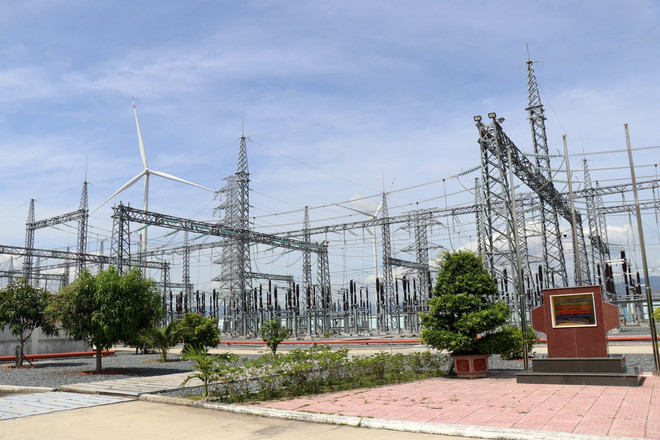
The IOE noted that Khanh Hoa is emerging not only as a generation hub but also a strategic energy transmission node. Power produced in the province can feed the south-central region and Central Highlands while key 500 kV lines connecting Ninh Thuan, Vinh Tan, Long Thanh and Ho Chi Minh City will enable renewable energy produced here to flow nationwide.
Building on its sustainable energy resource base, Khanh Hoa is pursuing integrated economic development that links energy with industry and services. Potential partnership with neighbouring Lam Dong province could spawn value chains around wind and solar power, green hydrogen and green ammonia production, while creating green industrial – agricultural corridors that blend eco-tourism and energy projects. The Ninh Phuoc – Thuan Nam area is envisioned as a comprehensive cluster of industrial parks, ports, energy facilities and service-oriented urban zones, while the Cam Ranh – Ca Na port area is set to develop logistics and export renewable energy equipment.
With renewables set to surge, demand is increasing for synchronous infrastructure across power generation, storage, transmission, and new energy production. In particular, ultra-high-voltage alternating current (HVAC) and high-voltage direct current (HVDC) lines will gradually be rolled out./.