Vietnam ranks third globally in cassava exports, supply chain faces challenges

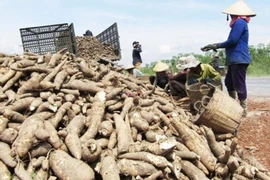
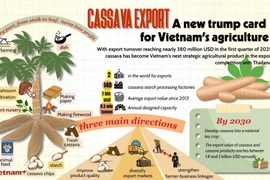
Alongside domestic consumption, cassava has posted strong export growth, with turnover in 2025 estimated at about 1.3 billion USD, making Vietnam the world’s third-largest cassava exporter.

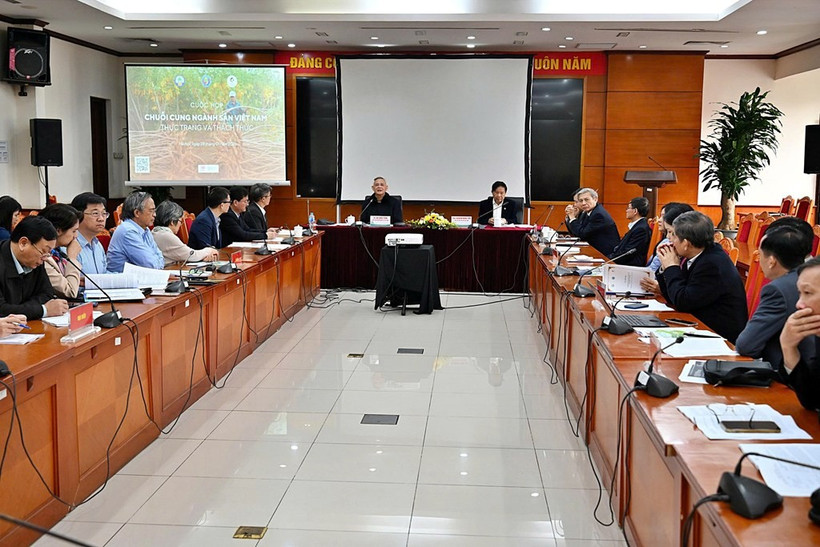
Delegates at the meeting (Photo: VNA)

Hanoi (VNA) – Vietnam currently ranks third in the world in cassava exports, but its cassava supply chain continues to face significant challenges, heard a meeting held in Hanoi on January 28.

The meeting, themed “Vietnam’s cassava supply chain: Current situation and challenges”, was jointly organised by the Vietnam Economic Science Association of Agriculture and Rural Development, the Vietnam Cassava Association, and Forest Trends.

Speaking at the event, Nghiem Minh Tien, Chairman of the Vietnam Cassava Association, said cassava production, processing and trade play an important role in Vietnam’s agricultural trade and provide livelihoods for around 1.2 million farming households, mainly in midland, mountainous and disadvantaged areas. Alongside domestic consumption, cassava has posted strong export growth, with turnover in 2025 estimated at about 1.3 billion USD, making Vietnam the world’s third-largest cassava exporter.

Vietnam is both a major producer of raw cassava and a large processing and export hub in the region. Annual cassava supply exceeds 18 million tonnes of fresh roots, of which about 58% comes from domestic production and 42% from imports, mainly from Laos and Cambodia. Cassava cultivation area in Vietnam covers more than 500,000 hectares, producing roughly 10 million tonnes annually, while imports stand at about 8 million tonnes.

Participants noted that although export volumes have risen sharply, export value has grown more slowly. A key long-term solution is to increase added value through deeper processing. This includes gradually reducing exports of dried cassava chips and low-processed starch, while encouraging investment in high-tech products such as modified starch and products for the food, pharmaceutical, industrial and bioenergy sectors, thereby improving efficiency, sustainability and resilience to raw-material price fluctuations.

While several important policies have been issued, including the scheme on sustainable development of the cassava sector to 2030 with a vision to 2050, implementation remains limited due to the lack of detailed guidance, monitoring tools and sufficient incentives to ensure compliance with requirements on traceability, transparency and forest protection.

Meanwhile, despite a slight nationwide decline in cassava cultivation area in recent years, expansion has continued in some localities, raising concerns about impacts on forest resources. International markets are also tightening requirements on legality, traceability and deforestation-free products, notably the EU’s Deforestation Regulation (EUDR), posing growing challenges for Vietnam’s cassava exports.

Ha Cong Tuan, Chairman of the Vietnam Economic Science Association of Agriculture and Rural Development, pointed out that the biggest difficulty in ensuring traceability lies in the raw material stage, including supplies from both domestic farmers and foreign sources.

Nguyen Vinh Quang, representing Forest Trends, said the cassava sector needs to restructure its supply chain, strengthen control over production and land use, formalise informal activities and improve transparency across the chain to meet traceability requirements.

From the business perspective, Tien affirmed that cassava enterprises are committed to building a transparent and sustainable supply chain that meets forest protection, environmental and traceability standards. He also called on authorities to provide clearer guidance and appropriate support mechanisms to facilitate compliance with new requirements./.
VNA

See more

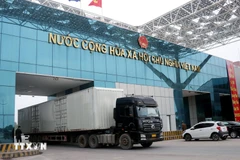
The Mong Cai international border gate in Quang Ninh province (Photo: VNA)

Vietnam to pilot smart border gate at Mong Cai-Dongxing international crossing

The overall objective of the pilot scheme to develop a smart border gate at the Mong Cai (Vietnam) – Dongxing (China) international border gate pair is to transform the Mong Cai border-gate economic zone in particular and Quang Ninh province in general into a major hub for import-export activities, trade, services, tourism and border-gate economy within the northern key economic region.

Do Thi Quynh Phuong, owner of Viet–France Market (Photo: VNA)

Vietnamese goods ready for peak Tet shopping season in France

At markets and specialty stores selling Vietnamese goods in France, preparations for the festive season are already in full swing. Imported Vietnamese products this year are diverse, focusing on items closely associated with Tet meals and traditions.

People visit Autumn Fair 2025. (Photo: VNA)

Spring Fair 2026: New Year boost for consumer demand

More than a conventional trading venue, the Spring Fair 2026 is emerging as a convergence point for consumption, culture and tourism, offering enterprises an opportunity to engage directly with consumers, test products and shape market strategies as early as the first quarter.

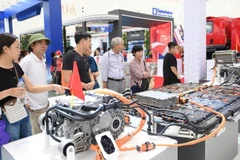
Auto technology solutions are on display at an exhibition on the 80-year national achievements (Photo: VNA)

Digital economy expected to revamp growth model

Meeting the goals set in Resolution No. 57-NQ/TW, including a digital economy share of at least 30% of GDP by 2030 and 50% by 2045, will demand more substantive, high-value progress fueled by breakthrough innovations.

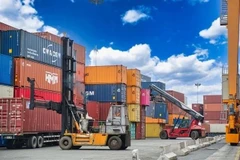
Vietnam has set a target of expanding exports by 8% in 2026 (Illustrative photo: VNA)

Vietnam targets new export growth milestone in 2026

According to MB Securities’ Vietnam Outlook 2026 report, Vietnam's exports may grow by 15–16% in 2026, driven by market expansion and a shift towards higher-value products, led by electronics and high-tech industries amid rising global demand for AI and digital transformation.

Mobile Money services are not only a convenient payment tool but also an effective means of extending digital financial services to remote and disadvantaged areas. (Photo: VNA)

New legal framework for Mobile Money to take effect in Vietnam soon

The issuance of a implementation plan for Government Decree No. 368/2025/ND-CP on the provision of Mobile Money services is considered an important step toward promoting financial inclusion. Mobile Money services are not only a convenient payment tool but also an effective means of extending digital financial services to remote and disadvantaged areas.

Many OCOP gift baskets now combine nutritious food items and handcrafted products (Photo: VNA)

OCOP products dominate Tet gift baskets

A visit to major supermarkets such as Go!, Co.opmart and WinMart, as well as spring markets across Quang Ngai province, shows that OCOP product stalls are attracting the most attention.

Electronic device manufacturing at the Rhythm Precision Vietnam Co., Ltd., in Hanoi's Noi Bai Industrial Park. (Photo: hanoimoi.vn)

Hanoi creates new momentum for industrial growth

Manufacturing – processing remained the backbone of industrial growth last year, with value added in this sector increased by 7.18%, contributing 0.85 percentage points to Hanoi’s overall GRDP growth.

At the meeting between Can Tho authorities and the Sumitomo delegation on January 27 (Photo: VNA)

Can Tho woos Sumitomo with industrial park, green energy pledges

Can Tho spans more than 6,360 square kilometres with a population exceeding 4.2 million, and serves as the economic, cultural, and science-and-technology hub of the Mekong Delta, enjoying strategic advantages in transport, logistics and regional connectivity.