OCOP products dominate Tet gift baskets

A visit to major supermarkets such as Go!, Co.opmart and WinMart, as well as spring markets across Quang Ngai province, shows that OCOP product stalls are attracting the most attention.

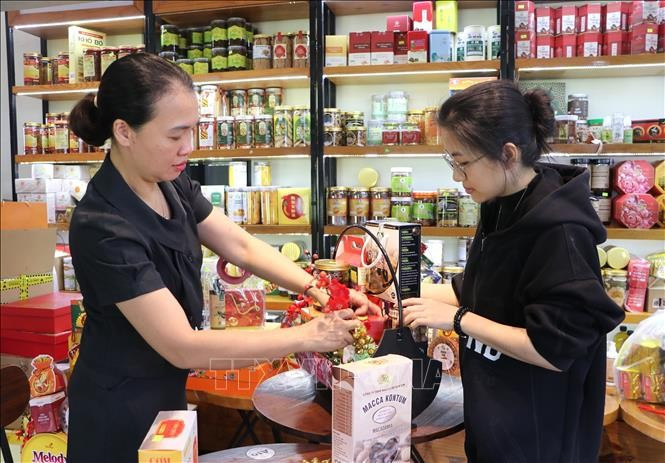
Many OCOP gift baskets now combine nutritious food items and handcrafted products (Photo: VNA)

Quang Ngai (VNA) – With just around 20 days remaining until the Lunar New Year (Tet) 2026, the traditional Tet gift market in Quang Ngai province is undergoing a noticeable transformation since once dominated by confectionery and imported sweets, Tet gift baskets are now increasingly filled with locally produced OCOP (One Commune, One Product) items, reflecting changing consumer tastes and values.

A visit to major supermarkets such as Go!, Co.opmart and WinMart, as well as spring markets across the central province, shows that OCOP product stalls are attracting the most attention. A few years ago, local specialties were often regarded as “rural gifts” with simple and basic packaging. Today, however, their appearance has been significantly upgraded, helping them secure a firm foothold in the premium gift segment.

Products such as cordyceps, sesame cakes and Ngoc Linh ginseng tea are now presented in sleek, modern designs. Many producers have invested in high-end packaging materials, including carved wooden boxes, eco-friendly paper bags, and handcrafted bamboo and rattan baskets. These choices not only enhance commercial value but also highlight traditional craftsmanship and local cultural identity.

Truong Quang Ninh, Director of the Ninh Truong Medicinal Mushroom Co., Ltd. in Tho Phong commune, said his company’s cordyceps has achieved a four-star OCOP rating. “To access the high-end gift market, quality alone is not enough. Presentation is equally important,” he said. This year, the firm introduced gift sets featuring images of local landscapes, helping orders from corporate clients double compared to last year.

The growing popularity of OCOP products during Tet is largely driven by consumer trust. In a market where food quality can vary widely, OCOP certification – ranging from three to five stars – serves as a reliable guarantee. Products must meet strict criteria covering raw materials, production processes and food safety standards.

Digital technology has further strengthened this trust. Nearly all OCOP products in Quang Ngai now carry QR codes, allowing consumers to trace product origins, production dates and certification details with a simple smartphone scan.

According to Bach Thanh Phu, owner of the Oly Food brown rice production facility in Truong Giang commune, greater transparency has helped small producers gain access to supermarkets and e-commerce platforms with more confidence.

Consumers have also welcomed the shift. Thoi Thi Hue, a resident of Truong Quang Trong ward, said she chose a basket of local specialties instead of imported sweets.

“The products suit my taste, and I feel reassured by the OCOP labels and traceability. Giving these gifts to relatives far away makes me proud of our local produce,” she said.

Beyond taste and appearance, sustainability has also emerged as a trend. Many OCOP gift baskets combine nutritious foods with handicrafts, while the use of bamboo and rattan packaging instead of plastic reflects growing environmental awareness and adds a warm, traditional touch to Tet.

Despite these positive signs, experts note that retaining market share and expanding further remains a challenge. Maintaining consistent quality and ensuring sufficient supply, especially during peak seasons such as Tet, are among the key issues.

Vo Quoc Hung, Deputy Director of the provincial Department of Industry and Trade, said authorities will continue to support producers in linking supply and demand and accessing modern distribution channels. He stressed that quality must be maintained after certification, warning against prioritising quantity over standard adherence.

An OCOP Tet gift basket today is more than a seasonal present. It embodies the dedication of farmers, the identity of Quang Ngai’s local produce, and a modern consumer mindset that values authenticity, sustainability and Vietnamese cultural pride./.
VNA

See more

Electronic device manufacturing at the Rhythm Precision Vietnam Co., Ltd., in Hanoi's Noi Bai Industrial Park. (Photo: hanoimoi.vn)

Hanoi creates new momentum for industrial growth

Manufacturing – processing remained the backbone of industrial growth last year, with value added in this sector increased by 7.18%, contributing 0.85 percentage points to Hanoi’s overall GRDP growth.

At the meeting between Can Tho authorities and the Sumitomo delegation on January 27 (Photo: VNA)

Can Tho woos Sumitomo with industrial park, green energy pledges

Can Tho spans more than 6,360 square kilometres with a population exceeding 4.2 million, and serves as the economic, cultural, and science-and-technology hub of the Mekong Delta, enjoying strategic advantages in transport, logistics and regional connectivity.

Multi-currency cards – a payment card supported by a mobile application that enables users to exchange local currency for foreign currency and make payments in stores or online - and mobile wallets for both daily and overseas spending will be popular in 2026. (Photo: courtesy of baochinhphu.vn)

Visa highlights Vietnamese payment trends for 2026

Vietnamese consumers are increasingly seeking premium experiences, from travel and shopping to wellness and dining, and are showing greater interest in payment cards with travel-related benefits.

In the manufacturing sector, the profitability ratio reached 74.1%, up 3.9 points, while the loss-making ratio dropped sharply to 13%, according to JETRO. (Illustrative photo: VNA)

Japanese firms in Vietnam hit 15-year profit high

JETRO’s 2025 Survey on the Business Conditions of Japanese Companies Investing Overseas shows that 67.5% of Japanese firms in Vietnam expect to be profitable this year, up 3.4 percentage points from 2024 and the highest level since 2009.

Turning international trade into sustainable growth driver

Turning international trade into sustainable growth driver

With total import-export revenue reaching 920 billion USD in 2025, Vietnam has officially entered the world’s top 15 economies in terms of international trade, marking a significant milestone in national development after decades of global economic integration and 40 years of Doi moi (Renewal). International trade has become a key driver of Vietnam’s economic growth.

At a session of the Vietnam-RoK Joint Committee on Trade, Industry and Energy Cooperation in April, 2025 in Hanoi. (Photo: nhandan.vn)

Vietnam becomes RoK’s key export market in ASEAN

The RoK’s exports to Vietnam rose 7.6% in 2025 from a year earlier to 62.8 billion USD, while imports from Vietnam climbed 11.7% to 31.8 billion USD, according to data released by the RoK’s Ministry of Trade, Industry and Energy and the Korea International Trade Association (KITA).

Cai Mep–Thi Vai deep-water port has helped with FDI attraction to the southeastern region. (Photo: VNA)

Resolution 79: State economic sector to lead, catalyse private sector development

More than a document reaffirming the leading role of the state economic sector in a new era, the Resolution opens up an unprecedented space of “mutual reinforcement”, in which the sector shifts from an administrative management mindset to one of “development facilitation”, and is expected to serve as a solid pillar enabling the private sector and other economic components to make breakthroughs.

Vietnamese Ambassador to the RoK Vu Ho speaks at the event (Photo: VNA)

Vietnamese, Korean firms seek to enhance connectivity in new context

The association has actively contributed to policy discussions on issues important to Vietnam, including support for small- and medium-sized enterprises, artificial intelligence (AI) and sovereignty, as well as AI and semiconductor development policies in the RoK, while proposing recommendations for Vietnam.

Prime Minister Pham Minh Chinh chairs the Government Steering Committee for Macroeconomic Management and Administration's second meeting. (Photo: VNA)

Macroeconomic management must match words with action: PM

In 2025 the global environment remained highly uncertain due to geopolitical tensions and tariff policies, while domestically, natural disasters, storms and floods were unusually severe, exceeding historical levels. Despite these challenges, Vietnam recorded encouraging economic results, with inflation kept under control at 3.31%, macroeconomic stability consolidated, major economic balances safeguarded, and GDP growth reaching 8.02% – a notable rate globally.

A view of Chan May deep-water port (Illustrative image. Photo: VNA)

Resolution 79: Encouraging State-owned enterprises to link with FDI sector

The State economic sector has effectively fulfilled its function of orienting, leading and regulating economic activities, contributing to promoting economic growth, stabilising the macro economy, maintaining major economic balances, ensuring national defence and security, fostering social progress and justice, improving living standards and raising Vietnam’s international standing.