Electronics enterprises urged to embed ESG into core strategy amid global shifts

Compliance with environmental, labour, governance, and information transparency standards is no longer a voluntary choice, but a mandatory requirement for businesses participating in global supply chains or exporting to international markets

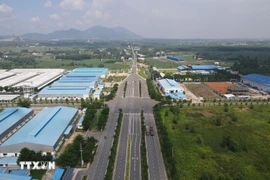
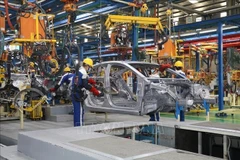
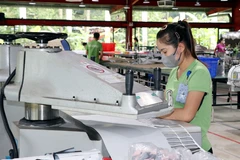
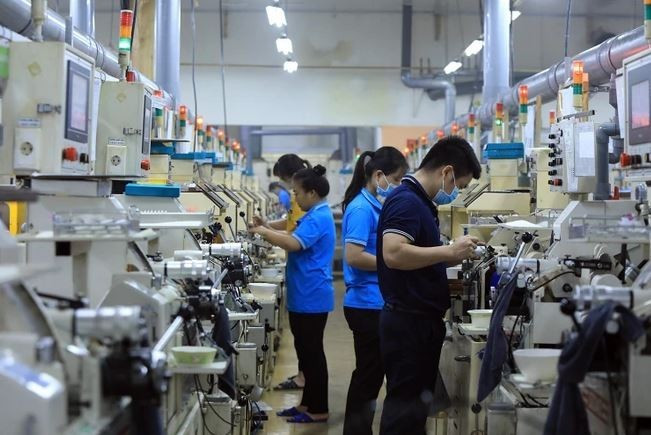
Vietnam is strengthening its position in the technology value chain, becoming a major manufacturing hub for complete consumer electronics products. (Photo: VietnamPlus)

Hanoi (VNA) - Meeting new standards poses significant challenges but also opens opportunities for domestic enterprises to reposition competitiveness and move up the value chain, insiders said.

For years, Vietnam’s electronics enterprises have joined global supply chains mainly through cost advantages and order-fulfilment capacity. However, this model is now under mounting pressure as major markets tighten environmental, social and governance (ESG) requirements.

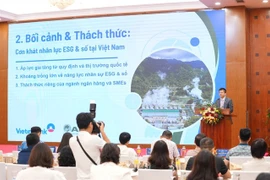
Do Thi Thuy Huong, a member of the Executive Board of the Vietnam Electronics Industries Association (VEIA), said ESG standards have become a cross-cutting requirement throughout business operations, particularly in electronics and high-tech sectors.

Compliance with environmental, labour, governance, and information transparency standards is no longer a voluntary choice, but a mandatory requirement for businesses participating in global supply chains or exporting to international markets, she noted.

According to the VEIA, the 2025–2027 period will be a pivotal phase, especially for exporters to the European market, which will require strict adherence to ESG criteria, including net-zero emission roadmaps, labour standards, governance rules and transparency obligations. As one of Vietnam’s strategic export industries, electronics is being directly affected by this transition.

Pham Thi Ngoc Thuy, Director of the Board for Private Economic Development Research, which operates under the PM’s Advisory Council for Administrative Procedure Reform, said enterprises involved in export supply chains are experiencing the strongest ESG pressures, while firms focused on the domestic market are less affected. However, she stressed that amid fast-changing global and domestic policies, businesses cannot remain outside international trends if they aim for sustainable growth and market expansion.

Domestically, Vietnam’s legal framework for environmental protection and sustainable development is being rapidly refined. Under the Law on Environmental Protection, more than 1,000 enterprises were required to conduct greenhouse gas emissions reporting by the end of 2025. The net-zero emissions target has also been reiterated in key Politburo resolutions, creating clear momentum for transformation across the business community.

In major markets, ESG requirements vary in approach but share a trend towards tighter standards. In the US, climate policies may differ by period and by state, while ESG requirements largely depend on corporations and supply chains. China has shown strong determination to turn environmental challenges into competitive advantages, quickly making green standards the new “rules of the game”. Meanwhile, the European Union continues to lead in setting sustainability benchmarks, introducing tools such as the digital product passport to monitor product life cycles and prevent “greenwashing”.

These differences mean Vietnam’s electronics enterprises must not only comply with standards but also proactively select suitable market strategies to avoid exclusion from global supply chains.

Experts point out that a key bottleneck lies in corporate awareness. Many firms cite shortages of capital, technology or information as major obstacles. However, treating ESG merely as an add-on makes substantive change difficult. Only when ESG is integrated into core strategies and business models can transformation be sustained.

Tran Duc Tung, Deputy General Director of Hanel PT JSC, said ESG implementation requires substantial investment in renewable energy, environmental monitoring and data governance. While short-term financial returns may be unclear, such investments strengthen governance capacity, improve productivity and enhance long-term competitiveness.

It is reported that the VEIA has proposed developing ESG guidelines tailored to domestic electronics enterprises and is rolling out specialised training programmes in cooperation with international partners./.

VNA
See more

Turning international trade into sustainable growth driver

Turning international trade into sustainable growth driver

With total import-export revenue reaching 920 billion USD in 2025, Vietnam has officially entered the world’s top 15 economies in terms of international trade, marking a significant milestone in national development after decades of global economic integration and 40 years of Doi moi (Renewal). International trade has become a key driver of Vietnam’s economic growth.

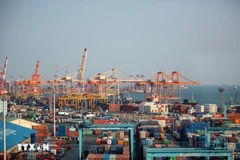
An aerial view of Busan Port in the Republic of Korea. (Photo: XINHUA/VNA)

Vietnam becomes RoK’s key export market in ASEAN

The RoK’s exports to Vietnam rose 7.6% in 2025 from a year earlier to 62.8 billion USD, while imports from Vietnam climbed 11.7% to 31.8 billion USD, according to data released by the RoK’s Ministry of Trade, Industry and Energy and the Korea International Trade Association (KITA).

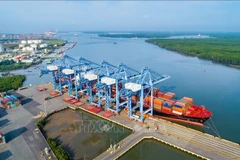
Cai Mep–Thi Vai deep-water port has helped with FDI attraction to the southeastern region. (Photo: VNA)

Resolution 79: State economic sector to lead, catalyse private sector development

More than a document reaffirming the leading role of the state economic sector in a new era, the Resolution opens up an unprecedented space of “mutual reinforcement”, in which the sector shifts from an administrative management mindset to one of “development facilitation”, and is expected to serve as a solid pillar enabling the private sector and other economic components to make breakthroughs.

Vietnamese Ambassador to the RoK Vu Ho speaks at the event (Photo: VNA)

Vietnamese, Korean firms seek to enhance connectivity in new context

The association has actively contributed to policy discussions on issues important to Vietnam, including support for small- and medium-sized enterprises, artificial intelligence (AI) and sovereignty, as well as AI and semiconductor development policies in the RoK, while proposing recommendations for Vietnam.

Prime Minister Pham Minh Chinh chairs the Government Steering Committee for Macroeconomic Management and Administration's second meeting. (Photo: VNA)

Macroeconomic management must match words with action: PM

In 2025 the global environment remained highly uncertain due to geopolitical tensions and tariff policies, while domestically, natural disasters, storms and floods were unusually severe, exceeding historical levels. Despite these challenges, Vietnam recorded encouraging economic results, with inflation kept under control at 3.31%, macroeconomic stability consolidated, major economic balances safeguarded, and GDP growth reaching 8.02% – a notable rate globally.

A view of Chan May deep-water port (Illustrative image. Photo: VNA)

Resolution 79: Encouraging State-owned enterprises to link with FDI sector

The State economic sector has effectively fulfilled its function of orienting, leading and regulating economic activities, contributing to promoting economic growth, stabilising the macro economy, maintaining major economic balances, ensuring national defence and security, fostering social progress and justice, improving living standards and raising Vietnam’s international standing.

Delegates attend the closing session of the 14th National Party Congress (Photo: VNA)

14th National Party Congress: Chinese expert praises Vietnam’s growth targets

Vietnam should further refine mechanisms for mobilising infrastructure capital, including expanding public–private partnership (PPP) models and considering the establishment of a national-level special infrastructure fund to attract sovereign wealth funds and long-term capital, said Liu Ying, a research fellow at the Chongyang Institute for Financial Studies under the Renmin University of China.

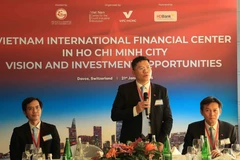
Vice Chairman of the Ho Chi Minh City People’s Committee Hoang Nguyen Dinh delivers remarks at the working luncheon themed “Vietnam International Financial Centre in Ho Chi Minh City (VIFC-HCMC) – Vision and Investment Opportunities”. (Photo: VNA)

Ho Chi Minh City strengthens global engagement at WEF Davos 2026

Vice Chairman of the Ho Chi Minh City People’s Committee Hoang Nguyen Dinh presented the city’s strategic vision, policy orientation and development priorities for building a modern, transparent and globally connected finance – technology ecosystem, with science – technology, data, artificial intelligence and fintech identified as core pillars.