Vietnam adopts solutions to improve business climate, boost national competitiveness in 2026

Resolution No. 02/NQ-CP stresses a comprehensive, synchronised approach to improving the investment and business climate across all fields, from mechanisms, policies, and administrative procedures to digital platform development and stronger enforcement capacity.

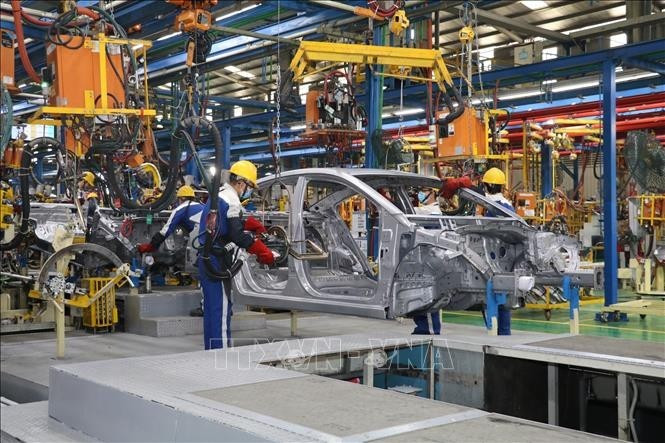
Hyundai Thanh Cong automobile production line. (Photo: VNA)

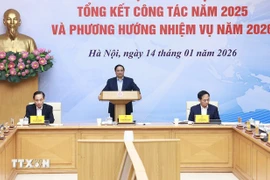
Hanoi (VNA) — The Government has issued Resolution No. 02/NQ-CP outlining key tasks and solutions to improve the business environment and enhance national competitiveness in 2026, aiming to support sustainable growth and deeper international integration.

The Resolution stresses a comprehensive, synchronised approach to improving the investment and business climate across all fields, from mechanisms, policies, and administrative procedures to digital platform development and stronger enforcement capacity. It seeks to ensure fair, transparent access to resources, markets, and development opportunities, while promoting new production forces and methods, with a focus on the digital, green, and circular economies and the building of an environmentally friendly digital society.

A key requirement is a decisive shift in lawmaking mindset from “management” to “facilitation and development,” with citizens and businesses placed at the centre of public service delivery. The resolution calls for improving the quality of legal drafting and policy advice, revising regulations in a coordinated manner to remove bottlenecks, encouraging enterprises to invest in priority sectors, protecting business and property rights, and fostering innovation. Breakthrough mechanisms and policies are to be proposed to unlock resources, turn institutional constraints into national competitive advantages, and create strong momentum for development.

Administrative reform will be accelerated through thorough decentralisation paired with strict inspection and supervision, greater transparency, enhanced autonomy, and stronger accountability to prevent corruption and wastefulness. The Government will replace pre-inspection with post-inspection based on clear standards, while ensuring clear assignment of responsibilities, aiming for easy implementation, monitoring, and evaluation.

The resolution sets the goal of markedly improving the quality of the business environment in line with domestic conditions and global trends, raising Vietnam’s standing in international rankings and reducing compliance costs in accordance with best international practices. In 2026, Vietnam targets a top-50 position in the UN Sustainable Development Goals index, a rise of at least three places in the International Property Rights Index, one place in the Global Innovation Index, two places in the E-Government Development Index, maintenance of the tier-1 status in the Global Cybersecurity Index, and gains of at least four places in both the Logistics Performance Index and the Travel and Tourism Development Index.

Domestically, the Government aims to improve perception-based indicators, including raising the national median Provincial Competitiveness Index score by one point, achieving average administrative reform scores of 84.7% for ministries and ministry-level agencies and 88.87% for localities, and lifting the Satisfaction Index of Public Administrative Services to 86%. The number of enterprises entering and re-entering the market is expected to rise by 15–20% compared with 2025.

To realise these goals and advance the vision of a developed, high-income Vietnam by 2045, the Resolution identifies four key task groups, including effective implementation of major Party resolutions on science, technology, international integration, and legal reform; improving the operation of the two-tier local government model; strengthening ministerial accountability for indices; and executing focused solutions to remove legal bottlenecks, reform procedures, support innovation, and reduce inspection burdens on enterprises./.

VNA
See more

Vietnamese Ambassador to the RoK Vu Ho speaks at the event (Photo: VNA)

Vietnamese, Korean firms seek to enhance connectivity in new context

The association has actively contributed to policy discussions on issues important to Vietnam, including support for small- and medium-sized enterprises, artificial intelligence (AI) and sovereignty, as well as AI and semiconductor development policies in the RoK, while proposing recommendations for Vietnam.

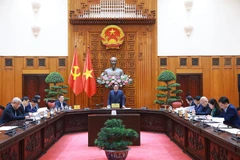
Prime Minister Pham Minh Chinh chairs the Government Steering Committee for Macroeconomic Management and Administration's second meeting. (Photo: VNA)

Macroeconomic management must match words with action: PM

In 2025 the global environment remained highly uncertain due to geopolitical tensions and tariff policies, while domestically, natural disasters, storms and floods were unusually severe, exceeding historical levels. Despite these challenges, Vietnam recorded encouraging economic results, with inflation kept under control at 3.31%, macroeconomic stability consolidated, major economic balances safeguarded, and GDP growth reaching 8.02% – a notable rate globally.

A view of Chan May deep-water port (Illustrative image. Photo: VNA)

Resolution 79: Encouraging State-owned enterprises to link with FDI sector

The State economic sector has effectively fulfilled its function of orienting, leading and regulating economic activities, contributing to promoting economic growth, stabilising the macro economy, maintaining major economic balances, ensuring national defence and security, fostering social progress and justice, improving living standards and raising Vietnam’s international standing.

Delegates attend the closing session of the 14th National Party Congress (Photo: VNA)

14th National Party Congress: Chinese expert praises Vietnam’s growth targets

Vietnam should further refine mechanisms for mobilising infrastructure capital, including expanding public–private partnership (PPP) models and considering the establishment of a national-level special infrastructure fund to attract sovereign wealth funds and long-term capital, said Liu Ying, a research fellow at the Chongyang Institute for Financial Studies under the Renmin University of China.

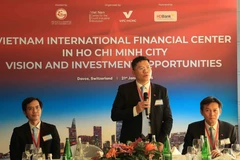
Vice Chairman of the Ho Chi Minh City People’s Committee Hoang Nguyen Dinh delivers remarks at the working luncheon themed “Vietnam International Financial Centre in Ho Chi Minh City (VIFC-HCMC) – Vision and Investment Opportunities”. (Photo: VNA)

Ho Chi Minh City strengthens global engagement at WEF Davos 2026

Vice Chairman of the Ho Chi Minh City People’s Committee Hoang Nguyen Dinh presented the city’s strategic vision, policy orientation and development priorities for building a modern, transparent and globally connected finance – technology ecosystem, with science – technology, data, artificial intelligence and fintech identified as core pillars.

The VSS reported that total accumulated reserves across the social, health, and unemployment insurance funds now top 1.5 quadrillion VND. (Illustrative photo: VNA)

VSS pledges tighter fund management, diversified investments

The VSS will also impose stricter financial discipline in fund management, while pursuing broader diversification of investment portfolios, as guided by the principle of “safety, sustainability, and efficiency”. This approach aims to secure strong liquidity for prompt benefit payouts and support growth in Vietnam’s capital markets and overall economy.

The ceremony unveiling AFT Connect portal (Photo: nhandan.vn)

AFT Connect portal links Vietnamese clean food producers

The platform is expected to serve as shared digital backbone enabling stakeholders in the clean food sector to gradually digitise, standardise, and publicly disclose information, ultimately aiding the fight against unsafe products and protecting consumer interests.

A Vietcombank employee guides a client in biometric process (Photo: qdnd.vn)

Vietnam's biometric surge powers digital banking overhaul

As the Party identified breakthroughs in science – technology and innovation as a key driver of national progress, the mastery and adoption of biometric technologies must go hand in hand with safeguarding public trust, data security, and citizens’ interests, all aligned with the people-first philosophy guiding the country's digital agenda.

A spring fair kicks off in the central Da Nang city on January 22, 2026 (Photo: VNA)

Da Nang 2026 spring fair features 200 booths

The fair features a diverse range of products and services, focusing on items for Tet such as food and beverages, regional specialties, OCOP products, and rural and industrial goods; fashion, footwear, cosmetics, and sports equipment; health care products and beauty services; household items, interior and exterior décor, and handicrafts; as well as equipment, technology, and services in sectors like electronics, automobiles, and telecommunications.

The Ministry of Finance is working to establish a mechanism for regular and ongoing dialogue with international credit rating agencies, including Fitch, Moody’s and S&P. (Illustrative image: VNA)

Fitch Ratings upgrades Vietnam’s senior secured long-term debt rating to BBB-

The rating for Vietnam’s secured long-term debt was raised to BBB-, equivalent to investment grade, one notch higher than the country’s long-term foreign-currency rating on unsecured debt, which remains at BB+. The upgrade followed Fitch’s review under its revised Sovereign Rating Criteria issued in last September, said the Ministry of Finance.