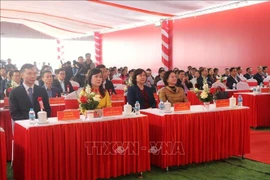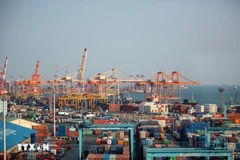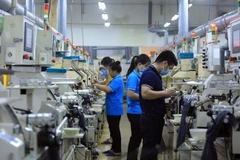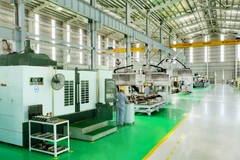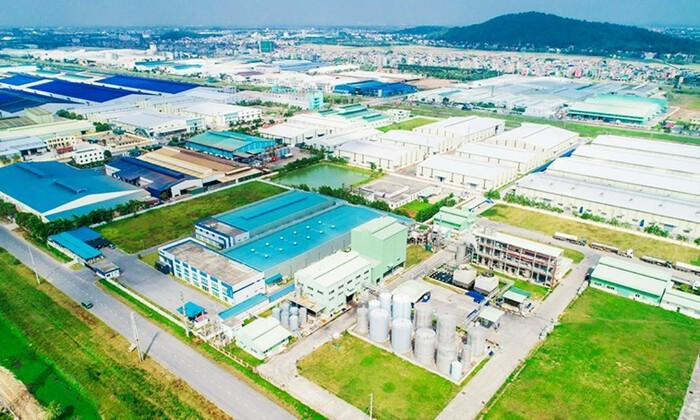
Bac Ninh (VNA) — The northern province of Bac Ninh ranked second nationwide in foreign direct investment (FDI) attraction in 2025, only after Ho Chi Minh City, underscoring its position as one of Vietnam’s leading industrial and investment hubs.
Last year, Bac Ninh attracted around 20 billion USD in total investment capital, with FDI reaching 5.73 billion USD. The province also saw 7,686 newly established enterprises, bringing the total number of businesses to nearly 50,000.
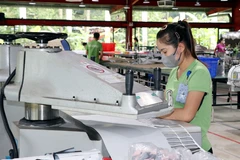
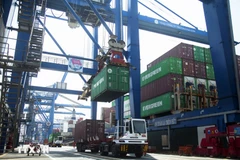
To date, the province hosts 3,403 domestic investment projects with registered capital of 838.8 trillion VND (32.02 million USD), and 3,396 FDI projects worth over 46.8 billion USD, involving investors from 42 countries and territories, mainly in electronics, garments, logistics, and real estate.
According to Vice Chairman of the Bac Ninh provincial People’s Committee Ngo Tan Phuong, the locality will continue to step up efforts to attract investment, foster business development, and promote all economic sectors in 2026.
The province has set a target of reaching 598.81 trillion VND in gross regional domestic product (GRDP), with total realised investment at 224.5 trillion VND, equivalent to 37.5% of GRDP.
Bac Ninh plans to intensify the attraction of FDI linked with high-tech transfer, while creating favourable conditions for domestic enterprises and improving the competitiveness of small- and medium-sized enterprises (SMEs). It also aims to raise industrial land occupancy rates and secure 5.5 billion USD in FDI in 2026.
Administrative procedure simplification combined with digital transformation will remain a key priority, helping facilitate transactions for citizens and businesses. At the same time, the province is committed to building a safe, transparent, and attractive investment and business environment to draw strategic investors, large-scale and high-tech projects, and promising start-ups aligned with its development planning.
Bac Ninh is also focusing on ensuring fair and favourable access for domestic private enterprises to capital, land, incentives, and other resources. The private sector is expected to become a pioneering force in industrialisation, modernisation, scientific and technological development, innovation, and digital transformation. To this end, the province is developing a private economic development programme and researching mechanisms to support SMEs, cooperatives, and collective economic models.
Strengthening linkages among state-owned, private, and FDI enterprises to form regional and global supply chains is another priority. Authorities are also closely monitoring business performance and providing support in investment procedures and production activities.
Looking ahead to the 2026–2030 period, Bac Ninh aims to mobilise around 1.6 quadrillion VND in total social investment capital. The province will continue to review and refine regulations and policies to remove bottlenecks, particularly in administrative reform, infrastructure development, site clearance, and human resource quality, while improving policy implementation effectiveness and avoiding short-term, term-based thinking./.
See more
Vietnam becomes RoK’s key export market in ASEAN
The RoK’s exports to Vietnam rose 7.6% in 2025 from a year earlier to 62.8 billion USD, while imports from Vietnam climbed 11.7% to 31.8 billion USD, according to data released by the RoK’s Ministry of Trade, Industry and Energy and the Korea International Trade Association (KITA).
Electronics enterprises urged to embed ESG into core strategy amid global shifts
Compliance with environmental, labour, governance, and information transparency standards is no longer a voluntary choice, but a mandatory requirement for businesses participating in global supply chains or exporting to international markets
Vietnam intensifies business networking with US chambers, associations
The Vietnamese Trade Office's branch in Houston in January convened an in-person seminar with two US associations and representatives of THACO Industries Group, drawing more than 60 participants from businesses in both countries.
Resolution 79: State economic sector to lead, catalyse private sector development
More than a document reaffirming the leading role of the state economic sector in a new era, the Resolution opens up an unprecedented space of “mutual reinforcement”, in which the sector shifts from an administrative management mindset to one of “development facilitation”, and is expected to serve as a solid pillar enabling the private sector and other economic components to make breakthroughs.
Vietnamese, Korean firms seek to enhance connectivity in new context
The association has actively contributed to policy discussions on issues important to Vietnam, including support for small- and medium-sized enterprises, artificial intelligence (AI) and sovereignty, as well as AI and semiconductor development policies in the RoK, while proposing recommendations for Vietnam.
Vietnam adopts solutions to improve business climate, boost national competitiveness in 2026
Resolution No. 02/NQ-CP stresses a comprehensive, synchronised approach to improving the investment and business climate across all fields, from mechanisms, policies, and administrative procedures to digital platform development and stronger enforcement capacity.
Macroeconomic management must match words with action: PM
In 2025 the global environment remained highly uncertain due to geopolitical tensions and tariff policies, while domestically, natural disasters, storms and floods were unusually severe, exceeding historical levels. Despite these challenges, Vietnam recorded encouraging economic results, with inflation kept under control at 3.31%, macroeconomic stability consolidated, major economic balances safeguarded, and GDP growth reaching 8.02% – a notable rate globally.
Resolution 79: Encouraging State-owned enterprises to link with FDI sector
The State economic sector has effectively fulfilled its function of orienting, leading and regulating economic activities, contributing to promoting economic growth, stabilising the macro economy, maintaining major economic balances, ensuring national defence and security, fostering social progress and justice, improving living standards and raising Vietnam’s international standing.
Resolution 68: Private economic sector affirms principal driver of growth, innovation
By 2030, Vietnam aims to have 2 million active enterprises, at least 20 large firms participating in global value chains, private sector growth of 10–12% annually, and contributions of 55–58% of GDP.
Reference exchange rate remains unchanged at week’s beginning
With the current trading band of +/- 5%, the ceiling rate applicable for commercial banks during the day is 26,369 VND/USD, and the floor rate 23,857 VND/USD.
14th National Party Congress: Chinese expert praises Vietnam’s growth targets
Vietnam should further refine mechanisms for mobilising infrastructure capital, including expanding public–private partnership (PPP) models and considering the establishment of a national-level special infrastructure fund to attract sovereign wealth funds and long-term capital, said Liu Ying, a research fellow at the Chongyang Institute for Financial Studies under the Renmin University of China.
Ministry proposes May 6 as Vietnam Logistics Day
The week containing May 6 each year is proposed as Vietnam Logistics Week, to be organised flexibly depending on actual conditions each year.
International Financial Centre, infrastructure boost Da Nang's appeal
The IFC is not merely about attracting major financial institutions, but also about positioning Da Nang as a hub for digital finance and fintech.
VIETRADE, RMIT Vietnam partner to strengthen national brands
Under the MoU, the two sides agreed to establish a long-term cooperation framework in trade promotion, training, research, and education related to brand development and international business.
Ho Chi Minh City strengthens global engagement at WEF Davos 2026
Vice Chairman of the Ho Chi Minh City People’s Committee Hoang Nguyen Dinh presented the city’s strategic vision, policy orientation and development priorities for building a modern, transparent and globally connected finance – technology ecosystem, with science – technology, data, artificial intelligence and fintech identified as core pillars.
Vietnam, India explore opportunities in food, beverage industries
Vietnamese Trade Counsellor Bui Trung Thuong highlighted India as one of the fastest-growing consumer markets in the world, with a large population, an expanding middle class, and rising demand for quality food and beverage products.
Small firms undergo digital transformation amid pressures
Unlike in the past, when the transition to the single-window mechanism was conducted manually, digital transformation is now taking place amid high compliance requirements and increasingly clear penalties.
Dong Thap’s OCOP products revamped, set sights on int'l markets
Dong Thap’s OCOP programme has grown beyond a rural economic initiative to become a strong driver for local businesses to upgrade both product quality and packaging to win over discerning consumers.
VSS pledges tighter fund management, diversified investments
The VSS will also impose stricter financial discipline in fund management, while pursuing broader diversification of investment portfolios, as guided by the principle of “safety, sustainability, and efficiency”. This approach aims to secure strong liquidity for prompt benefit payouts and support growth in Vietnam’s capital markets and overall economy.
AFT Connect portal links Vietnamese clean food producers
The platform is expected to serve as shared digital backbone enabling stakeholders in the clean food sector to gradually digitise, standardise, and publicly disclose information, ultimately aiding the fight against unsafe products and protecting consumer interests.