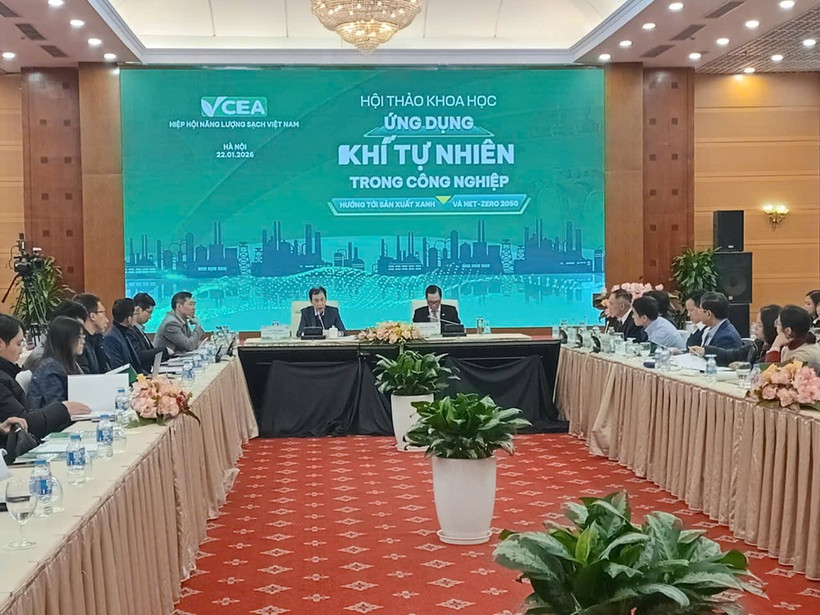
Hanoi (VNA) - Industry stakeholders met in Hanoi on January 22 for a scientific workshop organised by the Vietnam Clean Energy Association (VCEA), focusing on how natural gas can support greener industrial production and help the country achieve its 2050 net-zero emissions goal.
In his opening speech, VCEA Chairman Mai Duy Thien described green transition as both an inevitable trend and a pressing need amid tightening environmental regulations.
For Vietnam, the shift from a fossil fuel-dependent growth model toward green practices is essential to meet international commitments, safeguard energy security and sharpen economic competitiveness, he said.
Projections show Vietnam's energy needs surging through 2050, particularly in industry, households, and services, testing the limits of the current supply system and emissions-reduction pathways. As one of the world's most climate-vulnerable nations, Vietnam faces projected annual economic damage from climate impacts equivalent to roughly 3% of GDP. The stakes make a rapid, decisive overhaul toward a cleaner and more resilient energy model unavoidable.
Nguyen Khac Quyen, Deputy Director of the Vietnam Institute of Strategy and Policy for Industry and Trade, delivered a detailed roadmap for natural gas deployment in industry from 2025 to 2035. Accordingly, natural gas will remain a vital transitional fuel, as domestic gas production trends downward while demand from the power and industrial sectors climbs steadily.
Gas output from Vietnam's 26 producing fields hit its peak between 2010 and 2015, followed by a steep fall-off after 2016. During 2021-2025, annual volumes hovered between around 5.95 and 8.08 billion cu.m.
To plug the growing gap, the country has aggressively scaled up liquefied natural gas (LNG) imports. The first shipment arrived at the Thi Vai terminal in July 2023, signalling a fundamental rebalancing from predominantly domestic sourcing to a diversified portfolio of local and imported supplies. A milestone came in January 2026 when State-owned PV Gas inked its first long-term LNG supply agreement with Shell, securing deliveries of roughly 400,000 metric tonnes annually from 2027 through 2031 and laying a firmer foundation for reliable medium- to long-term volumes.
Despite these strides, participants also flagged ongoing hurdles, including dwindling local reserves, growing dependence on imported LNG, underdeveloped and fragmented gas and LNG infrastructure, and regulatory frameworks lagging behind market expansion pace.
The workshop built consensus around a natural gas strategy highlighting stability and flexibility, tied closely to LNG-to-power projects, broader industrial use beyond electricity generation, and readiness to incorporate lower-emission alternatives such as green gas and hydrogen.
Key recommendations focused on integrated planning of gas, power and industrial park infrastructure, the adoption of flexible supply models like direct pipelines, satellite LNG facilities and integrated energy hubs, alongside formal recognition of gas infrastructure as critical within industrial and economic zones. These steps should be backed by public-private partnership (PPP) mechanisms and long-term gas offtake agreements to ensure secure, viable supplies./.