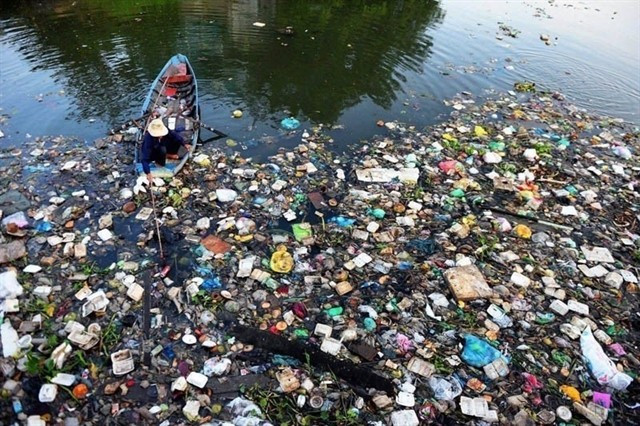
Hanoi (VNS/VNA) - Plastic quietly piles up in Vietnam’s cities, a relentless tide of thin shopping bags, foam food containers and disposable cups that clogs kitchens, alleyways and landfills.
It is the by-product of a convenience-driven lifestyle, and without decisive, coordinated action, it will continue to infiltrate the environment, harming ecosystems and posing growing risks to human health.
The scale of the problem is vast. The world produces about 430 million tonnes of plastic every year, more than two-thirds designed for single use before quickly becoming waste. Much of it ends up polluting oceans and waterways, with serious consequences for wildlife and people.
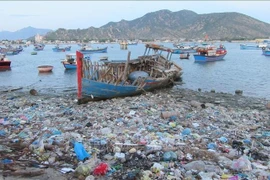
Vietnam is no exception. The country generates an estimated 1.8 million tonnes of plastic waste annually, yet only around 27% is recycled. Most of the remainder is buried, burned or leaks into rivers and the sea. Plastic’s threat lies not only in its volume but in its persistence. Lightweight and durable, it spreads easily across land and water and can take hundreds of years to break down.
"Plastic takes centuries, sometimes even longer, to decompose," said Bui Thi An, Director of the Institute for Natural Resources, Environment and Community Development. "At our current level of consumption, we are facing the risk of being drowned by our own waste."
For many young urban residents, plastic waste is not an abstract environmental problem but a constant part of daily life.
Ha Thi Phuong Linh, 20, a second-year university student in Thanh Xuan ward, Hanoi, said her busy schedule leaves little time for cooking, forcing her to rely heavily on takeaway food. Breakfast is usually a baguette bought at the school gate, wrapped in plastic and accompanied by small sachets of chilli sauce. Lunch typically comes in a foam box with a plastic spoon and multiple layers of plastic bags from a rice shop or convenience store.
Even a quick stop at the market in the evening often results in more single-use plastic bags, sometimes for nothing more than a few eggs or a bunch of greens.
"I can bring home four or five plastic bags a day without even noticing," Linh said. "They’re convenient – you use them and throw them away. But when I collect the rubbish at the weekend, I’m shocked at how much plastic I’ve accumulated."
Linh said she cares deeply about the environment, but changing habits is difficult when shops automatically hand out new bags and alternatives are rarely offered.
A similar pattern is seen in the booming milk tea culture.
For Le Ngoc Nhi, 22, who lives in Hanoi’s Hoàng Mai ward, a cup of milk tea has become a daily reward after studying and part-time work. Each drink arrives with a plastic cup, lid, straw and carry bag. On days packed with deadlines, Nhi may order two or three drinks, especially via delivery apps. To prevent spills, drivers often add extra layers of plastic packaging. "After just a few days, my bin is full of empty cups," she said.
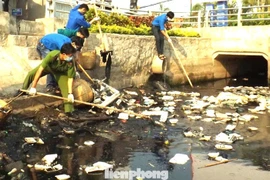
Environmental experts warned that the consequences extend far beyond overflowing bins. Plastic waste is accumulating across all environments, from soil and urban drains to rivers and open seas. Heavy rains can wash tonnes of plastic bags, bottles and foam containers into waterways, eventually carrying them out to sea.
The result is not only visual pollution but severe ecological damage, particularly to aquatic life. More troubling still are the risks to human health. As plastic breaks down, it fragments into microplastics: tiny particles that are ingested by fish and other marine organisms before moving up the food chain.
"We are eating our own waste without realising it," An said. "Microplastics can disrupt hormones and accumulate in organs such as the liver and kidneys."
Vu Thanh Ca, a senior lecturer at Hanoi University of Natural Resources and Environment, argued that the core problem lies in consumption habits and production systems that remain heavily dependent on single-use plastics. He pointed to everyday scenes in supermarkets: a small piece of meat placed on a foam tray, wrapped in plastic film and then put into another plastic bag at checkout.
"All of that packaging serves one product," he said. "Yet producers, distributors and consumers still haven’t changed their thinking."
The deeper issue, he added, is cost. Plastic is cheap – too cheap. Its environmental damage is not reflected in its price.
"In environmental economics, pollution costs must be fully accounted for," Ca said. "But the damage caused by plastic waste isn’t included in production costs. That’s why plastic appears cheap, and consumers never see its real price."
Even when people try to change their behaviour, structural barriers remain. Waste sorting at source is meaningless if all rubbish ends up in the same truck. Effective recycling requires investment in specialised collection vehicles, clear schedules for different waste streams and financial mechanisms that allow waste management companies to operate sustainably.
When waste is mixed, recycling becomes far more costly. Plastic must be cleaned before processing, and contaminated material dramatically increases water use and treatment expenses, undermining the economics of recycling.
Nguyen Trung Thang, Deputy Director of the Institute of Strategy and Policy on Agriculture and Environment, said Vietnam has established a relatively comprehensive legal framework, including the 2020 Law on Environmental Protection and subsequent decrees and circulars.
"The laws are there. The challenge is turning them into concrete actions that actually shape how people and businesses behave," Thắng says.
Limited funding and weak infrastructure remain major obstacles. Many localities lack the capacity and equipment required to implement waste sorting, collection and treatment at scale.
Still, the Government has set out a clear roadmap. From January 2026, the production of certain non-biodegradable plastic bags will be banned. By 2030, single-use plastic products and non-degradable bags are to be phased out entirely.
Some supermarkets have already switched to biodegradable bags, but Thang said stronger market incentives are needed.
"Single-use plastics must become more expensive. That’s how you change consumer behaviour," he added.
Le Van Hung, a senior lecturer at Hanoi University of Natural Resources and Environment, said a broader transition is required, combining legal reform, technological innovation and sustained public education.
"Plastic bags are just one part of the problem," he said. "The real goal is a circular economy where waste is reduced, reused and recycled efficiently."
For now, Vietnam continues to generate about 1.8 million tonnes of plastic waste each year. Without systemic change, the plastic tide will keep rising, quietly, persistently and at a cost that grows harder to ignore./.
VNA