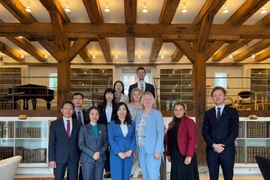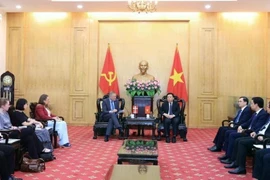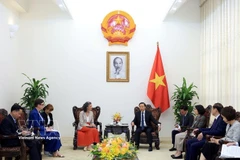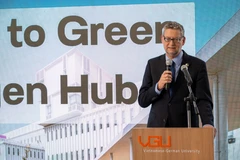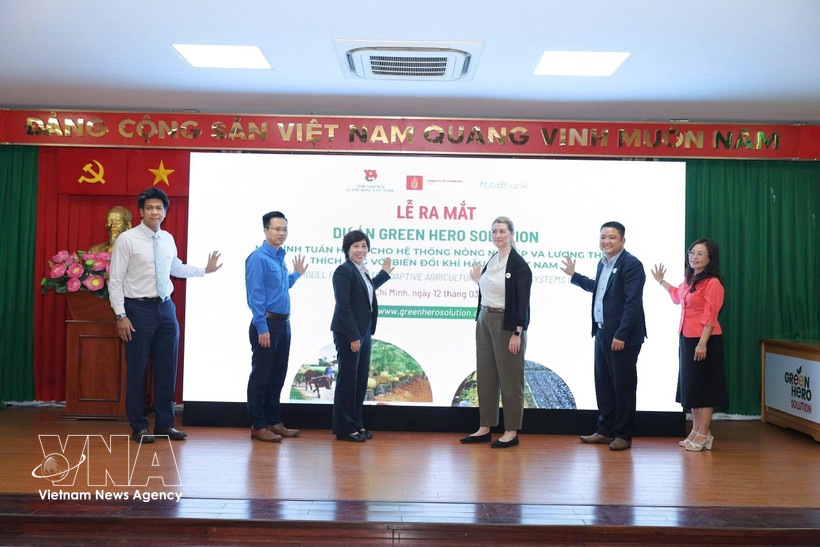
Ho Chi Minh City (VNA) – The “Green Hero Solution” project aimed at promoting circular food systems and climate-resilient agriculture in Vietnam was launched in Ho Chi Minh City on March 12.
The lauch was jointly implemented by the Youth Union of the Ministry of Agriculture and Environment (MAE), the Vietnam Foodbanking Network, and the Embassy of Denmark. Vietnam and Denmark established their green strategic partnership in November 2023, focusing on areas such as renewable energy, green economy, sustainable agriculture, resource management and innovation, with the shared goal of achieving net-zero emissions by 2050.
Sanne Høj Andrén, Counsellor for Food and Agriculture at the embassy, said the project will pilot a circular food system model in Ho Chi Minh City and the Mekong Delta city of Can Tho.
Under the initiative, organic food waste will be collected from partner organisations and businesses and processed into compost. The compost will then be used at two Food Bank community gardens, where fresh vegetables will be grown to support disadvantaged households.
In this way, the project creates a positive cycle from food waste to organic fertiliser, serving food production and community support, Andrén said, noting that it represents not only a circular economy model but also a community-level response to climate change.
She affirmed that Denmark considers Vietnam an important partner in sustainable development cooperation, particularly in agriculture, food, and resource management.
Ho Chi Minh City generates around 9,000 tonnes of household waste daily, of which more than 60% is organic. Most of this waste is still disposed of in landfills, where it produces methane, a potent greenhouse gas that contributes to climate change. At the same time, many vulnerable communities continue to face difficulties accessing nutritious food, highlighting the need for solutions that address both environmental and social challenges. The Green Hero Solution project aims to do precisely that.
According to Nguyen Tuan Khoi, founding chairman of the foodbanking network, the project has set several concrete targets. These include diverting at least 300 tonnes of organic food waste from landfills, reducing CO₂ emissions by about 600 tonnes, producing about 40 tonnes of compost for urban agriculture, and establishing two Green Hero community gardens in Ho Chi Minh City and Can Tho. The gardens are expected to provide more than 500 kilogrammes of fresh produce for families in need.
Beyond waste treatment, the initiative also seeks to build a broader collaborative ecosystem among stakeholders across the agriculture-food value chain.
Green Hero Solution serves as the first step of the Green Hero programme, which aims to connect businesses, cooperatives, farmers, youth start-ups and social organisations in developing sustainable food systems. Through the programme, participants hope to promote innovative models that help farmers and cooperatives make better use of resources, reduce food waste and increase the value of agricultural products, Khoi said.
Le Viet Binh, deputy head of the MAE’s southern office, said the initiative represents an innovative model with strong social impact. It contributes to key programmes at the ministry, including sustainable agriculture and resource management, while supporting Vietnam’s Net Zero commitments to the international community.
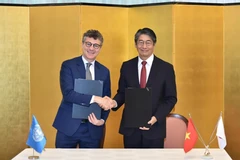
During the event, participating organisations and businesses also signed cooperation agreements to expand the Green Hero partnership network and promote circular economy models within the food sector.
In the coming period, the project will implement a range of activities, including developing community garden models, organising environmental education programmes in schools, connecting farmers and cooperatives to circular value chains, and supporting green start-up initiatives led by young people./.
VNA