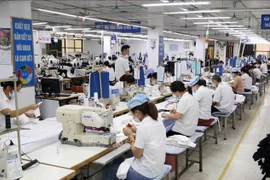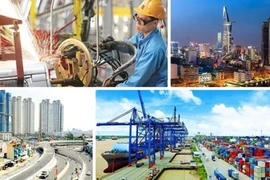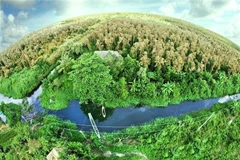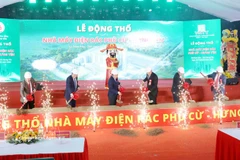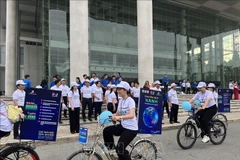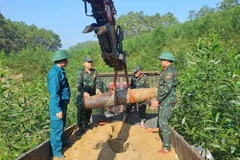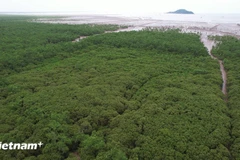
Hanoi (VNA) - Documents for the 14th National Party Congress have reaffirmed the imperative of pursuing rapid yet sustainable development anchored in sci-tech, innovation, and digital transformation, while placing strong emphasis on efficient management and use of natural resources, environment protection, and proactive climate change adaptation.
Green growth, circular economy, and low-carbon economy are identified as cross-cutting orientations designed to drive deep structural economic reform; boost productivity, quality, efficiency, and national competitiveness. Amid new development requirements, advancing green growth is no longer viewed as discretionary but as an inevitable path to harmonise robust economic expansion with environment protection and rising living standards.
In response, the Vietnamese Ministry of Agriculture and Environment’s Party Committee moved swiftly to issue an action plan in line with the 14th National Party Congress’s Resolution. The plan targets sustainable agricultural development grounded in green and ecological principles, with sharply reduced emissions, while ensuring food security, lifting rural incomes, improving the effective management and use of natural resources, and proactively adapting to climate change, all in support of the broader ambition to achieve sustained double-digit growth.
To deliver on these goals, the plan spells out specific tasks, timelines, lead and coordinating agencies, and resource requirements. Institutional reform sits at its core, with priority given to building a modern legal framework for emerging domains, including green economy, circular economy, and carbon markets. It also calls for greater decentralisation accompanied by oversight, a decisive shift from pre-approval controls to ex-post supervision, and the use of sci-tech and data as the backbone of modern governance. A detailed roadmap for revising, supplementing, and issuing legal documents has been laid out, complete with assigned responsibilities and deadlines, signaling firm intent to convert the Party’s resolution into concrete, measurable action.
In the new development phase, green growth stands as both a strategic direction and a long-term national commitment. Many localities have moved proactively to translate the policy into tailored schemes and practical models adapted to their specific circumstances.
The northern mountainous province of Son La offers a clear illustration of how green growth can be attuned to local realities. Guided by the Party Central Committee’s directives, the provincial Party Committee has identified two pillars: climate-resilient clean and organic agriculture powered by modern technology, and the development of eco-tourism, agricultural tourism, and experiential travel that capitalises on its cultural heritage and natural landscapes.
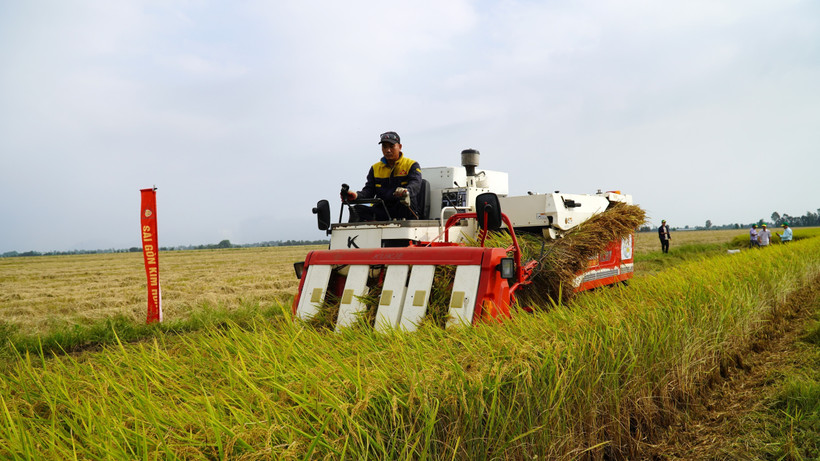
To date, Son La has established nine hi-tech agricultural zones, hundreds of traceable planting areas and safe agricultural supply chains, and hundreds of OCOP (One Commune One Product) items, many of which are protected domestically and globally. Local farm produce have been exported to more than 20 countries and territories.
In tourism, the province is working to build a sustainable eco-tourism brand to drive the green restructuring of its economy. Notably, the Moc Chau National Tourist Area has been honoured by the World Travel Awards as “Asia’s Leading Nature Destination” for four consecutive years (2022-2025) and “World’s Leading Nature Destination” in 2022, 2023, and 2025.
With the right policy mix, institutional support, and measurable results, green growth is poised to emerge as a pillar of Vietnam’s new development model, helping advance its ambition for rapid and sustainable progress.
Looking ahead, the provincial Party Committee plans to renew leadership approach, focus on key priorities and breakthrough areas, and promptly evaluate on-the-ground experiences to scale effective models. Priority will be given to developing circular economy in agriculture, through greater reuse and deep processing of by-products, and linking clean, organic, hi-tech agriculture with eco-tourism. These aim to minimise environmental footprints, protect biodiversity, and preserve both cultural identity and natural scenery.
At the same time, Son La seeks to effectively harness its potential in solar, hydropower, wind, and biomass energy, while expanding renewable energy production and models tailored to local conditions./.