Rare Himalayan sapria discovered in Phong Nha – Ke Bang forest

The discovery provides additional scientific data on the region’s flora and suggests that the limestone forest ecosystem in the national park remains well preserved.

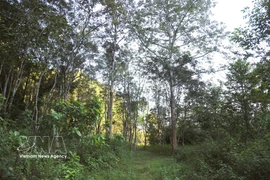
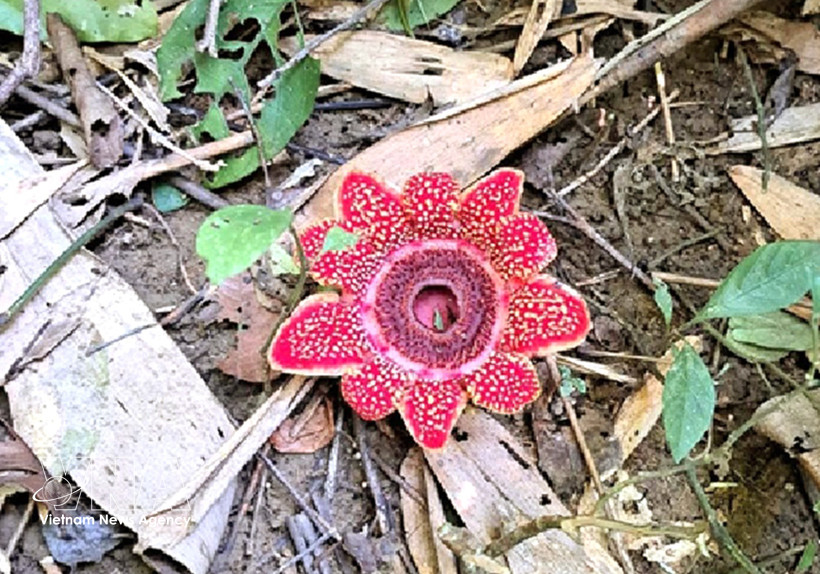
The Himalayan sapria found in the Phong Nha – Ke Bang National Park (Photo published by VNA)

Quang Tri (VNA) – A rare parasitic plant species, the Himalayan sapria (Sapria himalayana), has been recorded in the Phong Nha – Ke Bang National Park, according to the park’s management board.

The species was found in Sub-zone 649 within a strictly protected area managed by the Con Roang Forest Protection Station.

Himalayan sapria belongs to the Rafflesiaceae family, a group of plants known for their unusually large and distinctive flowers. The discovery provides additional scientific data on the region’s flora and suggests that the limestone forest ecosystem in the national park remains well preserved.

Researchers say the Himalayan sapria is a fully parasitic plant that lacks chlorophyll, leaves or true stems for photosynthesis. Its vegetative body is highly reduced and survives by attaching to the roots of host plants to absorb water and nutrients.

At the site in Sub-zone 649, the plant was found parasitising woody climbing vines of the Tetrastigma genus in the grape family. The flower is the only part of the plant that emerges above the ground for reproduction.

Recorded specimens have a diameter of about 15–20 cm, with dark red petals dotted with pale yellow spots. The flowers emit a smell similar to decaying meat to attract pollinating insects, mainly flies belonging to the Diptera order.

Experts note that the Himalayan sapria has a very narrow ecological range and is highly sensitive to changes in soil conditions, humidity and forest canopy structure. It typically occurs only under dense evergreen tropical rainforest where thick layers of leaf litter, high canopy cover and minimal human disturbance are present.

In both the Vietnam Red Data Book and the Red List of the International Union for Conservation of Nature, the Himalayan sapria is classified as endangered due to its limited distribution and complete dependence on host plants.

According to the park’s management board, the discovery raises the total number of plant species recorded in the Phong Nha – Ke Bang National Park to 2,957, further affirming the site as one of the most important biodiversity centres in Vietnam and the region./.

VNA

See more

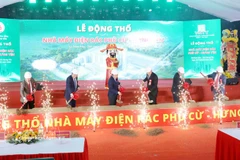
The groundbreaking ceremony for the Phu Cu waste-to-energy plant project in Doan Dao commune, Hung Yen province, on March 6 (Photo: VNA)

Hung Yen breaks ground on 4 trillion VND waste-to-energy plant

With a population of about 3.5 million, Hung Yen generates around 1,850 – 2,000 tonnes of household waste each day, along with about 1,000 tonnes of waste from production and business establishments, posing a major challenge for the locality.

A cycling convoy from the former Binh Duong province (now part of Ho Chi Minh City) parades through the streets to raise awareness in support of Earth Hour 2025. (Photo: VNA)

Earth Hour 2026 launch event rescheduled

The launch ceremony of a nationwide campaign that calls on all citizens to use energy economically and efficiently in response to Earth Hour 2026 will be held on the morning of Saturday, March 21, instead of March 7 as initially planned.

Nghe An neutralises 350kg unexploded wartime bomb (Photo: VNA)

Nghe An authorities safely dispose of 350kg wartime bomb

After inspection, military engineers identified the object as an MK-82 high-explosive bomb, measuring 20cm in diameter and 155cm in length, weighing about 350kg and still fitted with an intact detonator. The bomb was believed to be left over from the war.

Vietnam expands coastal forests to bolster green growth

Vietnam expands coastal forests to bolster green growth

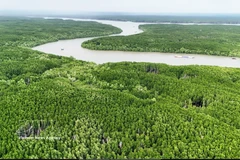
Restoring and developing forests as part of the 2026–2030 coastal forest protection and development project is still a big job. The plan aims to plant 5,088 hectares — including 3,236 hectares of mangroves and 1,852 hectares on soil and sandy land — and to enrich, restore, and improve 1,514 hectares of existing forests, with 683 hectares of mangroves and 831 hectares on soil and sand.

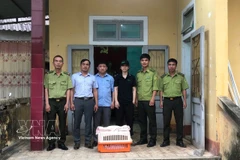
The People’s Committee of Dakrong commune in the central province of Quang Tri, in coordination with the Dakrong Forest Protection Station hand over a small-clawed otter to the Cuc Phuong National Park and the Wildlife Rescue Centre in Vietnam (Photo: VNA)

Quang Tri hands over rare otter to Cuc Phuong National Park

The People’s Committee of Dakrong commune in the central province of Quang Tri, in coordination with the Dakrong Forest Protection Station, on February 26 handed over a small-clawed otter to the Cuc Phuong National Park and the Wildlife Rescue Centre in Vietnam for further care and rehabilitation.

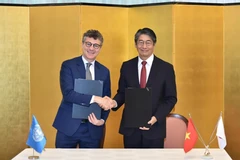
UNESCO Representative to Vietnam Jonathan Wallace Baker and Japanese Ambassador Ito Naoki at the signing ceremony (Photo: baoquocte.vn)

UNESCO, Japan sign deal to bolster Vietnam’s disaster early warning

Climate change adaptation remains a top priority in Vietnam’s development strategy and national security outlook through 2050. Vietnam will maintain close cooperation with Japan, UNESCO and other partners to guarantee the project’s effectiveness and advance common goals.

The German Agency for International Cooperation (GIZ)'s Managing Director Thorsten Schäfer-Gümbel speaks at the working session with the Vietnamese-German University. (Photo: VNA)

Vietnam, Germany step up collaboration on energy transition, green hydrogen

Schäfer-Gümbel praised the strong commitment of Vietnamese partners to sustainable energy goals. He noted that the long-standing development cooperation between Germany and Vietnam is evolving, with energy transition emerging as a strategic area of collaboration in addressing global challenges.

Cat Ba langur is an extremely rare primate species found exclusively in the humid tropical forests of Cat Ba island (Photo: VNA)

Belgian TV spotlight: Vietnam's wild nature reborn

Through the lens of “Le Jardin Extraordinaire”, Vietnam was portrayed not simply as a travel destination but as a still-emerging realm of discovery: a nation whose nature, though heavily wounded in the past, demonstrates extraordinary powers of recovery, quietly upholding its pristine essence against the pressures of time.

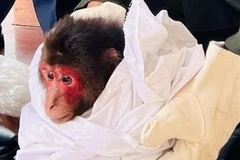
The macaque, scientifically known as Macaca arctoides. (Photo: VNA)

Quang Tri receives endangered stump-tailed macaque

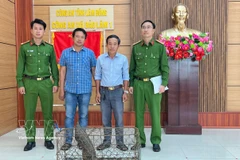
The Cam Lo-Dong Ha forest protection unit in the central province of Quang Tri has received a rare stump-tailed macaque, a species listed as endangered, precious and rare in the Vietnam Red Data Book.