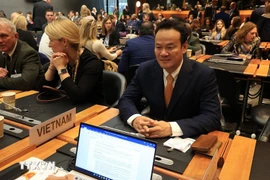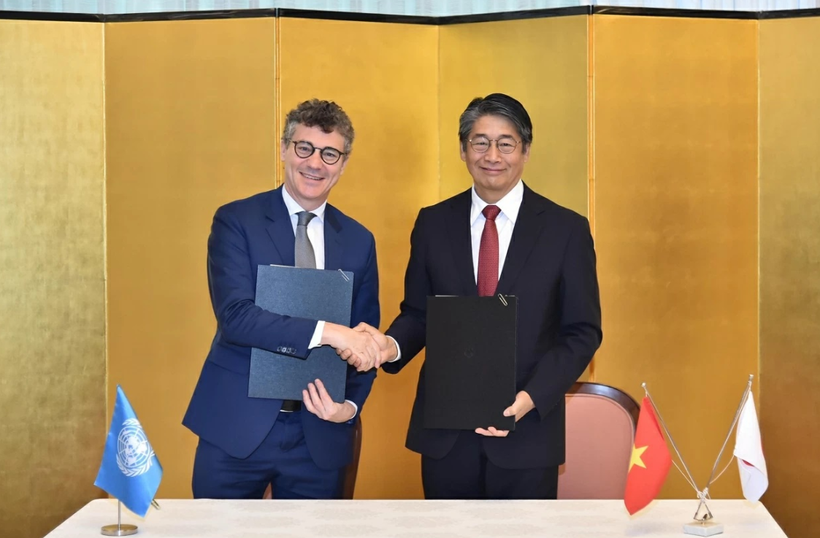
Hanoi (VNA) – UNESCO and the Japanese Government on February 12 signed an agreement to launch a project aimed at strengthening Vietnam’s capabilities in early warning, disaster risk mitigation and ensuring safe learning environment.
The project, funded at 533,333 USD, will run from March 2026 to March 2027 and target the central province of Nghe An, which is prone to frequent natural disasters, home to the UNESCO-recognised Western Nghe An Biosphere Reserve and former Vinh city, a member of UNESCO Global Network of Learning Cities.
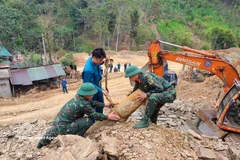
Its major aim is to improve near real-time early warning systems for flash floods and landslides in high-risk areas while enhancing school resilience. Key activities include participatory risk mapping, school-level preparedness and response plans, and capacity building for education managers and teachers to ensure learning continuity amid natural hazards.
Speaking at the signing ceremony, UNESCO Representative to Vietnam Jonathan Wallace Baker underscored the importance of shifting from emergency response to proactive prevention, saying that the project is designed to address needs in a targeted and holistic way.
Provincially, the effort will aid in reviewing and updating disaster risk management and emergency response plans, improving risk mapping, and reinforcing real-time monitoring and early warning for floods and landslides. At the communal level, it will deliver specialised training to local authorities and frontline technical staff on disaster prevention and emergency planning, with a focus on high-risk zones. Community and school efforts will focus on participatory risk mapping and response planning, awareness-raising, and practical preparedness measures to ensure early warning information is clearly communicated and acted upon before, during and after disasters.
UNESCO expects to continue working closely with the Vietnamese and Japanese governments and Nghe An province to deliver measurable outcomes and tangible benefits for locals, he said, adding that UNESCO will partner with government agencies and Nghe An authorities to adapt global expertise into context-specific solutions, ensuring that no one is left behind.
Deputy Minister of Foreign Affairs and Chairman of the Vietnam National Commission for UNESCO Ngo Le Van affirmed that climate change adaptation remains a top priority in Vietnam’s development strategy and national security outlook through 2050.
Vietnam will maintain close cooperation with Japan, UNESCO and other partners to guarantee the project’s effectiveness and advance common goals, he said.
The project is expected to reach about 15,000 people, including local communities, students, teachers and school administrators, with broader indirect benefits. Insights gained will serve as references for other localities and at the national level. The effort aligns with Vietnam’s priorities in disaster combat and education reform, supporting global commitments under the Sendai Framework for Disaster Risk Reduction and the Sustainable Development Goals./.