Vietnam takes actions to combat desertification, ensure sustainable land, resource management

Preventing and combating desertification is identified as a key task, helping with nature and biodiversity conservation, sustainable management of forests, water and land resources, and improvement of people's incomes and life quality.

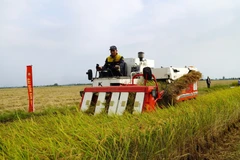
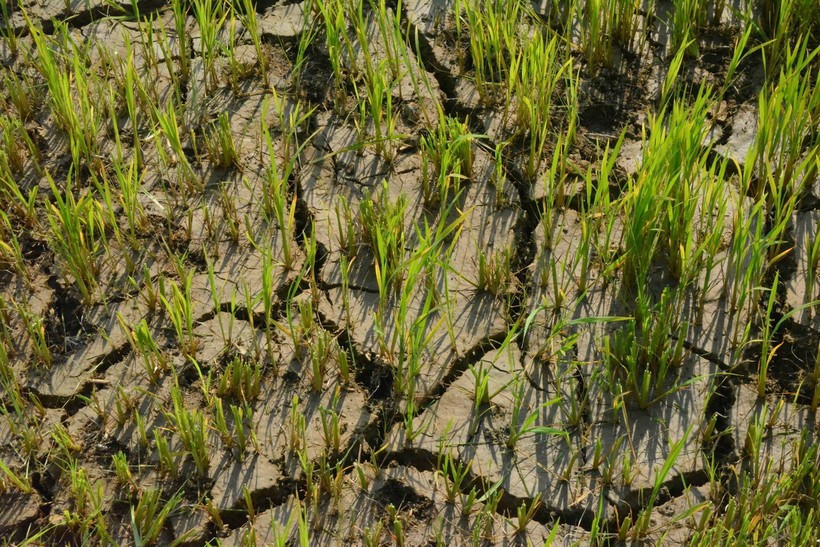
Rice fields in Lien Son Lak commune, Dak Lak province, are at risk of crop failure due to drought. (Photo: VNA)

Hanoi (VNA) – The Ministry of Agriculture and Environment has issued the national action plan on combating desertification through 2030, with a vision to 2050.

The plan reflects Vietnam’s sense of responsibility and efforts to contribute to the implementation of the United Nations Convention to Combat Desertification (UNCCD) and fulfil the international commitments to which the country is a party.

Preventing and combating desertification is identified as a key task, helping with nature and biodiversity conservation, sustainable management of forests, water and land resources, and improvement of people's incomes and life quality. It also supports poverty reduction, stable settlement, and the integration of desertification control objectives with national, sectoral and local strategies, as well as the UN Sustainable Development Goals (SDGs).

By 2030, the plan aims to identify and map desertification-prone areas nationwide and by socio-economic region; expand the meteorological and hydrological monitoring network for observation, forecasting and early warning; and develop adaptive management plans to mitigate impacts of drought and land degradation. Targets include sustainable use of land and water resources, maintaining 3.5 million hectares of rice farming land, ensuring forest coverage of 42–43%, improving forest quality, and conserving wetlands.

By 2050, total degraded land is to account for no more than 40% of the country’s natural land area, with severely degraded land and that at high risk of desertification kept below 4.5%. Average incomes in desertification-affected areas are hoped to reach at least 50% of the national average.
140847-tuoi-tiet-kiem-nuoc-dam-bao-nguon-cung-rau-mau-trong-mua-han-man-o-tien-giang.jpg
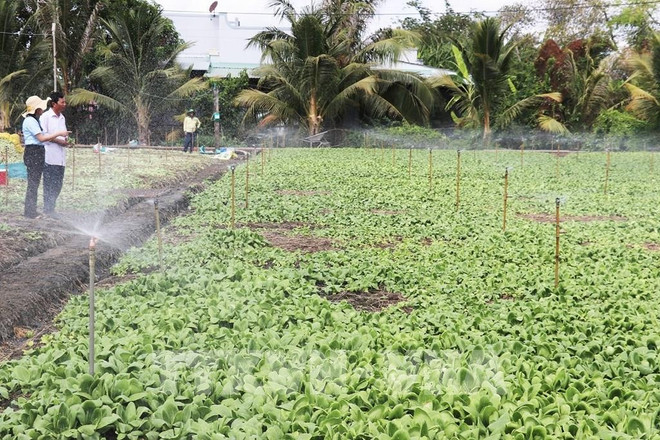
Farmers apply automatic sprinkler irrigation techniques to save water. (Photo: VNA)

Among region-specific measures, northern midland and mountainous areas will have eroded and leached land restored through reforestation, sustainable farming on sloping land and agroforestry.

The north-central region is set to rehabilitate arid and infertile land; conserve protection, coastal, special-use, and large-timber forests; form concentrated citrus fruit, tea, peanut, and sugar cane cultivation zones; develop drought-resistant crops; and upgrade irrigation infrastructure.

Meanwhile, the south-central coast and Central Highlands will prioritise natural forest protection, water-saving practices, high-tech agriculture, and crop restructuring to avoid natural disasters, droughts, and saltwater intrusion.

In the Red River Delta, southeastern, and Mekong Delta regions, efforts will focus on controlling salinity and acidification, expanding irrigation and coastal forests, upgrading reservoirs and dykes, enhancing inter-provincial coordination in operating irrigation systems to prevent saltwater intrusion, promoting intensive and high-technology farming and increasing high-quality rice cultivation, and stepping up climate-adaptive crop restructuring linked to processing and markets./.
VNA

See more

The German Agency for International Cooperation (GIZ)'s Managing Director Thorsten Schäfer-Gümbel speaks at the working session with the Vietnamese-German University. (Photo: VNA)

Vietnam, Germany step up collaboration on energy transition, green hydrogen

Schäfer-Gümbel praised the strong commitment of Vietnamese partners to sustainable energy goals. He noted that the long-standing development cooperation between Germany and Vietnam is evolving, with energy transition emerging as a strategic area of collaboration in addressing global challenges.

Cat Ba langur is an extremely rare primate species found exclusively in the humid tropical forests of Cat Ba island (Photo: VNA)

Belgian TV spotlight: Vietnam's wild nature reborn

Through the lens of “Le Jardin Extraordinaire”, Vietnam was portrayed not simply as a travel destination but as a still-emerging realm of discovery: a nation whose nature, though heavily wounded in the past, demonstrates extraordinary powers of recovery, quietly upholding its pristine essence against the pressures of time.

The macaque, scientifically known as Macaca arctoides. (Photo: VNA)

Quang Tri receives endangered stump-tailed macaque

The Cam Lo-Dong Ha forest protection unit in the central province of Quang Tri has received a rare stump-tailed macaque, a species listed as endangered, precious and rare in the Vietnam Red Data Book.

At a ceremony to donate 100,000 trees to the Naval Region 4 (Photo: HANE)

Tree planting programme spreads green momentum in islands

The Ho Chi Minh City Association for Conservation of Nature and Environment (HANE) on January 11 announced 10 outstanding green programmes and activities carried out in 2025, including a programme to plant 1 million trees in Vietnam’s island areas.

Lam Dong releases hundreds of wild animals into the wild. (Photo: VNA)

Lam Dong releases hundreds of wild animals back into the wild

According to the Ta Dung National Park Management Board, the park has for years served as a trusted destination for authorities and residents to hand over and release wildlife. Such actions not only contribute to biodiversity conservation but also help reduce illegal hunting and captivity of wild animals.

According to the Hanoi Department of Agriculture and Environment, air quality index (AQI) readings have at times reached poor and very poor levels. (Photo: VNA)

Hanoi targets 20% reduction in PM2.5 levels

Hanoi has affirmed its commitment not to trade environmental protection for economic growth. The city is moving to establish low-emission zones (LEZs) as a core measure to control emissions and promote green, sustainable urban development.

A waste collection area. (Photo: VNA)

Ca Mau approves investment policy for waste-to-energy plant

The waste-to-energy plant is planned for construction in Dat Moi commune, covering a total area of about 20 hectares. It will have a waste treatment capacity of approximately 600 tonnes of household waste per day and a power generation capacity of 6MW.