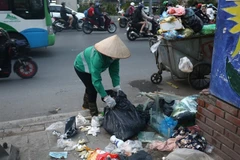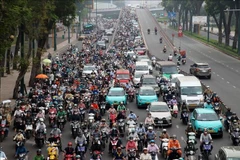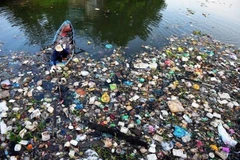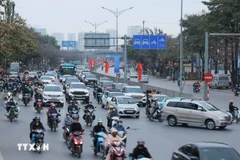
Hanoi (VNA) – The draft documents for the 14th National Party Congress underscores the requirement for sustainable development based on a harmonious balance between economic growth, social progress and environmental protection, with the last identified as one of the focuses closely linked to the quality of growth and people’s living standards.
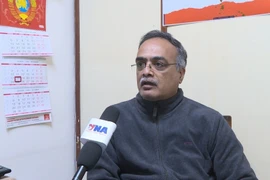
Dr Tran Van Mieu, Vice Chairman of the Vietnam Association for Conservation of Nature and Environment, said placing environmental protection at the heart of the national development strategy reflects a significant shift in development thinking, in line with both practical demands and global trend.
Mieu noted that experts and scientists working in the environmental field have clearly witnessed positive changes in the Party’s thinking and policy orientation on environmental protection and nature conservation over nearly four decades of Doi moi (renewal). This transition, though challenging, has become inevitable as environmental pollution, resource depletion and climate change increasingly pose direct threats to socio-economic development and people’s life.
A key feature of this progress is the Party’s consistent and overarching leadership. Through numerous important resolutions and directives, the Party has firmly established environmental protection, climate change response and biodiversity conservation as inseparable components of socio-economic development, moving away from the earlier mindset of trading environmental quality for economic growth.
On that basis, the State has institutionalised the Party’s guidelines through an increasingly perfect legal and policy system.
Mieu emphasised that successive versions of the Law on Environmental Protection have created an essential legal corridor, not only defining responsibilities and obligations for organisations and individuals, but also introducing incentive and support mechanisms to encourage broad social participation in environmental protection, biodiversity conservation and climate change adaptation.
He also highlighted the clearly defined role of the Vietnam Fatherland Front, socio-political organisations, and social and professional associations in environmental protection as institutionalised in Party resolutions and current legislation. Mobilising the entire political system and society has helped translate policies into practice and generate widespread social momentum.
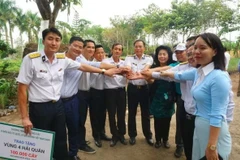
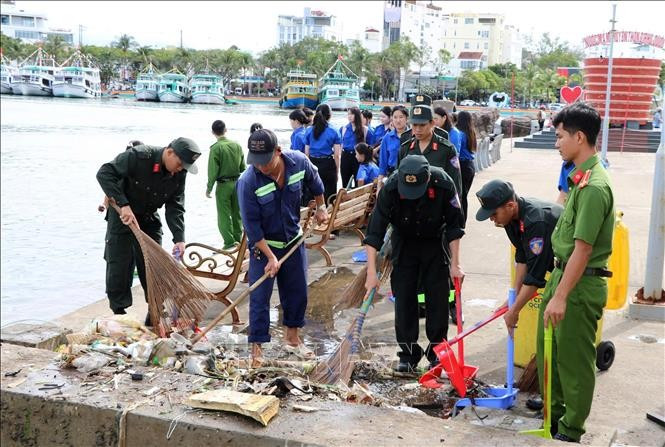
At the same time, community participation has become increasingly prominent. In both urban and rural areas, environmental protection is now a core component of efforts to build civilised cities and new-style rural areas. Communities are not only involved in practical activities such as maintaining sanitation and improving landscapes, but also gradually embracing environmental protection as an integral part of daily life.
Environment – foundation for development
From a strategic perspective, Mieu pointed to a notable new feature in the draft documents of the 14th National Party Congress: environmental protection is no longer treated as an auxiliary task, but increasingly regarded as a foundation for the country’s sustainable development in the coming period.
International experience shows that sustainable development rests on three inseparable pillars – economic, social and environmental. In this framework, the environment plays a foundational role in ensuring long-term economic growth and social stability.
In the context of deep international integration, environmental standards, green development and traceability have become mandatory requirements in many major markets. Failure to meet these standards risks undermining market access and national competitiveness, he went on.
Beyond production, environmental quality is also crucial for service sectors, particularly tourism. The goal of attracting tens of millions of international visitors annually can only be achieved if living environments, landscapes and urban and rural spaces are green, clean, beautiful and safe.
Mieu stressed that the Party and State’s commitment not to sacrifice the environment for short-term economic gains reflects the sense of responsibility towards long-term national interests and future generations.
With effective implementation of Party resolutions and the active participation of businesses, communities and the entire society, environmental protection will serve as a solid foundation for sustainable growth, prosperity and the well-being of the people on the path towards Vietnam’s development goals for 2045, according to the expert./.
See more
PM chairs sixth meeting of COP26 National Steering Committee
Prime Minister Pham Minh Chinh stressed that climate action remains a global movement and trend, in which Vietnam is actively engaged.
Eight rare animals released into the wild in Dong Nai province
The species include three Macaca fascicularis (long-tailed macaques), three Nycticebus pygmaeus (pygmy slow lorises), one Python reticulatus (reticulated python) and one Manis javanica (Javan pangolin).
Tree planting programme spreads green momentum in islands
The Ho Chi Minh City Association for Conservation of Nature and Environment (HANE) on January 11 announced 10 outstanding green programmes and activities carried out in 2025, including a programme to plant 1 million trees in Vietnam’s island areas.
Wildlife conservation creates green livelihoods at Ben En National Park
Ben En National Park in the central province of Thanh Hoa has implemented a wide range of scientific studies and conservation projects aimed at safeguarding biodiversity, particularly rare and endangered wildlife species.
Ca Mau strives to put coastal, riverbank erosion under control by 2030
Solutions have been designed to suit local geological and hydrological conditions, combining traditional hard engineering works such as dykes and revetments with soft, nature-based and ecological solutions, including mangrove restoration.
Lam Dong releases hundreds of wild animals back into the wild
According to the Ta Dung National Park Management Board, the park has for years served as a trusted destination for authorities and residents to hand over and release wildlife. Such actions not only contribute to biodiversity conservation but also help reduce illegal hunting and captivity of wild animals.
Hanoi pilots early air quality forecasting system
The system can forecast air quality trends over time and across locations, helping authorities guide and implement pollution control measures.
Recycling fly ash into valuable resource: sustainable path towards circular economy
The rate of fly ash utilisation has steadily increased over the years, to 84% in 2021 from 37.5% in 2018. During 2022–2023, many plants managed to consume 100% of the daily fly ash produced while also processing a significant portion of long-stored stockpiles.
Hanoi targets 20% reduction in PM2.5 levels
Hanoi has affirmed its commitment not to trade environmental protection for economic growth. The city is moving to establish low-emission zones (LEZs) as a core measure to control emissions and promote green, sustainable urban development.
Forest protection, development stepped up from start of 2026
Localities are requested to encourage the participation of mass organisations, schools, businesses, armed forces and communities, while enhancing public responsibility for caring for and protecting trees after planting.
Vietnam takes actions to combat desertification, ensure sustainable land, resource management
Preventing and combating desertification is identified as a key task, helping with nature and biodiversity conservation, sustainable management of forests, water and land resources, and improvement of people's incomes and life quality.
Ca Mau approves investment policy for waste-to-energy plant
The waste-to-energy plant is planned for construction in Dat Moi commune, covering a total area of about 20 hectares. It will have a waste treatment capacity of approximately 600 tonnes of household waste per day and a power generation capacity of 6MW.
Hanoi to require household waste sorting, allow collectors to refuse unsorted trash
Under the new rules, household waste must be separated at source into recyclable materials, food waste and hazardous waste.
HCM City curbs pollution through transition to green transport
Together with metro expansion, HCM City will continue to enlarge its electric and green bus network, targeting a public transport share of 15–20% of travel demand.
Plastic waste piles up as Vietnam struggles to curb culture of convenience
Vietnam produces nearly two million tonnes of plastic waste each year, most of it unrecycled. Interviews with young consumers and environmental experts reveal why regulation alone has struggled to curb a problem rooted in daily habits and low-cost plastic.
Peak Fansipan blanketed in ice on Christmas Day
With temperatures hovering between 1 and 3 degrees Celsius, frost and ice covered the summit area, creating an ideal condition for tourists eager to admire icy scenery, clouds and experience a Christmas atmosphere amid a sea of cold mist.
Vietnam targets vehicle emissions with stricter standards, digital enforcement
A substantial share of vehicles currently in use, especially motorcycles in use for years without routine checks or upkeep, are aging fleets that rank among the biggest emitters.
First public electric bus route in Con Dao Special Zone starts December 25
Electric bus Route No. 173 runs through 39 passenger pick-up and drop-off points, directly linking two locations with high travel demand — Con Dao Airport and Con Dao Market.
Nationwide mandatory management of emission quotas to be launched from 2028
Representatives of energy, coal – mineral, cement, and building materials enterprises said that the implementation of emission quota allocation must strike a balance between emission reduction targets and the maintenance of growth momentum.
20 trailblazing companies in national green ESG rankings honoured
In 2025-2026, the “For a Green National Environment” programme will pivot around six tasks that merge expertise with broad social outreach, including targeted communications, "Journey to Net Zero" conferences and trainings, ESG surveys and announcements, a "National Green Ambassador" contest, a "Green Fashion" design competition, and the rollout of "National Green Station" models focused on zero-waste living.