14th National Party Congress: Social welfare aligned with sustainable development

Humanitarian work has emerged as an important complementary pillar, providing timely support to vulnerable groups while reinforcing ties between the Party, the State and the people.

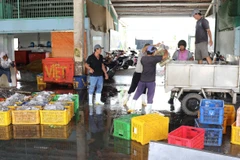
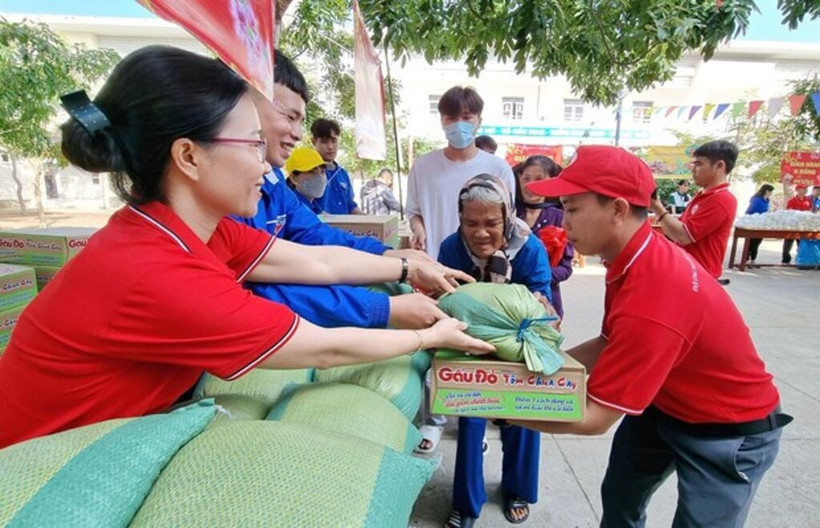
Staff members of the Ninh Thuan provincial Red Cross Society assist elderly people with difficult circumstances in transporting goods at a humanitarian market fair. (Photo: VNA)

Hanoi (VNA) – The 14th National Party Congress convenes as Vietnam is entering a new phase of development shaped by both opportunities and challenges, underscoring the need to pursue rapid and sustainable economic growth in tandem with social progress, equity and improved living standards, with humanitarian work playing a pivotal role in advancing human development and strengthening national unity.

Recent developments indicate that amid the growing impacts of natural disasters, epidemics, climate change and social risks, humanitarian activities must move beyond short-term, ad hoc assistance towards a more comprehensive and sustainable approach closely linked to long-term development goals.

Integrating humanitarian work into the Party’s overall development strategy

Over time, the Party and the State have progressively built and refined a framework of viewpoints, policies, guidelines and laws centred on human development, with due respect for and protection of human and citizens’ rights.

Within this framework, humanitarian work has emerged as an important complementary pillar, providing timely support to vulnerable groups while reinforcing ties between the Party, the State and the people. In 2025, despite major organisational changes stemming from administrative restructuring, humanitarian activities were carried out continuously without interruption. Total resources mobilised across the system exceeded 5.3 trillion VND (201.7 million USD), benefiting more than 8.9 million people.

According to Do Thi Thu Thao, President of the Vietnam Red Cross Society, staff, members and volunteers nationwide stepped up efforts to deliver a wide range of practical humanitarian initiatives. Emergency relief was provided promptly, voluntary blood donation campaigns were maintained effectively, social resource mobilisation improved, and the Society’s role in emergency response was increasingly recognised by both authorities and the public.

A key direction for humanitarian work in the new period is the shift from short-term relief to sustainable solutions. In 2025, alongside emergency assistance, thousands of households received support for livelihoods as well as housing construction and repairs, helping to secure long-term stability. This approach is consistent with the goal of sustainable poverty reduction and strengthens people’s capacity for self-reliance.

As disasters grow more complex, prevention and response have continued to be identified as core pillars of humanitarian action. In 2025, tens of thousands of households affected by storms and floods were assisted in a timely manner, while disaster response teams from the central level to the grassroots were further strengthened, with thousands of members ready to respond when incidents occur. Total spending on disaster prevention and response exceeded 1.234 trillion VND, supporting more than 513,000 people.

Public healthcare also remains a central component of humanitarian work. In 2025, healthcare activities worth over 307 billion VND were implemented, assisting around 2.6 million people through humanitarian medical examinations and treatment, community-based first aid and disease prevention communications. Meanwhile, the voluntary blood donation movement remained stable, with more than 1.75 million units of blood collected, largely meeting emergency and treatment demands.

These outcomes show that humanitarian work in 2025 not only expanded in scale but also steadily shifted towards a more sustainable orientation, closely aligned with the goal of ensuring social welfare and caring for people, in line with the consistent spirit of the Party’s policies and resolutions.

Toward sustainable humanitarian movements

In 2026, humanitarian efforts will continue to focus on consolidating organisational structures and improving operational efficiency, ensuring the stable and smooth functioning of the Red Cross system following administrative mergers.

Alongside organisational strengthening, humanitarian activities will remain closely linked to social welfare objectives and the improvement of people’s livelihoods, particularly for vulnerable groups, the poor, those in difficult circumstances, and people affected by natural disasters and epidemics.

In the field of disaster prevention and response, Red Cross chapters at all levels will prioritise enhancing organisational and management capacity, strengthening disaster response forces, expanding training for staff, members and volunteers, and working closely with local authorities and relevant agencies to provide timely assistance when disasters or incidents occur, contributing to social stability and production recovery.

Public healthcare activities will continue to focus on humanitarian medical care, community-based first aid, disease prevention communications and the sustained promotion of voluntary blood donation.

At the same time, greater emphasis will be placed on resource mobilisation, communications and external relations to encourage broader participation by organisations, businesses and all segments of society in humanitarian work./.
VNA

See more

The court hearing on January 14 (Photo: VNA)

Former food safety chief sentenced to 20 years for bribery

The court imposed the heaviest sentences on two former VFA directors, namely Nguyen Thanh Phong, who receive 20 years in prison, and Tran Viet Nga, who was sentenced to 15 years. Two former deputy directors, Nguyen Hung Long and Do Huu Tuan, were given 12 years and seven years, respectively.

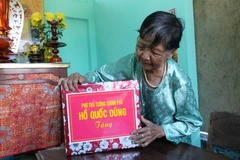
Gift from Deputy PM Ho Quoc Dung to a flood-hit family (Photo: VNA)

Quang Trung campaign: A call from the heart, for the people

In nine provinces and cities across the central and Central Highlands regions, over 11,000 public security officers and staff were mobilised to work alongside grassroots security forces and local authorities. The ministry also sent an extra 300 mobile police officers and public security cadets to assist with housing construction, repairs, and post-disaster recovery efforts.

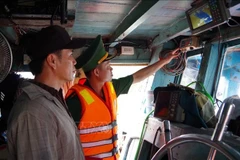
A Dong Thap border guard officer checks VMS device aboard a fishing a vessel (Photo: VNA)

Dong Thap closely monitors vessels to combat IUU fishing

In recent years, the Dong Thap provincial People’s Committee has directed relevant departments, agencies and localities with fishing fleets to strengthen management and strictly monitor fishing vessel operations at sea as part of efforts to prevent and combat IUU fishing.

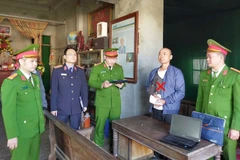
A policeman reads an order to detain Le Minh Vu (Photo: VNA)

Thanh Hoa man faces charges for anti-State social media activity

Between 2023 and 2025, Le Minh Vu in Thanh Hoa province repeatedly used a Facebook account bearing his own name and a fan page titled “Le Minh Vu electronic portal – A place to send petitions to recipients” to post content described as unfounded, hostile and dismissive toward the Party, State and government agencies.

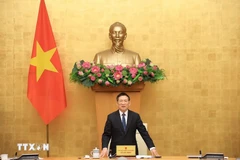
Deputy Prime Minister Ho Duc Phoc speaks at the conference to review and announce the preliminary results of the 2025 rural and agricultural census. (Photo: VNA)

Preliminary results of 2025 rural, agricultural census announced

The 2025 census is Vietnam’s sixth nationwide survey focusing on rural areas and agriculture. It aims to collect fundamental data for compiling socio-economic statistical indicators, serving assessments of the current situation, analyses of trends, and the formulation of plans and strategies for rural development and agricultural, forestry and fisheries production at both national and local levels.

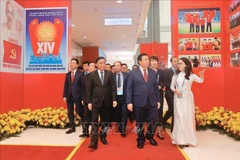
Officials visit the photo exhibition “Under the Party’s Leadership – The nation enters a new era” at the National Convention Centre in Hanoi on January 14. (Photo: VNA)

VNA photo exhibition opens, marking 14th National Congress

The exhibition features approximately 500 archival photographs from the Vietnam News Agency, organised into eight thematic sections reflecting key stages of Vietnam’s modern history in connection with successive Party Congresses.

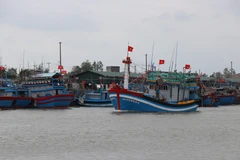
Quang Ngai now has 4,846 registered vessels, including nearly 3,000 over 15 metres long, while smaller vessels under 15 metres for nearshore fishing are gradually being reduced. (Illustrative photo: VNA)

IUU fishing: Quang Ngai helps fishermen transition to sustainable livelihoods

In recent years, fishermen in Quang Ngai province have actively upgraded and retrofitted large-capacity vessels, applying technical advancements in fisheries operations. As a result, the province’s fisheries sector has continued to make notable progress, with annual catches consistently meeting or exceeding planned targets.

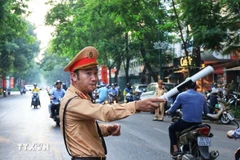
A traffic police officer regulates the traffic flow on a street in Hanoi. (Illustrative photo: VNA)

Hanoi Police announce traffic diversions for 14th National Party Congress

To ensure security, public order and traffic safety for the 14th National Party Congress, to be held from January 19 to 25 at the National Convention Centre in Hanoi’s Tu Liem ward, Hanoi Police have announced traffic diversion and regulation plans on key roads across the capital city.

Illustrative image (Photo: VNA)

IUU combat: Vinh Long tightens fishing port control

Vinh Long will maintain close coordination among agencies and localities, intensify legal outreach on fisheries regulations, strengthen management of the fishing fleet, and enhance the effectiveness of vessel monitoring.

Hanoi sees early gains from AI-powered camera system (Photo: VNA)

Hanoi’s AI-powered camera system shows initial positive results

From December 13, 2025 to January 12, 2026, the system recorded 6,351 cases eligible for automated traffic enforcement, with red-light violations accounting for 66.36% and helmet violations 32.32%. Captured images and video clips provided clear legal evidence for enforcement.