VNA photo exhibition opens, marking 14th National Congress

The exhibition features approximately 500 archival photographs from the Vietnam News Agency, organised into eight thematic sections reflecting key stages of Vietnam’s modern history in connection with successive Party Congresses.

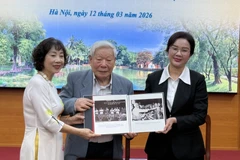
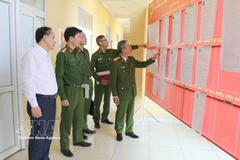
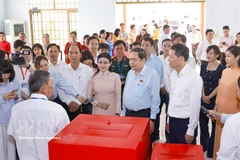
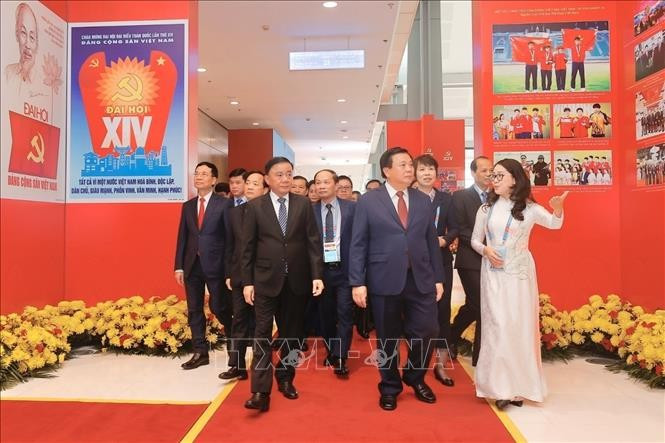
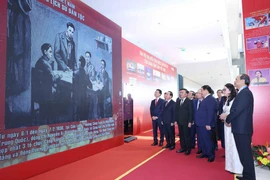
Officials visit the photo exhibition “Under the Party’s Leadership – The nation enters a new era” at the National Convention Centre in Hanoi on January 14. (Photo: VNA)

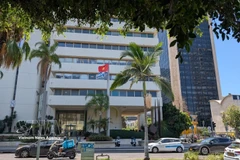
Hanoi (VNA) – To mark the upcoming 14th National Congress of the Communist Party of Vietnam, the Vietnam News Agency (VNA) is presenting a large-scale photo exhibition at the National Convention Centre in Hanoi under the theme “Under the Party’s Leadership – The nation enters a new era.”

Over the past 96 years, since its founding on February 3, 1930, the Communist Party of Vietnam has led the country through major historical turning points. The 14th National Party Congress is regarded as a significant milestone, setting the direction for a new phase of national development focused on growth, social well-being, and long-term prosperity.

The exhibition features approximately 500 archival photographs from the Vietnam News Agency, organised into eight thematic sections reflecting key stages of Vietnam’s modern history in connection with successive Party Congresses. Section 1 (1935-1850) focuses on building revolutionary forces and leading the August Revolution, which resulted in the establishment of a democratic republic. Section 2 (1951-1959) highlights leadership in resistance and national reconstruction. Section 3 (1960 to 1975) covers building socialism in the North and the struggle for national reunification. Section 4 (1976-1986) explores post-war reunification and nationwide socialist transformation.

The exhibition then moves to Section 5 (1986-1995), which showcases the launch of the Doi Moi (Renewal) reforms and the transition away from a centrally subsidised economy. Section 6 (1996-2005), highlights continued Doi moi, with an emphasis on industrialisation, modernisation, and international integration. Section 7 (2006-2015) documents economic recovery and Vietnam’s transition to a middle-income developing country. Finally, the exhibition concludes with the period from 2015 to 2025, focusing on efforts to advance a modern, internationally integrated socialist-oriented market economy.

The final section, which forms the core of the exhibition, highlights the achievements of nearly four decades of Doi moi. It reflects the draft documents submitted to the 14th National Party Congress and presents major policy orientations, including strategic breakthroughs, institutional reforms, Party building, administrative restructuring, and progress in economic development, culture, society, national defence, security, and international integration.

The exhibition underscores national unity and affirms Vietnam’s chosen development path, while providing a visual overview of the country’s reform and integration process.

A 6m by 3.5m electronic screen has also been installed within the exhibition space, allowing Congress delegates to view historical images and follow key activities related to the 14th National Party Congress.

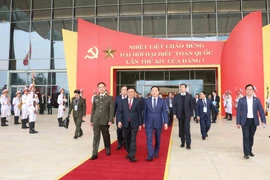
The exhibition is located on the second floor of the National Convention Centre, along the corridor leading to the main hall. The design draws inspiration from the red flag bearing the hammer and sickle, with red and yellow as the dominant colours, reflecting both historical continuity and forward-looking aspirations.

The central visual feature is a sculptural “V” motif, symbolising Vietnam and evoking the image of a bird in flight. This element represents the country’s ambition to rise, integrate more deeply into the international community, and pursue sustainable development. The exhibition theme is prominently displayed as a symbolic gateway, conveying Vietnam’s outlook toward a new era of growth and opportunity./.
VNA

See more

Brocade weaving is a cultural lifeblood for the Khmer community in the Bay Nui (seven-mountain) area of An Giang. (Photo: VNA)

Khmer brocade weaving helps drive heritage-based economic development

Nestled at the foot of the majestic That Son mountain range, Van Giao - the brocade weaving village of Khmer people in An Cu commune, An Giang province - is not only a repository of centuries-old cultural heritage but is also emerging as a model for heritage-based economic development.

People and vehicles travel across the Lo river pontoon bridge on the morning of February 16. (Photo: VNA)

PM commends units for constructing pontoon bridge to serve Tet travel demand

Prime Minister Pham Minh Chinh on February 16 sent a letter commending the determination and strong sense of responsibility of agencies and units in urgently building a pontoon bridge across the Lo river in Phu Tho province to promptly serve people’s travel demand during the Lunar New Year (Tet) 2026.

Prime Minister Pham Minh Chinh visits and extends Lunar New Year greetings to a patient undergoing treatment at Bach Mai Hospital. (Photo: VNA)

PM extends best wishes to doctors, patients on Tet occasion

Prime Minister Pham Minh Chinh visited and extended Tet greetings to medical staff and patients at Bach Mai Hospital and Viet Duc University Hospital in Hanoi while inspecting healthcare services during the holiday at these two leading central hospitals on February 16, or the last day of the Year of the Snake.

The Van Mieu-Quoc Tu Giam heritage site in Hanoi remains a major attraction for large numbers of visitors during the early days of spring. (Photo: VNA)

Hanoi offers free parking, public transport during Lunar New Year

During Tet, Hanoi offers free parking at selected schools and locations surrounding central heritage sites. In addition, single-journey fares are waived on the Cat Linh–Ha Dong and Nhon–Hanoi Station metro lines, while subsidised public bus services across the city are operating free of charge during the holiday period.

President Luong Cuong, his spouse, delegates and artists at the special Spring Homeland Art Programme 2026. (Photo: VNA)

Five major shifts chart overseas Vietnamese affairs in 2026 and beyond

In a world marked by intensifying strategic competition, emerging conflicts and intertwined economic, security and social challenges, nearly 6.5 million Vietnamese living in over 130 countries and territories have continued to look to the homeland as a firm spiritual anchor. The homeland remains a source of confidence, connection and aspiration for Vietnamese abroad.

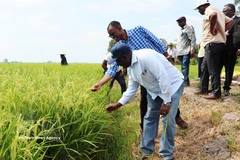
Vietnamese Ambassador to Cuba Le Quang Long (right) symbolically hands over 250 tonnes of rice to Cuban Deputy Minister of Agriculture Telce Abdel González (Photo: VNA)

Vietnam supports Cuba in ensuring food security

Cuban Deputy Minister of Agriculture Telce Abdel González affirmed that Cuba will create all favourable conditions for AgriVMA’s rice production project in Los Palacios district, Pinar del Río province, with a view to expanding the model to other localities across the country.

The Binh Phuoc provincial Intelligent Operations Center (IOC), operational since September 2020, has played an important role in supporting the development of digital government. (Photo: VNA)

Breakthroughs under Resolution 57 drive local development

Following the Politburo’s Resolution No. 57-NQ/TW on advancing science, technology, innovation and national digital transformation, many localities across Vietnam are translating strategic guidelines into concrete action, laying the foundation for a new development model based on knowledge, technology and modern governance.