Z Holding counterfeit milk case: Tough ruling plugs institutional, regulatory gaps

The court called on competent authorities to review and refine the legal framework on food quality and safety towards tighter control of all food products and preventive and curative medicines that directly affect public health.

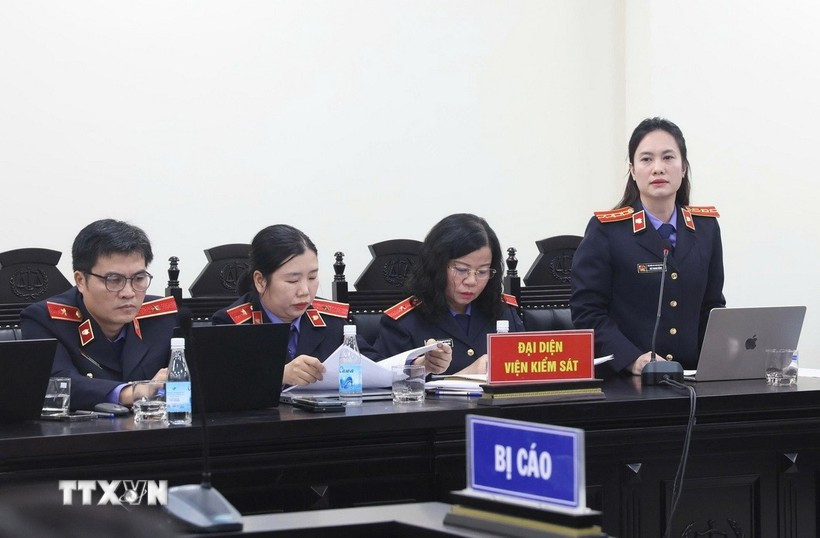
A representative of the procuracy at the trial (Photo: VNA)

Hanoi (VNA) – The Hanoi People’s Court on January 14 handed down sentences to 18 defendants in the fake milk case involving the Z Holding Company, convicting them of producing and trading in counterfeit goods being food, foodstuffs, or food additives (Article 193 of the Penal Code), violating accounting regulations causing serious consequences (Article 221), and laundering money (Article 324).

During the trial, the jury found numerous institutional and regulatory loopholes in the management of food products, corporate accounting and finance, and cash-flow supervision. On that basis, the first-instance verdict issued a series of comprehensive and direct recommendations aimed at thoroughly addressing these shortcomings.

Regulatory shortcomings laid bare

According to the verdict, the case at Z Holding was particularly serious, large in scale, complex in nature and prolonged over time. Hoang Quang Thinh, Chairman and General Director of Z Holding, together with accomplices, organised the production and distribution of counterfeit nutritional and dietary food products (HIUP powdered milk), generating illegal revenues amounting to trillions of VND and causing significant harm to consumers.

The defendants employed various tactics to conceal corporate revenues, resulting in especially large losses to the state budget and severely undermining public trust in food safety management and fair business practices. The case attracted widespread public attention.

Through the adjudication process, the court identified multiple loopholes in institutional frameworks and regulatory practices. These included lax quality management, licensing and post-market inspections, with the testing, appraisal and supervision of functional foods largely relying on dossiers provided by enterprises, in the absence of independent verification and regular inspections. Coordination and information sharing among State management agencies were found to be inadequate, as no unified data-sharing mechanism exists, resulting in delayed detection of violations – only after serious consequences had occurred.

The court also pointed to weaknesses in corporate accounting and finance monitoring, as reflected in the large-scale use of dual bookkeeping and revenue falsification for tax evasion. In addition, controls over advertising and product communications were deemed insufficient, enabling enterprises to exploit social media platforms and celebrities to promote misleading claims, while regulatory tools and sanctions remained weak. Notably, gaps in the legal framework on anti-money laundering were identified, allowing illicit proceeds to be legitimised through multiple accounts and shell companies amid ineffective monitoring of suspicious transactions.

Comprehensive, targeted recommendations

The first-instance verdict devoted a separate section to broad and direct recommendations aimed at “sealing institutional and regulatory gaps” revealed by the case.

It called on competent authorities to review and refine the legal framework on food quality and safety, including amendments to the 2010 Law on Food Safety and Government Decree No. 15/2018/ND-CP, towards tighter control of all food products and preventive and curative medicines that directly affect public health.

The court stressed the need to strengthen post-market inspections, introduce mandatory periodic checks for self-declared products, and require batch-based sampling procedures. At the same time, market surveillance should be intensified, particularly for food products, to tighten control over counterfeit and substandard goods, alongside the development of a national goods database to support traceability, anti-smuggling and anti-counterfeiting efforts.

Regarding corporate finance and accounting, the court underscored the necessity of enhanced inspection and supervision mechanisms to ensure early detection of violations, coupled with stringent penalties for dual bookkeeping, tax evasion and accounting fraud.

The verdict also recommended that relevant agencies improve coordination and data sharing by establishing an interlinked national database among product licensing authorities, tax agencies, customs, police, market surveillance and health bodies. It urged tighter supervision of advertising and e-commerce activities, clearer regulations on the legal liability of advertisers, KOLs and social media platforms when promoting health-related products, and mandatory product verification via identification codes, electronic labels or online traceability systems.

To prevent future money laundering, the court called for stronger mechanisms to control illicit financial flows and suspicious transactions.

In terms of State management, the first-instance court recommended that competent authorities tighten supervision of the production and trade of food and foodstuffs, promptly prevent violations, and ensure that such illegal acts do not harm the economy, public health or consumer rights.

The jury also urged investigation agencies and procuracies to continue resolute action and strict handling of crimes in this field, contributing to stronger deterrence and more effective law enforcement./.

VNA

See more

The court hearing on January 14 (Photo: VNA)

Former food safety chief sentenced to 20 years for bribery

The court imposed the heaviest sentences on two former VFA directors, namely Nguyen Thanh Phong, who receive 20 years in prison, and Tran Viet Nga, who was sentenced to 15 years. Two former deputy directors, Nguyen Hung Long and Do Huu Tuan, were given 12 years and seven years, respectively.

Gift from Deputy PM Ho Quoc Dung to a flood-hit family (Photo: VNA)

Quang Trung campaign: A call from the heart, for the people

In nine provinces and cities across the central and Central Highlands regions, over 11,000 public security officers and staff were mobilised to work alongside grassroots security forces and local authorities. The ministry also sent an extra 300 mobile police officers and public security cadets to assist with housing construction, repairs, and post-disaster recovery efforts.

A Dong Thap border guard officer checks VMS device aboard a fishing a vessel (Photo: VNA)

Dong Thap closely monitors vessels to combat IUU fishing

In recent years, the Dong Thap provincial People’s Committee has directed relevant departments, agencies and localities with fishing fleets to strengthen management and strictly monitor fishing vessel operations at sea as part of efforts to prevent and combat IUU fishing.

A policeman reads an order to detain Le Minh Vu (Photo: VNA)

Thanh Hoa man faces charges for anti-State social media activity

Between 2023 and 2025, Le Minh Vu in Thanh Hoa province repeatedly used a Facebook account bearing his own name and a fan page titled “Le Minh Vu electronic portal – A place to send petitions to recipients” to post content described as unfounded, hostile and dismissive toward the Party, State and government agencies.

Deputy Prime Minister Ho Duc Phoc speaks at the conference to review and announce the preliminary results of the 2025 rural and agricultural census. (Photo: VNA)

Preliminary results of 2025 rural, agricultural census announced

The 2025 census is Vietnam’s sixth nationwide survey focusing on rural areas and agriculture. It aims to collect fundamental data for compiling socio-economic statistical indicators, serving assessments of the current situation, analyses of trends, and the formulation of plans and strategies for rural development and agricultural, forestry and fisheries production at both national and local levels.

Officials visit the photo exhibition “Under the Party’s Leadership – The nation enters a new era” at the National Convention Centre in Hanoi on January 14. (Photo: VNA)

VNA photo exhibition opens, marking 14th National Congress

The exhibition features approximately 500 archival photographs from the Vietnam News Agency, organised into eight thematic sections reflecting key stages of Vietnam’s modern history in connection with successive Party Congresses.

Quang Ngai now has 4,846 registered vessels, including nearly 3,000 over 15 metres long, while smaller vessels under 15 metres for nearshore fishing are gradually being reduced. (Illustrative photo: VNA)

IUU fishing: Quang Ngai helps fishermen transition to sustainable livelihoods

In recent years, fishermen in Quang Ngai province have actively upgraded and retrofitted large-capacity vessels, applying technical advancements in fisheries operations. As a result, the province’s fisheries sector has continued to make notable progress, with annual catches consistently meeting or exceeding planned targets.

A traffic police officer regulates the traffic flow on a street in Hanoi. (Illustrative photo: VNA)

Hanoi Police announce traffic diversions for 14th National Party Congress

To ensure security, public order and traffic safety for the 14th National Party Congress, to be held from January 19 to 25 at the National Convention Centre in Hanoi’s Tu Liem ward, Hanoi Police have announced traffic diversion and regulation plans on key roads across the capital city.

Illustrative image (Photo: VNA)

IUU combat: Vinh Long tightens fishing port control

Vinh Long will maintain close coordination among agencies and localities, intensify legal outreach on fisheries regulations, strengthen management of the fishing fleet, and enhance the effectiveness of vessel monitoring.

Hanoi sees early gains from AI-powered camera system (Photo: VNA)

Hanoi’s AI-powered camera system shows initial positive results

From December 13, 2025 to January 12, 2026, the system recorded 6,351 cases eligible for automated traffic enforcement, with red-light violations accounting for 66.36% and helmet violations 32.32%. Captured images and video clips provided clear legal evidence for enforcement.

At the inauguration of the community digital library in Quang Phu ward, Da Nang city. (Photo: VNA)

RoK locality-funded digital library makes debuts in Da Nang

After more than 10 months of construction, the project has been completed and put into use, featuring all the components of a modern digital library, including over 1,000 book titles, an e-book repository, tablet and desktop computers, dedicated study areas, and spaces for digital knowledge exploration and research.