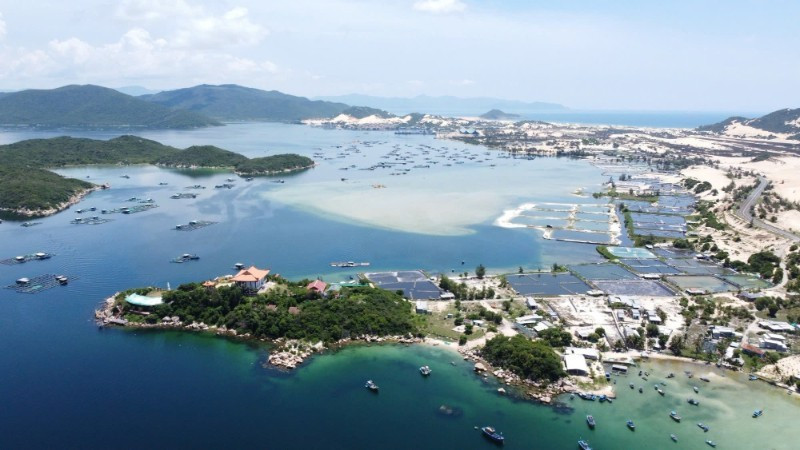
Hanoi (VNA) - With its sweeping coastline, lush forests, and fertile plains, the southern province of Khanh Hoa is doubling down on infrastructure upgrades, administrative streamlining, and tailored policies to court foreign direct investment (FDI), all with an eye toward becoming a centrally-run city by 2030.
A recent administrative merger has supersised Khanh Hoa to over 8,555 sq.km, complete with a 500km coastline – Vietnam’s longest. The province is chasing double-digit growth, a target meant to anchor sustainable progres. Already, a range of projects is propelling its economic ascent, lending credence to its ambitions.
Four investment pillars
In July, the provincial Party Committee issued the Resolution No. 01, a blueprint aligned with piloted special mechanisms approved by the Politburo and National Assembly. The resolution hinges on four strategic pillars, namely industry-energy, tourism-services, urban development, and sci-tech and digital transformation.
To realise this vision, Khanh Hoa is confronting three persistent choke points: human capital, long-delayed projects, and public investment efficiency. New highways, ports, and airports are under construction to bolster logistics and north-south connectivity.
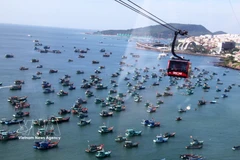
Khanh Hoa's southern part, in particular, is shaping up as a renewable energy hotspot, harnessing wind and solar potential while using its seaports to reel in foreign capital for energy, manufacturing, and industrial ventures. The province is also setting aside land for industrial parks, new urban zones, and sprawling mega projects. Meanwhile, it is weaving a tourism chain linking Nha Trang, Van Phong, Ninh Chu, and Nui Chua, aspiring to create a coastal and eco-resort haven that could rival the world’s best.
Surging investment momentum
Capitalising on Vietnam’s growing web of next-generation free trade agreements, Khanh Hoa has sharpened its pitch to major investors from the US, Japan, and the Republic of Korea. Several global conglomerates have signaled their intent to deepen their footprint in the locality.
In the first eight months of 2025, the province secured 62 off-budget investment projects worth over 391 trillion VND (15 billion USD). FDI projects now number 163, with registered capital nearing 5.1 billion USD, said Director of the provincial Department of Finance Chau Ngo Anh Nhan.
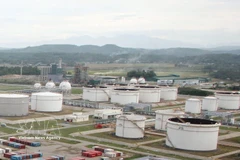
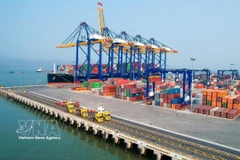
At the heart of this economic surge lies the Van Phong Economic Zone (EZ), established in 2006 and restructured in 2023. Envisioned as an industrial-seaport nexus with coastal urban and tourism developments, the zone hosts 11 completed subdivisions, with 131 domestic and 24 FDI projects totaling 5.4 billion USD in investment, of which 3.3 billion has been disbursed.
In the first half of 2025, it raked in over 1 billion USD in revenue, a 63% year-on-year jump, with exports up 56% to 751 million USD and imports at 559 million USD. Budget revenue soared 85% to exceed 1 trillion VND, according to Nguyen Thi Thu Ha, head of the zone’s investment and enterprise division.
Need for new policy support
Economists see boundless potential in Khanh Hoa but stress the need for stronger government backing to secure its place on Vietnam’s development map.
Trinh Minh Hoang, Vice Chairman of the provincial People’s Committee, said authorities plan to seek approval for pilot free trade zones between 2025 and 2030, including Van Phong EZ tied to its namesake port, the southern coastal zone linked to Ca Na port, and a zone connected to Cam Ranh international airport.
Looking ahead, Khanh Hoa will focus on infrastructure upgrades, transparent administrative reforms, and competitive incentives in investment, taxation, customs, and trade. The province aims to create an even level playing field, establishing itself as one of Vietnam’s most appealing international investment destinations, he added./.