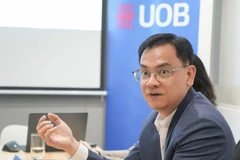
Hanoi (VNA) – Bui Hoang Hai, Vice Chairman of the State Securities Commission (SSC), has reaffirmed the regulator’s commitment to expanding foreign investors’ access to Vietnam’s capital market.
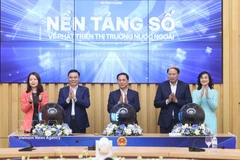
Speaking at the Vietnam Capital Market Outlook Forum 2026, held on December 12 by the Vietnam Financial Consultants Association (VFCA) and Vietnam Finance magazine, Hai said measures under way include allowing direct trading through global brokerage firms and enhancing information-sharing among market infrastructure institutions.
He noted that the SSC has been meeting frequently with foreign investors and international financial institutions to gather feedback and adjust policies accordingly.
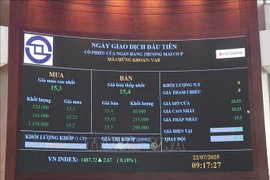
Hai highlighted a major milestone in 2025, when FTSE Russell formally upgraded Vietnam’s stock market from “frontier” to “secondary emerging”. He described the move as a recognition of more than two decades of reform, the quality, attractiveness and credibility of the market, and also a catalyst for further structural improvements.
Under the Government direction, the Ministry of Finance and SSC will continue strongly implementing policies to build a safer and more sustainable market and strengthen its role in mobilising medium- and long-term capital. Priorities include removing barriers, widening market openness, and meeting the higher standards set by FTSE Russell and MSCI.
A central task ahead is the introduction of a central counterparty clearing (CCP) mechanism, expected to become operational in the first quarter of 2027. Hai said the CCP will significantly reinforce foreign investor confidence and enhance the financial system's resilience by enabling more effective management of systemic risks and minimising contagion within the system.
Upgrades to market infrastructure are also accelerating. The launch of the KRX trading system has lifted liquidity to more than 29 trillion VND (1.1 billion USD) per session, up from 13–14 trillion VND previously, while daily orders have surged to 3 million.
Hai said this sharp increase requires continued system enhancement to ensure long-term stability and capacity for further growth.
At the same time, the SSC is expanding the range of financial products, including infrastructure bonds and green bonds, and promoting public offerings tied to listings. It also aims to rebalance the investor structure by increasing institutional participation, as the dominance of retail investors—who account for 85–95% of trading value—contributes to volatility and raises fundraising costs.
Regulators are stepping up supervision, strengthening market discipline and encouraging securities companies and fund managers to improve governance, technology, and human resources.
Hai said 2025 has also laid the groundwork for Vietnam’s digital asset market. Developing this market, he stressed, requires building a secure ecosystem in which service providers meet strict standards on technology, financial capacity, and risk management, while investors take greater responsibility. Amid rising fraud, the SSC has completed a draft decree on administrative sanctions for digital-asset violations, expected to be submitted to the Government within two months.
According to the official, 2026 will mark a new phase of development as institutional reforms and the market upgrade take effect, boosting Vietnam’s capacity for long-term capital mobilisation.
Three milestones in 2025—the market upgrade, the establishment of a legal corridor for digital assets, and the completion of the institutional framework for an international financial centre—will form the foundation for stronger growth, he added.
Dr Nguyen Son, Chairman of the Vietnam Securities Depository and Clearing Corporation (VSDC), said that from 2026, the capital market will face substantial opportunities as structural, risk management, technological, and procedural reforms bring it closer to international standards.
Luong Thi My Hanh, head of domestic asset management at Dragon Capital VietFund Management, said global experience shows that successful capital-market development depends on decisive State policies that encourage private-sector participation.
She added that the current period is favourable for fund managers to mobilise idle savings, enabling citizens to access the market safely while supplying stable long-term capital for economic growth./.