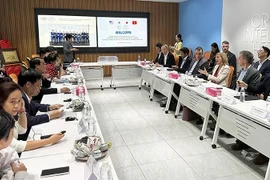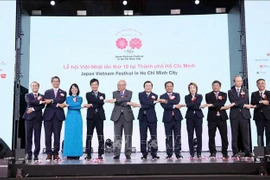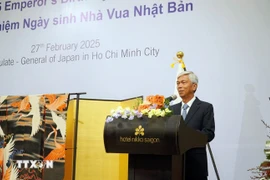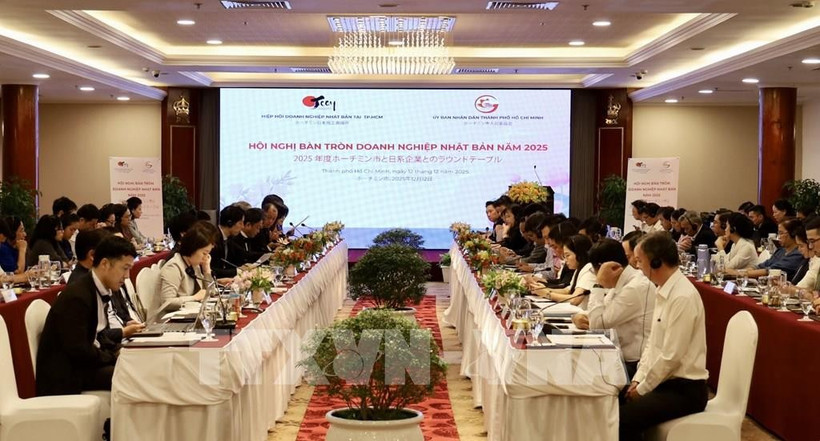
HCM City (VNA) - The Ho Chi Minh City Investment and Trade Promotion Centre (ITPC), together with the Japan Business Association of Ho Chi Minh City (JCCH), hosted the 2025 Japan business roundtable in the city on December 12.
The annual event, now in its 20th year, served as a platform to address challenges and gather recommendations from the Japanese business community to foster more effective bilateral ties.
Vice Chairman of the municipal People’s Committee Nguyen Loc Ha said 2025 marks a new phase in Vietnam-Japan relations as the two countries realise their “Comprehensive Strategic Partnership for Peace and Prosperity in Asia and the World”.
He underscored the pivotal contributions of Japanese firms, which have long supported local socio-economic progress through major infrastructure projects, industrial zones and workforce training courses. To date, Japanese companies have invested more than 15 billion USD in over 2,200 projects, reflecting sustained confidence and commitment to the market.
Japanese Consul General in Ho Chi Minh City Ono Masuo described Vietnam as an irreplaceable partner of Japan, with both sides solidifying a robust cooperation framework. Economic ties remain the cornerstone, and Japan is prepared to assist Vietnam’s industrial upgrade, especially in high-tech, digital transformation and green transition, he said, calling for a better business climate for Japanese operators.
On development direction, Deputy Director of the municipal Department of Finance Nguyen Thanh Toan hailed 2025 as a milestone year as the city has expanded its administrative boundaries, opening up vast market opportunities, broadening infrastructure connectivity and access to global financial resources. The local economy is expected to sustain momentum, with GRDP projected to top 8% and foreign direct investment exceeding 8.1 billion USD, where Japan ranks fifth in annual investment inflows.
Toan outlined the strategic priorities: establishing an International Financial Centre in Thu Thiem to draw global capital, building a regional smart urban chain with digital and green transport, including calls for metro and inter-regional rail investment, and restructuring the economy toward innovation and high technology, with Binh Duong as a hub for advanced industrial production.
The next focus is maritime economy and logistics, including digital super-port modelled free trade zones at Cai Mep-Thi Vai-Can Gio, plus offshore wind and petrochemical projects. The final strategic priority is creating an international-standard coastal eco-tourism chain spanning Vung Tau, Can Gio and surrounding areas.
To meet these goals, the city is rolling out special regulatory mechanisms under the amended Resolution No. 98/2023/QH15 on pilot policies for its development. Changes include greater authority to select strategic investors, special incentives for large-scale projects, transit-oriented development (TOD) models and refined public–private partnership (PPP) frameworks, and targeted support for hi-tech projects, research and development (R&D) and semiconductor workforce training.
JCCH also took this occasion to present 23 recommendations and proposals from the Japanese business community.
Chairman of the municipal People’s Committee Nguyen Van Duoc vowed to cut procedures and processing time by 30% and achieve 100% online public services this year. The city is accelerating belt roads, metro lines and transit-oriented development zones, as well as upgrading seaports and airports, and developing smart logistics and green mobility networks.
Preparations are also underway to operate the International Financial Centre, alongside simplified visas and tax breaks to lure global capital, with Japanese firms viewed as core partners. Efforts also include renewable energy, waste treatment and smart city development, and collaboration with JCCH to advance green governance, climate resilience and emissions reduction, he said.
On the workforce, the city is recruiting more foreign experts, upskilling workers in eight priority fields and launching the “Talent for Future City” programme to train 10,000 specialists in ESG (Environmental, Social, and Governance), data and innovation, Duoc added./.