Hanoi synchronises tourism offerings ahead of Tet peak

The Hanoi Department of Tourism has issued a directive requesting localities, tourism units, businesses and individuals across the city to review and improve service quality, develop new tourism products tailored to visitor demand and tastes, and strengthen safety and security measures during the holiday period.

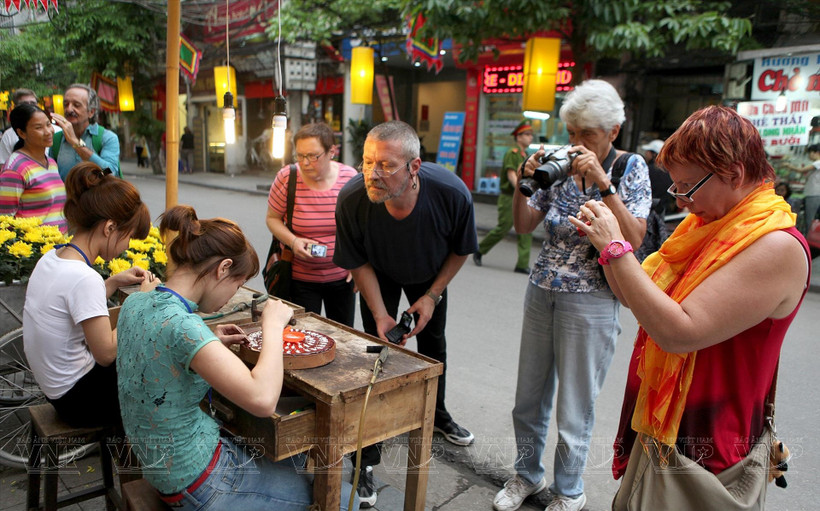
Tourists experience silver craft in Hang Bac street of Hanoi (Photo: VNA)

Hanoi (VNA) – As the country’s leading tourism hub, Hanoi is stepping up comprehensive preparations in terms of products, services and cultural–tourism activities to welcome a large influx of visitors during the Lunar New Year (Tet) holiday 2026.

The Hanoi Department of Tourism has issued a directive requesting localities, tourism units, businesses and individuals across the city to review and improve service quality, develop new tourism products tailored to visitor demand and tastes, and strengthen safety and security measures during the holiday period.

On this occasion, Hanoi will organise fireworks displays at 31 locations with 32 launch sites on New Year’s Eve, alongside a wide range of cultural and entertainment activities for residents and tourists. The Hoan Kiem Lake area and the Old Quarter will remain key highlights, featuring traditional Tet experience spaces, displays of handicrafts, and art exhibitions.

Major historical and cultural sites, including the Temple of Literature, the Thang Long Imperial Citadel and Hoa Lo Prison Relic, will open to visitors with themed experiential programmes. Inner-city tours such as “Hanoi – Touching the Realm of Memories” and “Flag Tower Memories” will continue to operate in the early days of the Lunar New Year.

At the same time, localities across the city have proactively prepared new tourism offerings, notably experiential routes in the Huong Pagoda area and the “Nam Thang Long – Hanoi Heritage Road”, which connects destinations such as Noi Binh Da communal house and temple (Binh Minh commune), the incense stick craft village (Ung Thien commune), and silk and lotus silk weaving villages (Hong Son commune).

Hotels and accommodation facilities are rolling out a variety of Tet-themed staycation packages, culinary services and festive decorations to attract visitors. A25 Hotel has launched a Tet tourism stimulus campaign offering a 30% room discount with no holiday surcharge for both domestic and international guests, while encouraging the combination of accommodation with early-year spiritual tours for peace, prosperity and good fortune. InterContinental Hanoi Landmark72 has also introduced a Binh Ngo Tet package featuring special privileges and experiential workshops on making traditional banh chung.

According to Dang Huong Giang, Director of the Hanoi Department of Tourism, with thorough preparations in place, the capital’s tourism sector aims to meet visitors’ travel and leisure needs while further promoting Hanoi as a green, safe, friendly and attractive destination, creating momentum for growth in 2026./.


VNA
See more

A number of youth union members at the Vietnam Academy of Social Sciences visit the exhibition space showcasing books and materials on culture. (Photo: VNA)

Book week underscores role of knowledge in policymaking

The highlight is a series of activities on April 21, including a book and document exhibition on culture, the launch of a special publication titled “Special scientific information for leadership” and initiatives promoting reading culture, including a book donation programme and a book review contest.

Hanoi has over 1,100 libraries and numerous cultural and educational spaces in the community. (Photo: VNA)

Spreading value of books, building foundations of learning society

Each weekend in Hanoi, the “Reading with Children” Club brings together students to practise reading, explore language, and express ideas creatively. According to founder of the club Nguyen Thuy Anh, the club encourages children to reflect, retell stories, and connect books with personal experiences, making reading more vivid and meaningful.

Automated ticketing system is used on the urban railway Cat Linh-Ha Dong line in Hanoi. (Photo: VNA)

Digital transformation powers Hanoi metro expansion

Beyond convenience, stable fares and the elimination of fuel, parking and maintenance costs have made urban rail increasingly attractive. The growing preference for metro travel is also contributing to a greener, more modern urban lifestyle.

Delegates cut the ribbon to inaugurate the operation of electric bus route No. 43. (Photo: VNA)

Hanoi accelerates shift to green buses, targets 100% by 2030

In the 2027–2030 period, the city will accelerate the transition towards the complete phase-out of fossil fuel-powered buses. The share of electric and green energy-fueled buses is projected to reach 79–89% by 2029 and 100% by 2030.

At the second session of the Ho Chi Minh City People’s Council (Photo: VNA)

Ho Chi Minh City greenlights central square, administrative centre in Thu Thiem

The new central city square and administrative centre will create a modern, centralised political-administrative complex for Ho Chi Minh City, designed to house around 8,000 officials, civil servants, and employees. It will also handle daily traffic of 1,500- 2,000 citizens and business representatives through a unified one-stop-shop administrative service system.

A working session at the job fair (Photo: VNA)

Vietnamese students flock to Seoul Job Fair 2026

The second annual Job Fair 2026 was held for Vietnamese students in the Republic of Korea. Organisers pitched it as a straight-up bridge between eager students and bosses hungry for young talent who can actually handle multicultural workplaces.

Defendants at the court (Photo: VNA)

Ho Chi Minh City court opens trial over Agribank lending scandal

The investigation revealed that multiple credit files were incomplete or riddled with inaccurate information, while some pledged assets lacked proper legal standing yet were accepted and grossly overvalued. As a result, the loans became high-risk and largely unrecoverable, leading to losses surpassing 1 trillion VND.