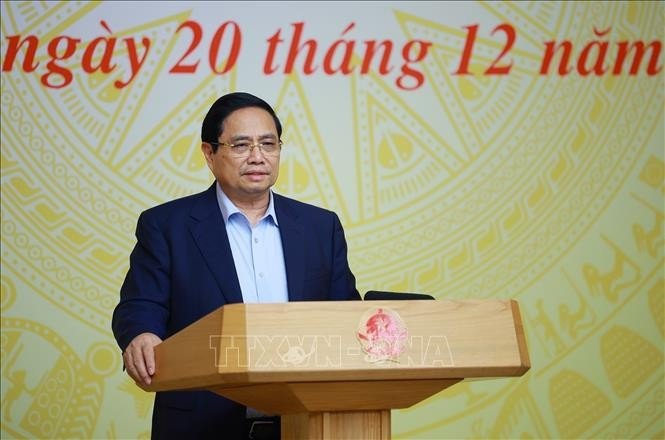
Hanoi (VNA) - Prime Minister Pham Minh Chinh underscored the principle of “trust, action, substance, effectiveness, and breakthroughs” for private sector growth in his closing speech at the third meeting of the National Steering Committee implementing the Politburo’s Resolution 68 in Hanoi on December 20.
PM Chinh noted that since the rollout of Resolution 68, alongside supporting resolutions from the National Assembly (NA) and Government, there has been a marked change in understanding the private sector’s critical position and role in Vietnam’s socialist-oriented market economy.
All 34 localities and 21 ministries and agencies have already issued action plans to follow the resolution, while Government bodies and local authorities have responded promptly to input and proposals from private enterprises.
The Government has passed resolutions slashing and simplifying administrative procedures and shortening processing times. Approvals have been granted to reduce more than 3,000 procedures and over 2,200 business conditions, trimming an estimated 13,200 processing days and cutting annual compliance costs by over 34.2 trillion VND (1.31 billion USD).
The Government also issued Resolutions 138 and 139, assigning 69 tasks to ministries, agencies and localities, of which 43 were targeted for completion in 2025 and 37 largely achieved. Besides, the Government submitted to the National Assembly for promulgation 15 laws, one resolution of the NA and 15 guiding decrees.
Ministries, agencies and localities have refined preferential policies on taxes, fees, capital and land access, investment procedures and the overall business climate, while intensifying communication and support for private firms and business households. These measures have made Resolution 68’s positive impact on the business community increasingly visible.
To meet two centenary goals and pursue double-digit growth from 2026 onward, he called on the private sector to contribute to macroeconomic stability, inflation control, debt reduction across public, government and external categories, economic security and national defence.
He urged continued efforts to build business trust in the Government and local authorities through tangible, practical and effective measures, alongside steps to lower input and compliance costs and raise labour productivity via three strategic breakthroughs.
Specific tasks were also assigned to ministries, agencies, and localities, including drafting a decree on a small-and medium-sized enterprise (SME) development fund, creating a national land database, issuing guidelines for green and circular projects, providing 2% interest-rate subsidies for such initiatives, offering cross-sector legal aid to SMEs and business households, and amending decrees on industrial clusters.
Stressing the need for full engagement across the political system, government apparatus and society to support businesses, he expressed confidence that with strong resolve, great effort and decisive action, Resolution 68 will gain even wider and more effective traction in 2026 and beyond.
Since May, Vietnam has averaged around 18,000 new enterprises monthly, a nearly 38% jump compared with the average of the first four months of the year. For full-year 2025, more than 300,000 enterprises are estimated to have registered anew or resumed operations, up nearly 30.9% year on year, with additional registered capital exceeding 6 quadrillion VND. Active enterprises nationwide are projected to reach nearly 1.1 million by year-end.
The VN-Index climbed to around 1,691 points by late November, up nearly 38% from the end of 2024. Market capitalisation is estimated at about 390 billion VND, equivalent to more than 80% of 2024 GDP, with investor accounts surging past 11 million. Most listed companies remained profitable, accounting for roughly 86% of the total.
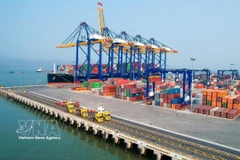
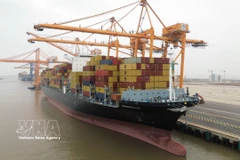
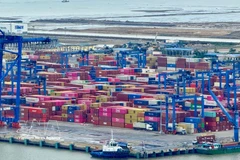
The private sector played a key role in Vietnam’s estimated 840 billion USD in export-import turnover for the first 11 months of 2025, already topping the full-year 2024 record, with a trade surplus exceeding 20.5 billion USD. Non-state enterprises contributed over 464 trillion VND to the state budget as of December 11, far surpassing targets and marking a sharp year-on-year increase./.