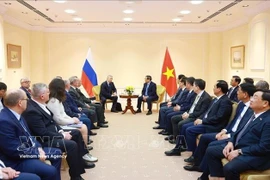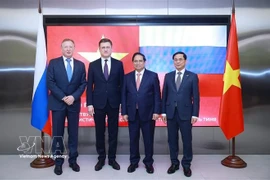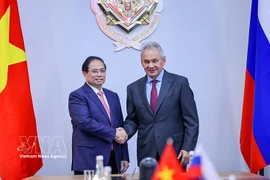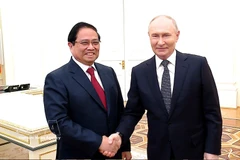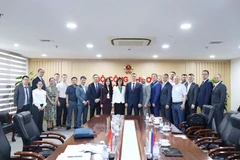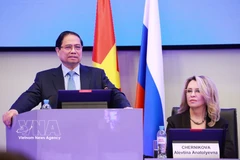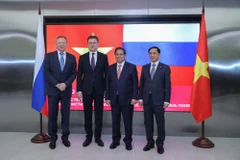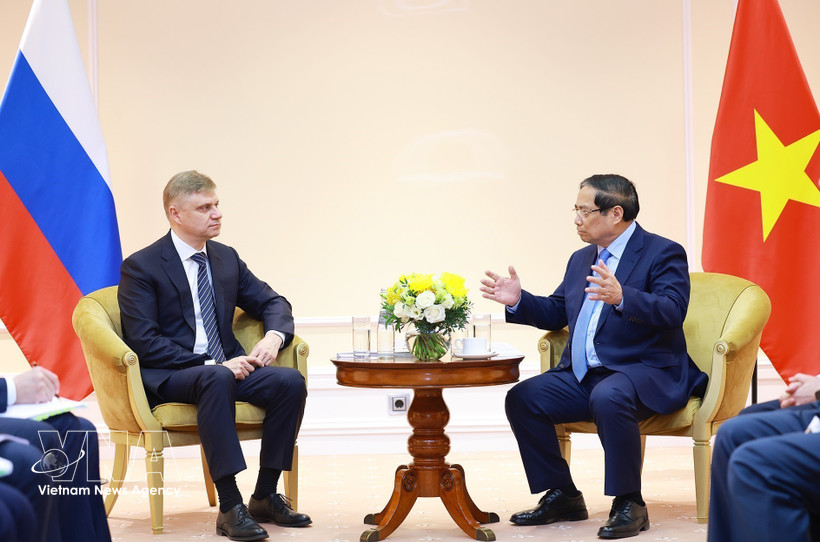
Moscow (VNA) - Prime Minister Pham Minh Chinh held working sessions in Moscow on March 25 with leaders of AFK Sistema, Russia’s largest private conglomerate, and Russian Railways (RZD), as part of his official visit to Russia.
Creating favourable conditions for Russian investors
At the meeting with AFK Sistema Chairman Vladimir Petrovich Evtushenkov and the group’s executives, PM Chinh hailed the corporation’s proactive engagement with major Vietnamese enterprises to promote cooperation programmes in recent times. He suggested that AFK Sistema increase and diversify its investment in Vietnam, contributing to the implementation of agreements reached by the two countries’ key leaders.
Introducing Vietnam’s development strategy, the PM said the Vietnamese Government always supports and facilitates cooperation between businesses of the two countries in areas where Russia – including AFK Sistema – has strengths and Vietnam has demand, such as database infrastructure development, information technology, digital transformation, cybersecurity, pharmaceuticals, nuclear energy, telecommunications, the digital asset market, and the exploration of underground and outer space. These include projects related to metro development in Hanoi and Ho Chi Minh City.
For his part, Evtushenkov recalled his positive impressions following his previous visit to Vietnam as well as his meeting with the Vietnamese leader. He affirmed that AFK Sistema intends to invest in Vietnam and contribute to the country’s efforts to achieve double-digit growth in the coming years.
He said that the group hopes the Vietnamese Government will facilitate procedures for establishing a legal entity and opening an office in Hanoi, the implementation of the Moscow House project in the capital and the participation in urban railway projects. The firm is also interested in cooperating with Vietnamese partners in pilot projects related to national biometric databases, AI-powered camera systems, cybersecurity and artificial intelligence
AFK Sistema also wishes to establish long-term cooperation with Vietnamese factories to produce pharmaceuticals in demand in Vietnam, transfer technologies for certain new transformer products that Vietnam has not yet mastered, and participate in pilot mechanisms related to financial technology and digital assets, he added..
Welcoming AFK Sistema’s commitment to invest in Vietnam, PM Chinh said the projects of interest to the group align well with Vietnam’s development plans.
Relevant Vietnamese agencies have been coordinating with partners, including Russian partners, to implement these initiatives. He added that the Government will direct relevant agencies to work closely with AFK Sistema to facilitate project implementation in accordance with legal regulations, ensuring harmonised interests, shared risks and effective investment.
Strategic role of Vietnam–Russia railway connectivity
At his meeting with Russian Railways CEO Oleg Belozyorov, the the Vietnamese Government leader was informed that the RZD is a wholly state-owned enterprise with revenue of approximately 34.5 billion USD in 2025, responsible for managing, maintaining and operating the country’s national railway infrastructure.
Russia currently possesses the world’s third-largest railway network after the US and China, with a total length of about 86,000 kilometres. It also operates the Trans-Siberian Railway - the world’s longest railway line, stretching around 9,289 kilometres, with passenger and cargo transport volume ranking second globally. With 51.2% of its railways electrified, Russia also has the world’s largest electrified railway network, helping optimise operating costs and reduce emissions. In late 2024, Russia began construction of a high-speed railway linking Moscow and Saint Petersburg with a design speed of up to 400 km/h. The 679-kilometre line, with a total investment of nearly 24 billion USD, is expected to be completed in 2028.
Vietnam and Russia are currently members of the Organisation for Cooperation of Railways (OSJD). The Vietnam Railways Corporation (VNR) and Russian Railways are both members of the OSJD Conference of General Directors and are parties to international agreements on railway freight transport, transit tariffs and other related mechanisms.
Rail freight between Vietnam and Russia in 2025 increased by more than 40% compared with 2024. However, the volume remains below the potential of the two markets due to certain limitations, including differences in infrastructure and railway gauge standards, which increase costs and extend transport time.
PM Chinh said that during the visit, the two sides agreed to further strengthen Vietnam–Russia relations, particularly cooperation in economic, trade, investment, energy, oil and gas, and transport sectors, including railways.
Highlighting the strategic importance of railway connectivity in linking the two economies, facilitating business cooperation and enhancing people-to-people exchanges, the Prime Minister said international railway transport between Vietnam and Russia should be restored and promoted more strongly and effectively through three main corridors: Vietnam–China–Kazakhstan–Russia; Vietnam–China–Mongolia–Russia; and Vietnam–China–Russia. He also suggested strengthening cooperation among Vietnam, China and Russia in this field.
The PM asked the two railway corporations and relevant agencies to work together to develop solutions to promote international railway transport between Vietnam and Russia through digital transformation, green transition and smart management, while expanding two-way cargo flows and improving competitiveness.
He also suggested enhancing cooperation in urban railway development and underground infrastructure in Hanoi and Ho Chi Minh City, areas where Russia has strong expertise. Cooperation could include sharing experience in planning, design, standards, construction, project implementation, management and safe operation, as well as technology transfer, contributing to the development of a modern railway industry ecosystem.
Emphasising that railway cooperation is a strategic matter of mutual interest and receives close attention from the leaders of both countries, the Vietnamese leader proposed establishing a joint working group to accelerate railway freight connectivity, human resource training, consultancy and support for urban railway projects in Hanoi and Ho Chi Minh City.
Agreeing with the PM Chinh's proposals, Belozyorov said Russia’s railway sector is ready to expand cooperation with Vietnam, including sharing advanced technologies and supporting workforce training. Russian Railways will promptly coordinate with Vietnamese partners to implement concrete initiatives, contributing to the development of the Comprehensive Strategic Partnership between the two countries, he pledged./.
VNA