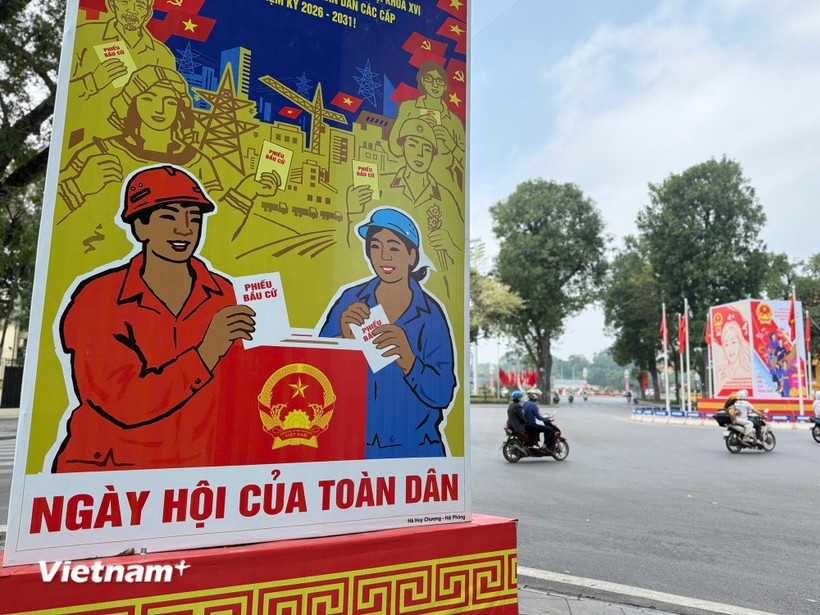
Hanoi (VNA) – As Vietnam approaches the March 15 polling day for deputies to the 16th National Assembly (NA) and People's Councils at all levels for the 2026–2031 term, reactionary forces are resorting to every possible tactic to undermine public confidence through a barrage of toxic content on social media. A fairly common method recently has been to downplay the significance of Election Day through indirect incitement.
Outright fabrications such as falsified vote tallies, invented personnel reshuffles at various levels, smears against leading candidates for top posts, or baseless legal accusations, no longer pack the same punch. Instead, indirect methods are deemed more potent, even as they adhere to the same well-worn playbook of distortion and malice.

The tactic of spreading as many rumours as possible is based on a psychological premise: people are more likely to believe what they hear or read repeatedly; over time, falsehoods can come to be seen as truth. First, there is the “familiarity effect”, which makes the brain more likely to accept repeated information. Second, there is the “bandwagon effect” – the tendency to believe something more readily when it is mentioned by many people or cited by multiple sources, rather than appearing as a lone rumour.
While hostile forces directly targeted the personal integrity of senior officials in the leadership pipeline before the 14th National Party Congress, they are now “saying A to target B” in the run-up to the NA vote.
By posting on social media about delays in a major transport infrastructure project, these actors ignore the conclusions of competent authorities. They feign concern about losses to the state budget, funded by taxpayers. All of this leads to a highly one-sided conclusion: Who bears the “highest responsibility”? Who, in the name of “political resolve” or a “new era of advancement”, allegedly steered contracts toward favoured cronies at the expense of national interest and public welfare?
Given Hanoi’s special status, its key leaders have also become targets of malicious rumours, suggesting that a certain official was promoted not solely because of talent, virtue, and decades of service, but a supposed “shared hometown connection” with a senior figure. This rumour follows the logic of a “half-truth”, taking a coincidental detail and using it to overshadow the broader, objective reality.
The armed forces are often a focus of such hostile attention, as President Ho Chi Minh once affirmed: “The public security and the army are the two arms of the people, Party, Government, and proletarian dictatorship."
In recent days, beyond spreading ambiguous rumours about supposed tensions between the “left hand” and the “right hand”. Some social media pages have circulated entirely fabricated claims — for example, false information about military personnel being transferred to leadership positions in a major city. The aim is to stir public outrage over an alleged “militarisation of the civil administration”.
Those spreading such crude fabrications also portray an alleged “disease of family rule” in an immature manner. They cling to ordinary coincidences such as similar surnames between senior and junior officials, and then spin narratives suggesting favouritism as if a “big brother” was pulling up a “little brother”.
Even illogical claims lacking basic reasoning have been circulated due to a shortage of “creative material” about the election. One example is the rumour of an impending second large-scale merger that would reduce the country to just 19 provincial-level administrative units. For such information to gain acceptance by a rational mind, it must slip through a very narrow gap in reason. Nevertheless, some members of the public have felt confusion and anxiety. If rumours manage to exploit the emotions of a susceptible crowd, they can gain enough traction to persist.
On March 4, Phan Trung Tuan, Director of the Ministry of Home Affairs’ Department of Local Government, affirmed that the Party and State currently maintain no policy of continued nationwide reorganisation or merger of provincial, city, or commune-level units. Before submitting proposals on administrative unit restructuring and a two-tier local administration model, the Government Party Committee had convened five meetings and sought review from the Politburo and the Party Central Committee's Secretariat on three separate occasions.
The surge of baseless rumors and fake news ahead of March 15 reflects deliberate attempts by hostile actors to sow confusion, erode public interest in citizens’ electoral rights and obligations, and cast Election Day in a negative light.
Rumours take root easily when they are just intriguing enough and easy to remember, particularly among those who lack knowledge or pay little attention to public affairs. They also proliferate when they align with preexisting negative biases — assumptions that can outweigh even strong contradictory evidence.
With sufficient awareness, broad knowledge, and clear judgment, residents can become immune to baseless rumours and fake news, just as viruses cannot multiply to cause illness in a healthy body with a strong immune system./.