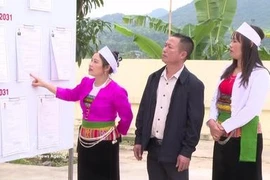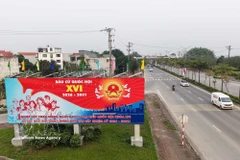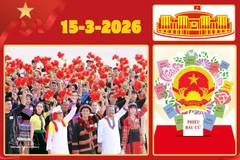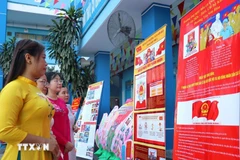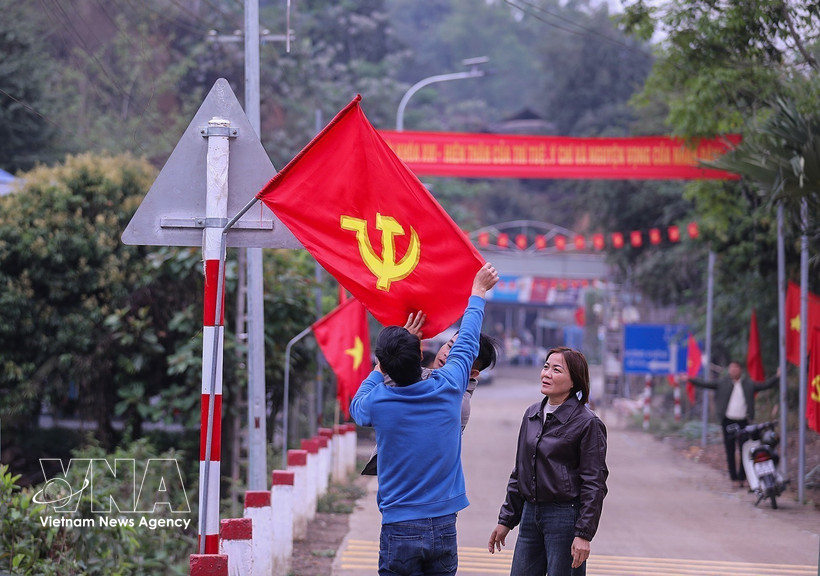
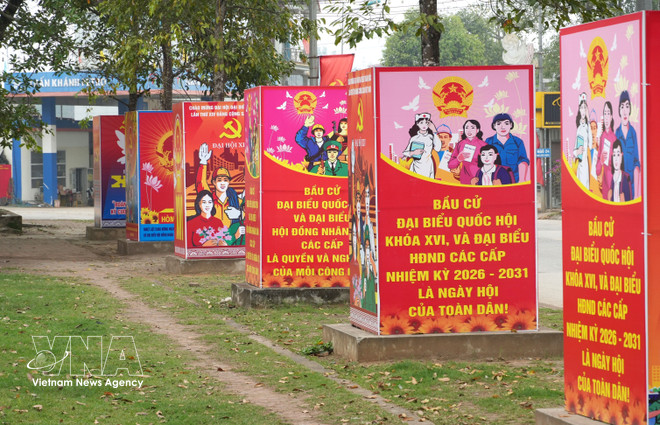
Hanoi (VNA) – As the election day for the 16th National Assembly (NA) and People’s Councils at all levels for the 2026–2031 term is approaching, the atmosphere across Vietnam is increasingly vibrant, with people nationwide turning their attention towards this major political event.
However, as seen in previous elections, the upcoming polling has also witnessed hostile forces intensifying the spread of distorted allegations on online platforms, aiming to deliberately misrepresent the nature of Vietnam’s electoral process and the role of its legislature.
Repetitive claims such as the election being “merely symbolic,” “lacking democracy,” or the legislature being “only nominal,” and assertions that “people do not truly hold the right to mastery” are entirely groundless when viewed against the country’s actual development trajectory.
In reality, the capacity and effectiveness of Vietnam’s legislative body have been clearly demonstrated through major policy decisions that have contributed to maintaining political stability, promoting economic growth and enhancing the country’s standing in the international arena.
Such assessments have also been affirmed through the objective perspectives of numerous international officials, scholars and members of the Vietnamese community abroad.
Rup Narayan Das, a former official of India’s Lok Sabha (lower house), said that the Vietnamese NA has well fulfilled its historic role and continues to increasingly enhance the effectiveness of its legislative, supervisory and decision-making functions on major national issues.
Assistant Professor Joe Pateman of York University in Canada affirmed that its legislative activities have contributed to building a stable institutional framework that supports Vietnam’s economic growth and international integration.
Meanwhile, Marcelo Rodriguez, head of the commission for foreign affairs of the Communist Party of Argentina Central Committee, said the NA has worked closely with the Government in issuing timely policies to respond to a rapidly changing international environment.
At critical junctures, the legislative body has also demonstrated a proactive and flexible role in adopting groundbreaking decisions. The NA's Resolution No. 30/2021/QH15, issued at the peak of the COVID-19 pandemic, provided the legal basis for the Government to implement flexible measures to control the outbreak and support economic recovery. According to Rup Narayan Das, thanks to such timely actions, Vietnam’s economy has not only rebounded quickly but also maintained positive growth momentum amid a volatile global economic environment.
Sharing this view, Malaysia-based senior engineer Luong The Huan emphasised that at a time when the world has been facing multiple “headwinds,” including the COVID-19 pandemic, geopolitical competition, energy crises and rising inflation, the NA has continued to establish important legal foundations for the country’s next stage of development. Its legislative decisions have not only helped remove many institutional bottlenecks but also unlocked resources and created new momentum for growth.
This view has also been echoed by many overseas Vietnamese intellectuals when assessing the performance of the legislature. In interviews with VNA correspondents, lawyer Dang Chien Thang in the US; Phan Thi Quynh Trang, founder of the Canada–Vietnam Cultural and Educational Council; and Nguyen Duy Anh, Honorary President of the Vietnamese Association in Fukuoka, Japan, all highlighted that the 15th NA has adopted numerous strategic laws that have promptly regulated emerging fields such as artificial intelligence, high technology, digital transformation, green transition and the development of the international financial centre.
Cao Thanh Dinh, a Vietnamese national living in Japan, also underscored that during its past term, the NA has clearly demonstrated a shift from a management-oriented mindset towards a service- and development-oriented approach.
Meanwhile, Dr. Julia Roknifard in Malaysia emphasised the role of the NA as an “institutional architect,” helping to create a stable environment to attract investment and sustain economic growth. This institutional stability, she noted, has enabled Vietnam to maintain one of the highest growth rates in ASEAN.
Professor Carl Thayer from the Australian Defence Force Academy at the University of New South Wales appreciated that during the 15th term, NA deputies raised a number of critical issues with government ministers during question time regarding environmental protection, land administration, and food safety. Deputies were particularly engaged during discussions on amendments to the 2013 Constitution and the Law on the Organisation of Local Administration. This stands as clear evidence of the responsibility upheld by deputies entrusted with voters’ confidence.
Highlighting the significance of the upcoming election of deputies to the 16th NA and People’s Councils at all levels for the 2026–2031 term, Joe Pateman described the event as an important political milestone for the country’s governance system.
According to him, the general election plays a key role in renewing and strengthening institutional mechanisms, enabling the State to mobilise the public's participation in the management and development of the nation.
He noted that under the leadership of the Communist Party of Vietnam, elections for the NA and People’s Councils at all levels have helped reinforce the close connection between the Party, the State and the people. They have also created conditions for governing bodies to further improve the legal system and enhance oversight of policy implementation.
This mechanism, he added, has contributed to maintaining the stability of the political system while continuing to advance socio-economic development programmes, clearly reflecting the people’s role as the masters of the country.
Regarding Vietnam’s decision to organise the election earlier than usual, Rodriguez said the move reflects the country’s proactiveness in accelerating administrative reform and strengthening state management structures. The early formation of a new administration, he said, will facilitate the effective implementation of development policies in the next phase.
According to the official, it can be seen that general elections in Vietnam are, first and foremost, a process of selecting individuals who possess integrity, vision and capability, and who are responsible and capable of representing the will and aspirations of the people in realising the country’s development goals. Any candidate with competence, credibility and a strong spirit of dedication has the opportunity to be chosen by voters.
The country’s practical development stands as the clearest evidence of the effectiveness of Vietnam’s legislative system. This reality also affirms that the upcoming election on March 15 will continue to be a festival of public trust, where the intellect and resilience of the Vietnamese nation are widely demonstrated./.