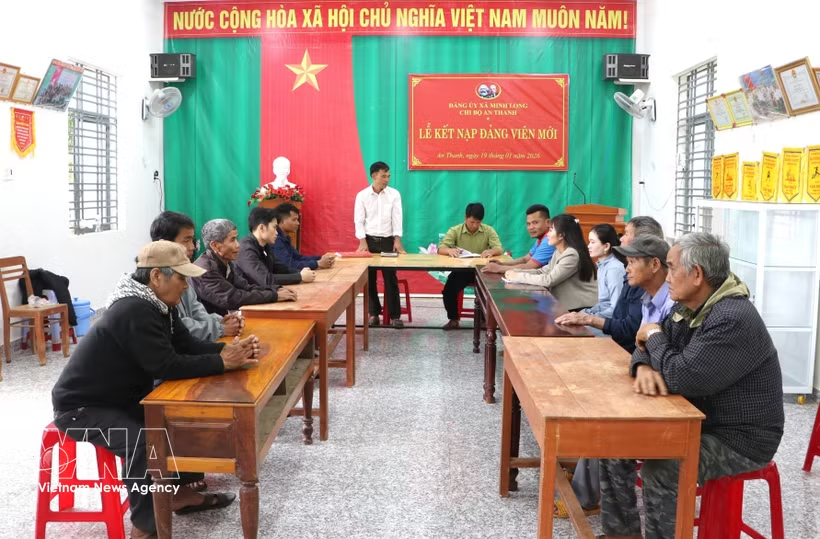
Greater efforts needed to strengthen grassroots political system

Ethnic minority officials play a central role in realising the Party’s directives and State’s laws and policies at the grassroots level, serving as a key link between local authorities and communities.

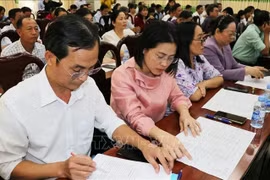
A Party cell meeting in An Thanh village of Minh Long commune, Quang Ngai province (Photo: VNA)

Hanoi (VNA) – Documents submitted to the 14th National Party Congress reaffirm the need to accelerate sustainable development in ethnic minority areas, narrow regional disparities, reinforce great national unity and build a more robust grassroots political system.

Focus on training ethnic minority officials

Ethnic minority officials play a central role in realising the Party’s directives and State’s laws and policies at the grassroots level, serving as a key link between local authorities and communities.

Many localities are scrambling to train and build a contingent of ethnic minority officials. The central province of Lam Dong, which is home to 124 communes and wards and nearly 700,000 ethnic minority residents, or 17.6% of its population, is making it a priority to build up this workforce. Party members from ethnic minority groups already make up about 12.05%, with many holding leadership positions across the political system.

Its official said the province is ramping up recruitment, planning, training and deployment of ethnic minority officials and civil servants, ensuring they are competent, full of new ideas and closely connected to local communities. It also wants to keep the special training perks in place and improve incentives to encourage long-term service in ethnic minority areas.

With over 80% of residents belonging to ethnic groups, the Lai Chau provincial Party Committee issued Resolution 06 to upgrade the quality of ethnic minority managers and key commune-level officials for the 2021–2025 period, with a vision to 2030. The resolution puts heavy focus on political education, leadership and management skills, and the ability to rally the masses at the grassroots level, particularly for young, female and ethnic minority officials. The moves have sharpened governance and made the bureaucracy run smoother in several spots.

Upholding role of trusted community figures

Tuyen Quang province, where ethnic minorities account for nearly 70% of the population, more than 3,000 respected figures from ethnic groups like Tay, Hmong, Dao, Nung, Pa Then and La Chi have played an important role in spreading government policies, encouraging economic development, supporting rural modernisation, preserving cultural traditions and maintaining social order.

Pilot models in several communes have engaged these community leaders in legal awareness campaigns and public outreach, helping to improve compliance with laws and regulations.

Lai Chau province boasts nearly 1,000 prestigious individuals in ethnic minority areas who have been backing national target programmes, cracking down on early and consanguineous marriages, encouraging changes in outdated customs and safeguarding border security. In Thu Lum commune, where ethnic minorities top 99% of the population, local authorities regularly coordinate with police and border guards to prevent illegal crossings and crimes, contributing to better public awareness and law compliance.

A local leader said upcoming efforts will zero in on training and refreshing this crew, identifying younger leaders with entrepreneurial and innovative mindsets to drive local economic development, adding that a stronger grassroots political system and broader national unity will raise living standards and reinforce public confidence in the Party and State./.

VNA
See more

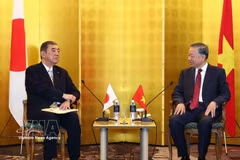
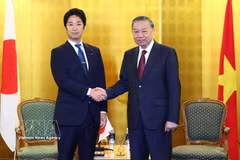
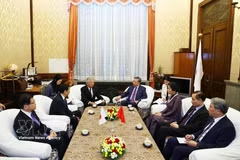
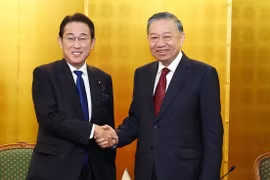
General Secretary of the Communist Party of Vietnam Central Committee and President To Lam (right) receives former Japanese Prime Minister Ishiba Shigeru in Tokyo on November 10, 2026. (Photo: VNA)

Top Vietnamese leader meets former Japanese PMs

Vietnam and Japan should focus on four cooperation priorities, including strengthening political trust through regular exchanges and meetings across Party, State and parliamentary channels; promoting economic cooperation and connectivity while ensuring economic security; expanding collaboration in innovation, space technology and high-tech agriculture; and enhancing the effectiveness of cooperation between localities of the two countries.

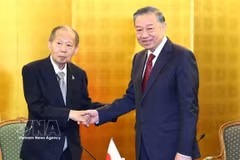
The meeting between General Secretary of the CPV Central Committee and President To Lam and Chairman of the JCP Central Committee Shii Kazuo in Tokyo on November 10 (Photo: VNA)

Top leader meets Chairman of JCP Central Committee

Vietnam wants deeper ties with Japan and continued cooperation between the two Parties and countries, General Secretary of the Communist Party of Vietnam (CPV) Central Committee and President To Lam said.

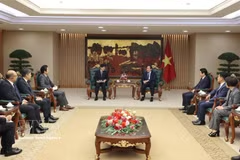
Deputy Prime Minister Le Tien Chau (R) receives Yamamoto Ichita, Governor of Japan's Gunma prefecture, in Hanoi on the morning of November 10. Photo: VNA

Governor of Japan's Gunma prefecture welcomed in Hanoi

Deputy Prime Minister Le Tien Chau called on Japan's Gunma prefecture to continue promoting cooperation with Vietnamese localities and swiftly translate agreements signed with Ninh Binh province and Hai Phong city into concrete cooperative projects, while exploring opportunities to expand ties with other Vietnamese localities.

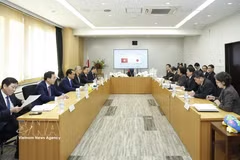
At the talks between Vietnamese Minister of Agriculture and Environment Trinh Viet Hung and Japanese Minister of the Environment Sasagawa Hiroyoshi (Photo: VNA)

Vietnam, Japan fortify cooperation in environment, agriculture, marine economy

The Vietnamese and Japanese environment ministries will run policy dialogues, expert exchanges, human resources training, feasibility studies and technology transfer, aiming to pull companies and research institutes from both countries into environmental projects, particularly in areas where Vietnam needs capital and technology.

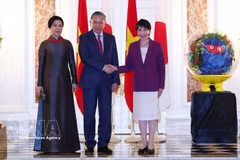
Japanese Prime Minister Takaichi Sanae hosts a welcome ceremony for General Secretary of the Communist Party of Vietnam Central Committee and President To Lam and his spouse in Tokyo on November 9. (Photo: VNA)

Vietnam, Japan issue Joint Vision Statement

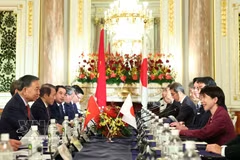
The leaders of Vietnam and Japan affirmed that bilateral cooperation in areas including defence, security, the economy, economic security, energy resources, trade, investment, science, technology, agriculture, the environment, ocean management, education and training, labour, culture, sports, tourism, law and justice, locality cooperation and people-to-people exchanges has developed substantially and has continued to strengthen and broaden.

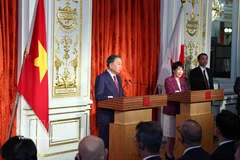
General Secretary of the Communist Party of Vietnam Central Committee and President To Lam and Japanese Prime Minister Takaichi Sanae meet the press in Tokyo on November 9 evening (local time) (Photo: VNA)

Top Vietnamese leader, Japanese PM meet the press after talks

The two sides agreed to issue the Vietnam–Japan Joint Vision Statement, lifting the Comprehensive Strategic Partnership to a new height as equal partners that accompany and co-create together on mutual benefit, for quality growth, strategic autonomy and self-reliance.

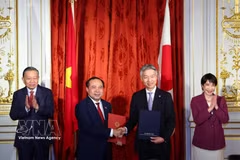
General Secretary of the Communist Party of Vietnam Central Committee and President To Lam and Japanese Prime Minister Takaichi Sanae witness the exchange of cooperation documents (Photo: VNA)

Vietnamese, Japanese leaders witness exchange of cooperation deals

General Secretary of the Communist Party of Vietnam Central Committee and President To Lam and Japanese Prime Minister Takaichi Sanae witnessed the exchange of nine cooperation documents out of 11 signed in total in Tokyo on November 9 evening (local time), as part of the top Vietnamese leader’s official Japan visit.