Domestic firms position for booming UAV industry in Vietnam

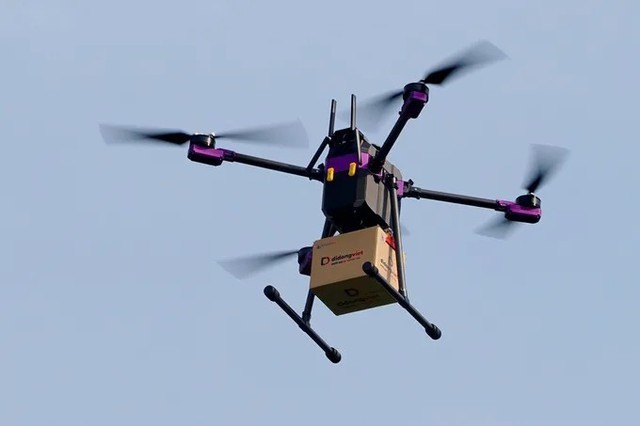
Ho Chi Minh City’s Department of Science and Technology has recently partnered with the Management Board of Saigon Hi-Tech Park (SHTP) and technology firms to pilot UAV-based delivery services within SHTP. Though currently limited to short-distance routes, the trial represents an initial step towards integrating UAVs into daily life in Vietnam’s largest economic hub.

A trial UAV-based delivery at the Saigon Hi-Tech Park. (Photo: VGP)

Hanoi (VNA) – Vietnam’s unmanned aerial vehicle (UAV) market could reach 10 billion USD and generate about 1 million jobs by 2035, according to the Vietnam Low-Altitude Economy Alliance (LAEP), highlighting strong potential for domestic technology firms to invest in research, production and services.

From pilot projects to practical applications

Ho Chi Minh City’s Department of Science and Technology has recently partnered with the Management Board of Saigon Hi-Tech Park (SHTP) and technology firms to pilot UAV-based delivery services within SHTP.

Though currently limited to short-distance routes, the trial represents an initial step towards integrating UAVs into daily life in Vietnam’s largest economic hub. Based on performance results, participating companies plan to expand flight ranges, potentially covering routes such as from Can Gio to Vung Tau, to support logistics across a growing metropolitan area.

Tran Anh Tuan, Director of Saolatek, a UAV developer based in SHTP, said the pilot programme allows companies to provide practical data and operational experience, contributing to the development of an appropriate legal framework for the civilian use of UAVs.

Similar initiatives have been rolled out in other localities. In late December 2025, Duc Giang General Hospital in Hanoi and Vietnam Post tested UAVs for transporting medical samples, pharmaceuticals and supplies within a 10-kilometre radius.

Chairman of the Board of Members of Vietnam Post Nguyen Truong Giang said the company is exploring UAVs as a new delivery service to improve speed and efficiency amid worsening urban traffic congestion. The Duc Giang Hospital expects the model to significantly shorten transport time for samples and medical supplies, enhancing operational responsiveness.
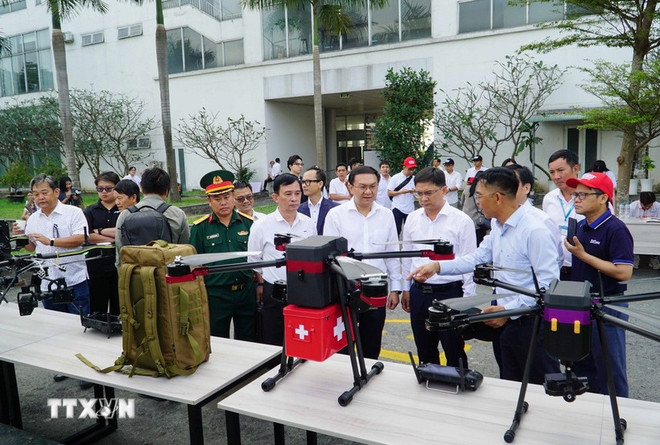
saigon.jpg
Officials of Ho Chi Minh City learn about UAVs and UAV-based delivery services. (Photo: VNA)

Earlier, during severe floods in the central and Central Highlands regions in October and November 2025, Viettel conducted nearly 300 UAV flights to deliver essential goods and support emergency relief efforts. Le Tuan Anh, Deputy Director of Viettel Post, said UAV systems originally developed for commercial logistics proved effective in disaster response, demonstrating strong adaptability and operational readiness.

Manufacturing momentum gathers pace

Growing demand is also driving investment in UAV manufacturing. In November 2025, Gremsy JSC began construction of a factory at SHTP with an initial investment of 550 billion VND (21 million USD). Founded in 2011, Gremsy develops gimbals, payloads and camera modules for UAVs, with plans to launch 50–100 new products annually.

Director Tran Quoc Vinh said Gremsy’s products have been exported to 83 countries, with North America contributing more than half of its revenue, noting that the company aims to expand its role within Vietnam’s UAV supply chain.

SHTP’s UAV ecosystem also includes Saolatek, which emerged from a high-tech startup incubator. Its products have been marketed in several international markets and are regarded as competitive in quality.

At the national level, major conglomerates are increasingly entering the sector. CT Group recently established CT UAV and built a research and manufacturing facility in Thuan An ward, Ho Chi Minh City. The company has unveiled three UAV models for surveillance, firefighting and smart agriculture, including an AI-powered firefighting hexarotor capable of hose guidance, foam spraying and deploying fire-extinguishing balls.

CT Group has also announced plans for a 400-hectare UAV industrial complex in Tay Ninh province. According to Vice Chairman of the Provincial People’s Committee Doan Trung Kien, the project is envisioned as a strategic high-tech hub linked to digital data development and a comprehensive UAV ecosystem.

Meanwhile, FPT Corp. has expressed early interest in UAV manufacturing. During a recent survey of the science, technology and innovation ecosystem in the Binh Duong area, FPT General Director Nguyen Van Khoa said the group hopes to work with local authorities on policies for the low-altitude economy and secure around 200 hectares of land for UAV production./.


VNA

See more

Prime Minister Pham Minh Chinh, Head of the National Steering Committee for the Implementation of the Politburo’s Resolution No. 79-NQ/TW on the Development of the State-owned Economic Sector, chaired the first meeting of the steering committee in Hanoi on February 1. (Photo: VNA)

PM chairs first meeting of steering committee for development of state-owned economic sector

According to the steering committee, the Politburo’s Resolution No. 79-NQ/TW on the Development of State-Owned Economic Sector was issued in the context that the whole country is striving and determined to innovate and reform in many fields, aiming to become a developing country with modern industry and upper-middle income by 2030; and a developed country with high income by 2045.

At the seminar to launch the 2 million USD initiative on green banking capacity development (Photo: VNA)

ADB, SBV launch 2 million USD green banking initiative

The initiative is a component of the technical assistance project “Inclusive and Climate Finance” funded by the Japanese Government through the Japan Fund for Prosperous and Resilient Asia and the Pacific (JFPR).

Prime Minister Pham Minh Chinh speaks at the meeting on January 31. (Photo: VNA)

PM urges flexible investment models for North–South high-speed railway

On the North–South high-speed railway, PM Chinh underscored its urgency for achieving double-digit growth, urging rapid completion of pre-feasibility and feasibility studies, parallel land clearance, and consideration of all three investment models—State, private, and PPP—ensuring balanced interests.

Deputy Prime Minister Nguyen Hoa Binh delivers a speech at the headquarters of the Switzerland Global Enterprise. (Photo: VNA)

Deputy PM concludes working visit to Switzerland

Vietnam will closely coordinate with Switzerland and other members of the European Free Trade Association to conclude a free trade agreement in 2026, meeting expectations of businesses in both countries and creating new drivers for bilateral economic cooperation.

At the fourth session of the National Steering Committee for the implementation of the Politburo’s Resolution 68-NQ/TW on private sector development (Photo: VNA)

PM sets digital, green priorities for private sector

Ministries, agencies, and local authorities must foster open mechanisms and streamlined administrative procedures, deliver synchronous and seamless infrastructure, cultivate smart workforce and governance, pool all possible resources for private firms, and share trials and tribulations faced by them.

A corner of Ho Chi Minh City (Photo: VNA)

Ho Chi Minh City – A magnet for global capability centres

Quality talent, cost advantages, and an expanding pipeline of ESG-compliant Grade A office space are turning Ho Chi Minh City into an increasingly strategic long-term destination for multinational corporations establishing or expanding Global Capability Centres (GCCs).

Leveraging the fertile alluvial soil along the Red River, Trinh Ngoc Tiep of Hiep Cuong commune, Hung Yen province, boldly develops a large-scale flower-growing model that generates high income and creates jobs for many local workers. (Photo: VNA)

Flower villages enter final sprint for Tet season

As the Lunar New Year (Tet) 2026 approaches, flower and ornamental plant villages nationwide are entering their peak season, with the market showing a mix of vibrant prospects and mounting challenges.

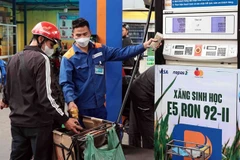
E10 bio petrol will be sold from June 1, 2026 while the production and use of E5 RON92 gasoline will continue to be maintained until December 31, 2030 (Photo: VNA)

Ministry unveils mandatory roadmap for E10 biofuel

Starting from June 1, all unleaded gasoline that meets current technical standards will be required to be blended into E10 gasoline for consumption on the domestic market, Nguyen Anh Tuan, head of the petroleum and gas business management division under the ministry's Domestic Market Management and Development Department, said at a regular press briefing for the fourth quarter of 2025 held in Hanoi on January 29.

Hanoi records more than 2 billion USD in agricultural export revenue in 2025 (Photo: VNA)

Hanoi’s agricultural exports surpass 2 billion USD in 2025

Of the total, key agricultural and food products accounted for about 1.4 billion USD, representing the largest share of the sector’s export turnover. The result reflects the effectiveness of Hanoi’s efforts to expand overseas markets, improve quality standards, strengthen traceability systems and promote international-standard production models to meet increasingly stringent import requirements.

Nhon-Hanoi Station metro line. A series of planned investments in national and urban railway infrastructure over the next 15 years is expected to generate enormous demand for railway industrial products. (Photo: VNA)

Ample room remains open for railway industry enterprises

A highlight of the scheme is the ambition to develop a modern, integrated railway industry capable of independently designing, manufacturing, and maintaining metro lines and inter-regional railways with design speeds below 200 km/h, while gradually mastering high-speed railway technologies with design speeds of 200 km/h or higher. The roadmap is structured in three phases.

At the Ministry of Industry and Trade's press conference held in Hanoi on January 29 (Photo: hanoimoi.vn)

Spring Fair 2026 to feature around 3,000 standard booths

The first Glorious Spring Fair 2026 will serve as a direct link between manufacturers, distributors, and consumers, helping to cut down unnecessary middle steps. As a result, businesses are expected to cut operating and consignment costs by around 15-20%, enabling both enterprises and consumers to benefit from more competitive prices at the event.