Vinh Long (VNA) – Vinh Long province in the Mekong Delta is making great strides in smart, low-emission farming, setting the stage for reshaping its agricultural sector toward a greener, more modern, and sustainable future. This shift aligns with the Party Central Committee’s Resolution No. 57-NQ/TW, which focuses on boosting science, technology, and digital transformation for socio-economic growth.
Foundation for agricultural restructuring
In recent years, Vinh Long has identified science, technology and digital transformation as key drivers of agricultural modernisation, helping raise added value and competitiveness. Advances in crop and livestock varieties, biotechnology, mechanisation, automation, smart management and traceability have been applied, contributing to lower production costs, more efficient resource use and improved climate resilience.
The province currently has more than 81,400 hectares under organic and high-tech agricultural production, accounting for about 10.5% of total agricultural land. Quality management, food safety and traceability have been strengthened, creating favourable conditions for local agricultural products to access demanding export markets.
In crop production, nearly 900 planting area codes covering more than 33,320 hectares have been issued, including 696 export-qualified codes for markets such as China, the US, the EU, the Republic of Korea and New Zealand. Key products include durian, rambutan, longan, pomelo, coconut and sweet potato. Meanwhile, 67 export-standard packing facilities have been licensed, enhancing transparency and market competitiveness.
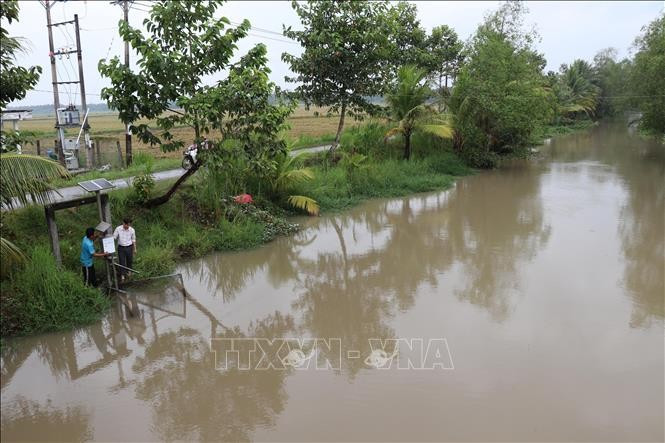
Digital transformation has been implemented across livestock, aquaculture, forestry and natural resource and environmental management. Many production areas have applied sensors, automated monitoring systems and specialised management software. In aquaculture and crop farming, automatic water environment monitoring systems have helped reduce disease risks and improve efficiency.
Notably, 100% of OCOP (One Commune-One Product) entities in the province have brought their products onto e-commerce platforms, expanding consumption channels and promoting the digital agricultural economy.
Alongside technological application, Vinh Long promotes green agriculture as a key pillar of long-term development. Farmers receive guidance to reduce chemical fertilisers and pesticides, increase the use of organic inputs and biological products, and expand water-saving irrigation, renewable energy use and low-carbon farming models.
The circular agricultural economy is being developed through close linkages among crop cultivation, livestock and aquaculture, maximising the use of by-products such as straw, rice husks and coconut fibre to produce organic fertilisers, bioenergy or inputs for processing industries. This approach helps reduce costs, minimise environmental pollution and increase value along the production chain.
For its two key products, rice and coconut, Vinh Long has set clear development targets. In rice production, by 2026, more than 9,200 households in 38 communes and wards will participate in the project on sustainable development of one million hectares of high-quality, low-emission rice in the Mekong Delta, covering 8,302 hectares. From 2027, the province aims to add more than 10,000 hectares annually, reaching at least 50,000 hectares by 2030.
For coconut, the province targets around 132,000 hectares by 2030, with an output of 1.72 million tonnes per year. Organic coconut is expected to account for about 50% of the area, linked with purchasing and processing enterprises, mainly in freshwater and newly converted areas.
According to Le Van Dong, Deputy Director of the provincial Department of Agriculture and Environment, Vinh Long is also studying the potential of carbon credits from coconut cultivation. Research by Can Tho University shows that coconut trees over 10 years old can absorb 70–75 tonnes of carbon per hectare annually, providing a basis for piloting carbon economy models and enhancing the value of the coconut industry.
Developing green, circular agriculture
Vice Chairman of the People’s Committee of Vinh Long Chau Van Hoa stressed that developing green and circular agriculture linked with science, technology and digital transformation is an inevitable requirement amid climate change and deeper international integration. This is a key pillar for the province to achieve green growth and sustainable development in line with Party resolutions.
Vinh Long will continue to refine mechanisms and policies to encourage enterprises, cooperatives, and farmers to adopt advanced technologies and environmentally friendly production models, while implementing the digital transformation scheme for the agriculture and environment sector through 2030, with a vision to 2050. By 2030, 15–20% of agricultural land is expected to apply high and digital technologies, forming smart production zones with full-chain traceability.
The province will focus on developing large-scale, high-quality commodity production areas for key products such as rice and coconut, promote deep processing, build brands and reorganise production along closed value chains. This will help shift from traditional agricultural production to a diversified agricultural economy that integrates production, processing, trade, services, and rural tourism.
Over the past five years, Vinh Long has implemented more than 50 science and technology projects, trained and provided technical consultancy for tens of thousands of farmers, and developed over 200 models of smart, high-tech, organic and GAP-standard farming. Sharing economy models have gradually taken shape through shared machinery, infrastructure, data and consumption platforms, helping reduce costs and strengthen linkages.
Resolution 57-NQ/TW has opened up new space and momentum for Vinh Long’s agriculture to transform towards modernity, sustainability and climate resilience. Turning the resolution into concrete, effective models will serve as a lever for the province to build and develop a green agricultural economy, a circular economy and deeper integration into the global economy./.
VNA