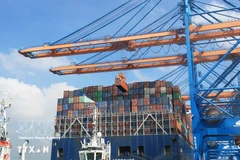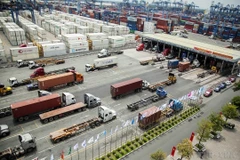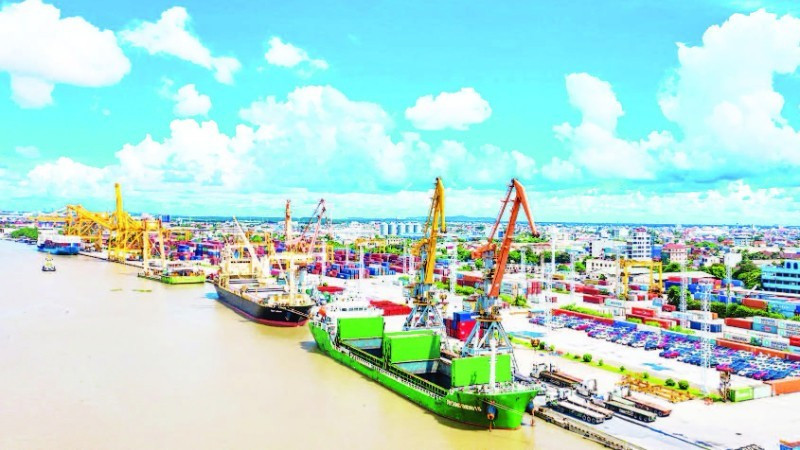
Hanoi (VNA) – Vietnam is ramping up efforts to make its seaport system more eco-friendly, as part of a wider maritime development plan and its pledge to reach net-zero emissions.
In recent years, while expanding infrastructure and boosting operational efficiency, the country has steadily rolled out a national green port initiative to align with international standards and encourage sustainable growth in the maritime industry.
Dang Van Hoa, Deputy General Director of Quy Nhon Port, says large ships can produce tens of tonnes of emissions every hour their engines run, putting serious pressure on ports aiming to meet green goals.
To implement the green port initiative, Quy Nhon Port has focused on three strategic directions: sustainable green growth, improving equipment efficiency to reduce emissions, and applying advanced technologies toward digital and smart port operations. The port has installed LED lighting across internal routes, introduced solar-powered batteries for forklifts, provided shore-side electricity for ships and equipment, replaced some diesel-powered cranes with electric ones, and applied AI and IoT systems to optimise operations and monitor environmental conditions.
In Hai Phong, the Hai Phong Port Joint Stock Company announced its green port plan in August 2024. During the 2024–2030 period, the port has focused on policy development, cleaner energy transition for vehicles and equipment, green transport infrastructure, and stronger international cooperation and technology application. From 2030, green port criteria will become mandatory for planning, investment and operations across its terminals.
Statistics from three major terminals in Hai Phong – Chua Ve, Tan Vu and Hoang Dieu – show that around 2,000 ocean-going vessels call each year, generating nearly 5,500 tonnes of carbon dioxide, while tugboats emit more than 600 tonnes. Nearly 300 pieces of equipment operating around the clock produce over 7,000 tonnes of emissions and pollutants annually, highlighting the urgency of greener operations to meet international standards and enhance competitiveness.
The Vietnam Maritime Corporation (VIMC), which manages 89 berths with a total length of 16.5 km and an annual handling capacity of about 80 million tonnes of bulk cargo and 6.5 million TEUs, has issued a roadmap for energy transition under the green port programme.
In 2025, VIMC signed an agreement with France’s HDF Energy to implement a hydrogen power project. Since 2024, the corporation has installed shore power systems at several ports, upgraded technical infrastructure, replaced fossil-fuel equipment, applied digital technologies in cargo operations, and developed green logistics chains. It aims for its ports to meet national green standards by 2045.
Mobilising resources and improving policy
Vietnam’s seaport system handles more than 100,000 international vessel calls and around 800 million tonnes of cargo each year. The national green port development scheme, approved in 2020, aims to pilot suitable models and make green port criteria mandatory nationwide from 2030.
The Vietnam Maritime and Waterway Administration has issued a technical framework for green port assessment (TCCS 02:2022), which is expected to be upgraded into a national standard by 2026 to strengthen its legal basis.
Authorities plan to implement the transition through voluntary participation and pilot programmes, recognising that building green ports and green vessels is a long-term process that must balance environmental goals with business capacity and economic development.
However, industry representatives noted that high investment costs remain the biggest challenge, along with the need for financial incentives, preferential policies, a national emissions database, and a more complete legal framework to support the sector’s green transition./.