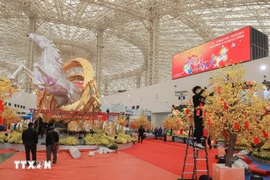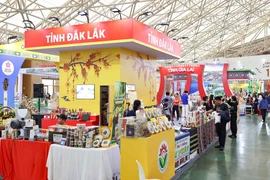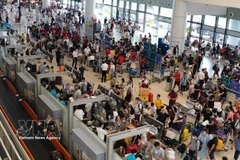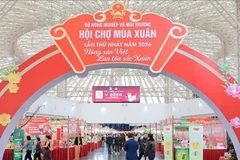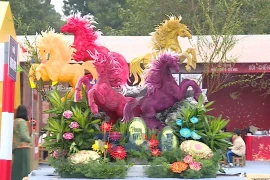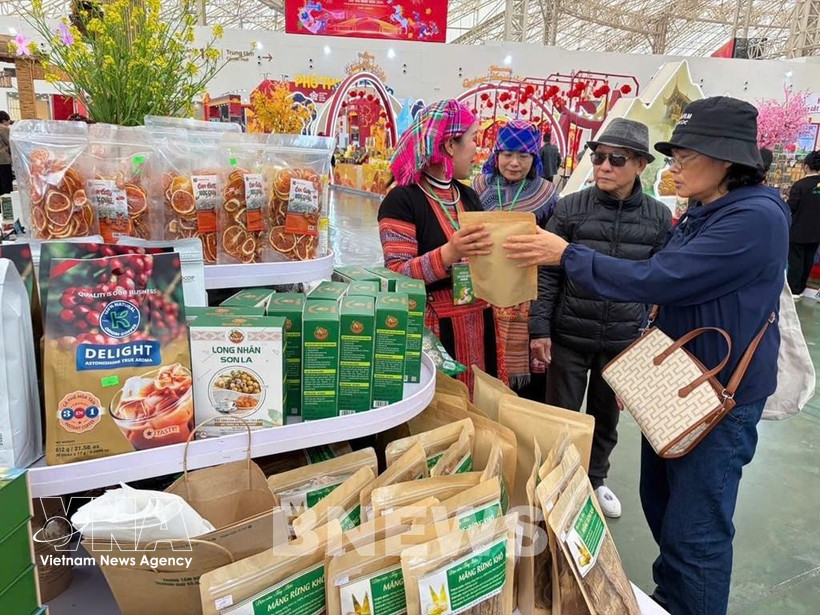
Hanoi (VNA) – Many observers believe the ongoing first Glorious Spring Fair is no longer simply a venue for early-year retail activity, but is increasingly becoming a platform for businesses to test products, expand distribution networks, build brand identity, and seek long-term partners.
One noticeable feature of this year’s fair is the shift in how companies approach the market. Whereas fairs were once associated mainly with promotions, clearance sales, and discounted goods, exhibitors are now investing more systematically in display design, product packaging, and brand communication.
Many businesses are doing more than presenting product functions; they are also telling the story of their raw-material regions, production processes, and social and environmental responsibility. This reflects a clear transition: companies are no longer competing solely on price, but increasingly on perceived value and consumer trust.
Ha Viet Nga, representing Lang Muop Co., Ltd. from the Mekong Delta province of Dong Thap, said trade fairs remain an especially important trade-promotion channel as businesses seek to expand their domestic market presence. The company’s products made from loofah fibre have been exported to Japan for nearly a decade, while the domestic market has only been developed over the past two years.
Direct interaction with consumers, she said, enables the firm to better understand market preferences, allowing adjustments to product design, packaging, pricing, and communication strategies for different customer groups. Such engagement is difficult to replicate fully through online sales channels, as first-hand experience remains crucial in building consumer confidence.
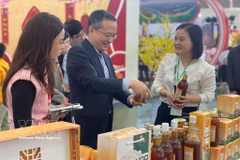
At the booth of the limited company BGHOME Vietnam, its representative Nong Thi Liep noted that although the company already exports to the US and primarily sells through e-commerce platforms, it still chose to participate in the fair to connect directly with domestic consumers and distribution partners.
“We have found that many agents and wholesalers come to the fair not only to make retail purchases but to survey the market and identify long-term suppliers,” she said. “Large orders are not always placed immediately, but after customers experience the products in person, they often return with bulk orders. For us, the first Spring Fair 2026 is a starting point for building sustainable business relationships.”
Agricultural cooperatives, too, see the fair as a gateway to broader markets.
Nguyen Huu Hoang, a member of the Dong Thuan agricultural services cooperative in the central province of Khanh Hoa, said today’s consumers are not only buying products but also the social and environmental values behind them.
When customers understand that each cashew nut produced by the cooperative is the result of sustainable cultivation linked to the livelihoods of upland communities, many are willing to pay a higher price to support the model. The Spring Fair therefore serves not only as a sales channel but also as a space for market education, where producers and consumers meet on the basis of trust and responsibility, he added.
From a local-government perspective, the first expo is also emerging as an important trade-promotion instrument in regional economic-development strategies.
A representative of Phu Tho province’s Department of Industry and Trade said bringing OCOP (One Commune One Product) items – including Doan Hung pomelo, rice noodles, fermented pork, and salt-baked chicken – to the fair helps businesses and cooperatives reach consumers directly while connecting with major distribution systems.
At the national level, Director General Vu Ba Phu of the Vietnam Trade Promotion Agency under the Ministry of Industry and Trade, said the greatest value of the fair lies not only in on-site sales, but in its ability to connect businesses with consumers, products with brand stories, and commerce with culture.
The event has helped to promote “Made in Vietnam” products, foster pride in Vietnamese goods, and encourage the campaign “Vietnamese people prioritise using Vietnamese products”, which carries long-term significance for domestic production, he said.
Moreover, as digital transformation, green transition, and sustainable consumption become inevitable trends, trade fairs should be viewed as an integral part of the modern commercial ecosystem./.
VNA