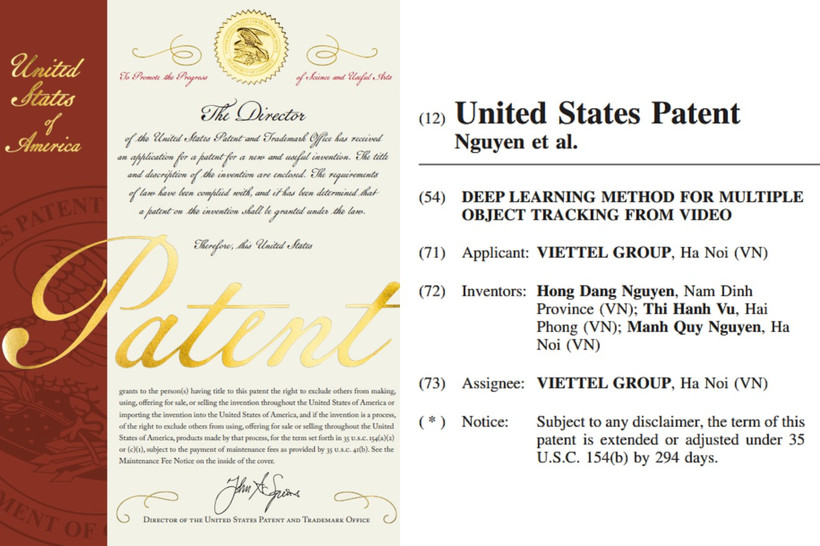
Hanoi (VNA) - The Viettel Artificial Intelligence and Data Services Centre (Viettel AI) under the Military Industry and Telecoms Group (Viettel) announced on February 26 that it has, for the first time, been granted a utility patent by the United States Patent and Trademark Office (USPTO).
The invention "Deep-learning method for multi-object tracking from video" is based on practical application and is owned and developed by Vietnamese engineers.
According to Viettel AI Director Nguyen Manh Quy, the patent was granted without any objections during the examination process, demonstrating the solution’s clear novelty, robust technical description, and low risk of dispute under US patent standards. The US has some of the most stringent patent standards for technology markets in the world.
Multi-object tracking is considered one of the most challenging tasks in video analytics and surveillance systems. Beyond detecting the presence of people or objects in a frame, the technology must accurately maintain the identity of each object throughout its movement, even when objects are temporarily occluded, leave and re-enter the frame, or when many individuals with similar appearances appear simultaneously.
In practice, many systems suffer from identity mismatches, especially under changing lighting conditions, in crowded settings, during rapid movement, or with complex camera angles. This mainly stems from traditional approaches that process tracking in separate stages, allowing errors at individual steps to propagate, reduce overall accuracy, and prolong processing time.
To address these challenges, Viettel AI adopted a different approach. Its research team developed a novel end-to-end AI model for multi-object tracking, enabling the system to learn and process the entire tracking workflow within a unified architecture rather than through fragmented steps. This approach helps improve stability, reduces identity errors, optimises processing time, and enhances performance in complex real-world conditions.
The USPTO patent reflects Viettel AI’s capability to master core technologies, from solving practical problems to large-scale deployment. Quy said that this provides a crucial foundation for Viettel to develop sovereign AI technologies researched and owned by Vietnam, meeting domestic demands and international standards.
Viettel AI has deployed this core technology in camera-based surveillance solutions at many locations, including offices of the People’s Committee at all levels, tourist sites, shopping centres, school gates, hospitals, jewellery shops, and other public spaces. The system supports automatic detection of incidents such as unauthorised access to restricted areas, wall climbing or fence crossing, illegal dumping, and unattended objects in public places.
Based on deployment evaluations, the solution is capable of detecting traffic safety violations and recognising crowds with accuracy rates of over 95%, while maintaining stable performance under round-the-clock surveillance.
The technology has also been applied in smart urban management systems in cities nationwide.
Being granted patent protection in the US not only recognises a specific research achievement but also affirms Viettel AI’s growing capability in mastering foundational AI technologies, helping “Made in Vietnam” AI products expand their applications and make inroads into international markets.
USPTO is the long-established US authority for patent examination and protection, known for its rigorous patent review procedures. Patent approval requires novelty, inventive merit, and practical applicability, with the examination process typically taking two to three years or longer, depending on complexity./.
See more
Hanoi’s innovation centre to drive digital transformation, creative industries
HIC is envisioned as a central “brain” connecting data, resources, policies, technology and culture to address urban development challenges, operate the national innovation ecosystem, promote a sustainable digital economy and digital society, improve the quality of life for local residents, and foster creative industries, particularly cultural industries linked to Hanoi’s identity.
Vietnam’s Internet speeds surge at start of 2026
While average 5G download speeds reached 594.81 Mbps in January, up 52% from 391.05 Mbps in December 2025, upload speeds rose 29.5% to 123.71 Mbps from 95.47 Mbps.
Hanoi creates favourable environment for high-tech projects
Hanoi identifies science and technology, innovation, and digital transformation as key growth drivers in the new development phase.
International conference spotlights advanced microscopy in life sciences, materials
The microscopy user community in Vietnam remains fragmented, lacking a common platform for sharing technical expertise, research experience and collaboration opportunities. This limited connectivity has, to some extent, curtailed the full potential of microscopy technologies in advancing scientific progress and industrial applications at home and abroad.
Viettel Telecom nominated for Global Mobile Awards
Since 2024, Viettel has migrated nearly 10 million 2G users, provided more than 800,000 free 4G devices to low-income subscribers, and expanded 4G/5G coverage to 98% of the population.
Blockchain becomes strategic pillar of national digital infrastructure
As Vietnam’s blockchain infrastructure layers such as NDADID and NDATrace become interoperable with international blockchain infrastructures, the country is positioned to build a production and trade ecosystem based on trust at the global level.
Vietnam makes scientific strides in decoding ancient human genomes
One of the most important outcomes was the successful sequencing of complete mitochondrial genomes from two ancient human bone samples over 2,000 years old excavated at the Dong Xa archaeological site, now in Luong Bang commune of Hung Yen province.
Science – technology: Driving force opening new avenues for growth
Science and technology create new knowledge and tools; innovation translates that knowledge into products and services; and digital transformation accelerates diffusion across society, unlocking growth and added value.
Digital transformation – a lever for building a smart tourism ecosystem
In recent years, digital transformation has become a common feature in socio-economic development strategies. For tourism – a multi-sector, experience-driven industry closely tied to information – digitalisation is no longer a trend but an inevitable requirement to enhance competitiveness and ensure sustainable development.
Harnessing digital transformation, green transition to bolster national strength
Despite slowing global growth and localised downturns in many economies, Vietnam has sustained robust growth, maintained macroeconomic stability, safeguarded key economic balances, recorded rapid gains in per capita income, and further strengthened its international standing.
VAST – core force in national science system: Prime Minister
The Party, the State, and the Government identify science, technology, and innovation as both a fundamental pillar and a central engine of growth, as well as a direct productive force driving rapid and sustainable development, Prime Minister Pham Minh Chinh said, stressing that VAST stands as a crucial “fortress” of knowledge that concentrates the intellectual resources and limitless creativity of the Vietnamese people.
Vietnam's Internet evolution: From connectivity to trusted digital backbone
Since 2020, Vietnam has achieved a 97% protection rate for its Internet address space. Additionally, 14,000 domain names have been secured to ensure digital identity safety.
Resolution No.57: driving shift to knowledge- and technology-based growth
With the official launch of the Hanoi Technology Exchange (HanoTEX) and the Digital Transformation Market (DTMarket) - combined with the development of hard infrastructure - Hanoi aims to become a place where technology is translated into practical value, directly contributing to the city’s GRDP growth target of at least 11% in 2026.
Central bank moves to tighten AI use in banking
Under the draft, banks and intermediary payment service providers must inform customers before deploying AI-powered tools such as virtual assistants, automated hotlines and chatbots in customer communications.
Central bank moves to tighten AI use in banking, requires prior customer notification
The State Bank of Vietnam (SBV) has moved to tighten oversight of artificial intelligence (AI) in the banking sector, requiring lenders and e-wallet providers to notify customers in advance when AI systems are used to interact directly with them.
Smooth, secure telecommunications ensured during Tet holiday
Service providers proactively enhanced system capacity, maintained round-the-clock technical duty and stood ready to respond at peak traffic times.
Vietnam officially becomes IEA association country
Becoming an association country is particularly important as Vietnam enters a new stage of development, remaining steadfast in its goal of carbon neutrality and green energy transition.
Finastra research: Vietnam’s financial sector accelerates AI adoption
The Finastra Financial Services State of the Nation 2026 report shows that 94% of financial institutions in Vietnam plan to increase investment in AI over the next 12 months, underscoring strong momentum to expand AI capabilities despite structural constraints.
Spring Fair 2026: Strong potential for Vietnam-Australia cooperation in high technology
Priority areas for cooperation between Vietnam and Australia include agricultural technology; computer vision; and smart cities and cybersecurity.
Satellite internet provider Starlink officially licenced to operate in Vietnam
Satellite internet services such as Starlink are expected to complement existing fixed and mobile networks, particularly in remote, border and island areas, as well as during natural disasters when terrestrial infrastructure may be disrupted.