Deputy PM urges Korea Telecom–Viettel partnership in AI, data centres

Welcoming the proposed partnership between KT and Vietnam's tech giant Viettel, Deputy Prime Minister Nguyen Chi Dung suggested KT consider joining Viettel in developing low-Earth orbit satellites and generative AI for socio-economic applications, where Vietnam is building capabilities.

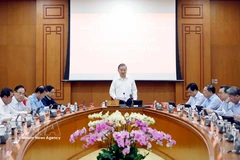
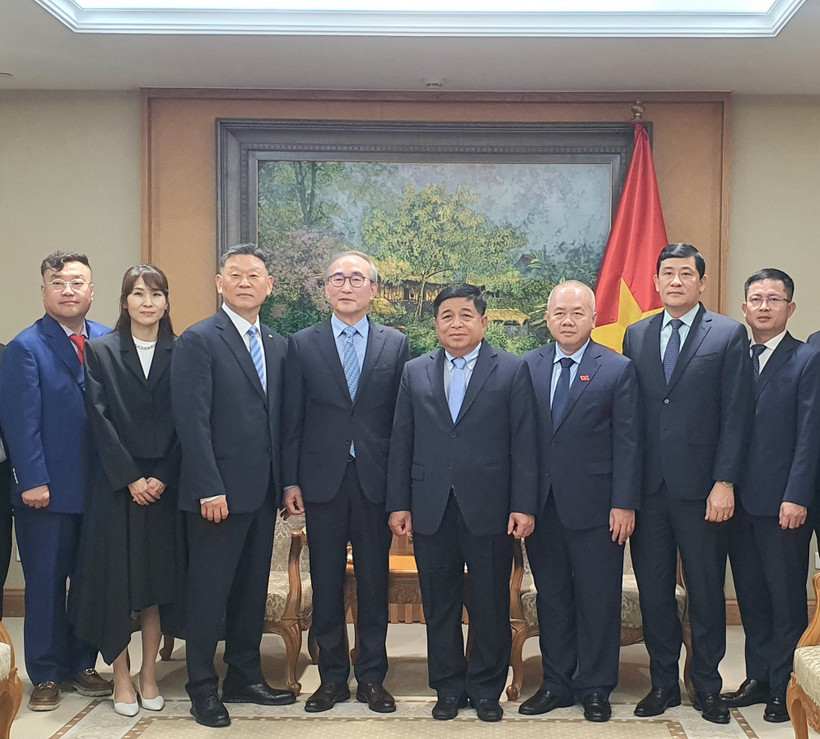
Deputy Prime Minister Nguyen Chi Dung (fifth from left) receives a delegation from Korea Telecom on May 26. (Photo: VNA)

Hanoi (VNA) - Deputy Prime Minister Nguyen Chi Dung has reaffirmed that the Vietnamese Government encourages businesses from the Republic of Korea (RoK), including Korea Telecom (KT), a major mobile carrier, to invest in large-scale projects in Vietnam, particularly in high-tech and emerging technology sectors where the RoK has strengths and Vietnam has demand.

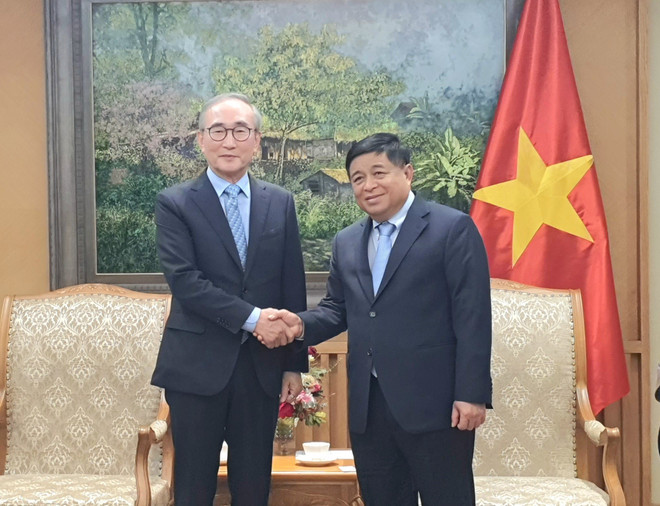
During a meeting with KT CEO Young Shub Kim on May 26 in Hanoi, Dung emphasised the importance of cooperation, shared development, and joint efforts in building value and supply chains in the region and globally.

The Deputy PM noted that the RoK has long been one of Vietnam’s top investors, significantly contributing to the country’s socio-economic development. Nearly all major Korean conglomerates have established a presence in Vietnam. The Deputy PM expressed hope that KT, as another major player, will soon follow suit.

He encouraged KT to become a strategic partner with Vietnam rather than just a strategic investor. Instead of concentrating solely on profit, KT should align itself with Vietnam's development goals and collaborate closely with the country to create mutually beneficial outcomes. Dung suggested that by adopting this approach, KT could achieve greater success, even as a later market entrant.
vna-potal-pho-thu-tuong-nguyen-chi-dung-tiep-chu-tich-tap-doan-korea-telecom-8055267.jpg
Deputy Prime Minister Nguyen Chi Dung (right) and KT CEO Young Shub Kim at the meeting (Photo: VNA)

Welcoming the proposed partnership between KT and Vietnam's tech giant Viettel, the Deputy PM suggested KT consider joining Viettel in developing low-Earth orbit satellites and generative AI for socio-economic applications, where Vietnam is building capabilities.

Dung also shared Vietnam’s ambition to become a global leader in AI and robotics, encouraging KT to explore collaborative models with Viettel that combine their strengths to pursue large-scale, strategic initiatives aligned with both sides’ visions.

Specifically, he proposed that KT and Viettel jointly establish a training and research centre, as well as an AI data centre. These institutions will provide large-scale, systematic training for personnel in Vietnam and the RoK. He also recommended that KT partner with the National Innovation Centre (NIC) to help develop high-quality human resources in AI.

For his part, Young Shub Kim said that since its founding, KT has focused on services and telecommunications rather than manufacturing. It currently holds the second-largest market share among the RoK’s telecom providers and is the nation’s top contributor to the telecom sector. However, the group has yet to make significant investments in Vietnam.

As the global telecom market nears saturation, the CEO explained that KT is evolving into a specialised operator focused on AI and ICT. Like Vietnam and many other countries, the RoK strives to keep up with AI advancements driven by the US and China. KT is seeking ways to implement the world's most advanced AI technologies in Korean industries. This motivation has prompted KT to explore long-term collaboration with Viettel in research and new business ventures within the Vietnamese market, aiming to establish a mutually beneficial relationship.

He expressed hope that the KT–Viettel partnership would develop in a spirit of mutual support, with KT sharing its experience while also learning from Viettel’s local market knowledge to produce visible, practical results./.

VNA

See more

A corner of the exhibition at the Vetnam Space Museum in Hoa Lac Hi-tech Park in Hanoi (Photo: VNA)

Major prospects for Vietnam’s space technology

Vietnam could adopt a mission-based service procurement model, prioritising projects with clear social and economic benefits, while investing strategically in domestic capabilities, standardising data, elevating remote sensing data to national data status, and gradually localising space products.

Prime Minister Pham Minh Chinh chairs the fifth meeting of the Government’s Steering Committee for science, technology, innovation, digital transformation and Project 06 in Hanoi on November 15, 2025. Photo: VNA

PM pushes for reforms in sci-tech, innovation, digital transformation

Prime Minister Pham Minh Chinh asked participants to propose priority tasks and breakthrough measures ahead, including removing obstacles, accelerating capital disbursement, simplifying procedures, promoting data reuse to cut paperwork, and offering maximum support to citizens and enterprises.

Illustrative image (Photo: VNA)

Da Nang remains Vietnam’s fastest 5G city

The city has held the top spot since the start of this year. Its 5G performance is almost 1.5 times higher than runner-up Hai Phong (429.53 Mbps) and even the capital Hanoi (415.73 Mbps).

Participants in the Vietnam–India Innovation Gateway Bootcamp (Photo: VNA)

Vietnam, India boost innovation cooperation

Bui Trung Thuong, Trade Counsellor at the Vietnamese Embassy in India, highlighted the shift in Vietnam–India relations from traditional cooperation to partnerships based on innovation, technology, and digital transformation.

Illustrative photo (Photo: VNA)

Vietnam emerges as new hotspot for AI data centre investment

A wave of investment in artificial intelligence (AI) data centres is sweeping across Vietnam, with both domestic and international corporations announcing multi-billion-USD projects that are set to transform the country into a rising hub in the regional AI infrastructure map.

An overview of the international seminar, themed “Building resilience against online frauds and scams in Southeast Asia: Spotlight on Vietnam". (Photo: VNA)

Experts propose anti-scam solutions suited to Vietnam’s conditions

Vietnam’s digital transformation has achieved remarkable progress. However, similar to other countries in the region, online scams and fraud cases are on the rise. Last year, authorities recorded 10,000 online fraud cases, with estimated losses of nearly 759 million USD.

Minister of Science and Technology Nguyen Manh Hung speaks at the Vietnam Open Technology Forum 2025 in Hanoi on November 3. (Photo: VNA)

Vietnam looks to develop, master digital technology through open standards

Vietnam has chosen to pursue this direction — developing open technologies, open-source software, and open data — to enable individuals and enterprises to co-create new values. With this approach, it will become a technology-driven nation that both benefits from and contributes to global knowledge.

The seminar held in London on October 28 between Party General Secretary To Lam and leading strategists on AI and technology in the UK and the world. (Photo: VNA)

Vietnamese Party chief attends seminar on AI, technology in London

With its aspiration to become a pioneer in digital economy, Vietnam seeks to learn from the UK - the cradle of the Industrial Revolution and the homeland of great minds such as Isaac Newton, John Locke, Adam Smith, Alan Turing, William Shakespeare, and Charles Dickens - to build an innovative, human-centred, and sustainable technological ecosystem.