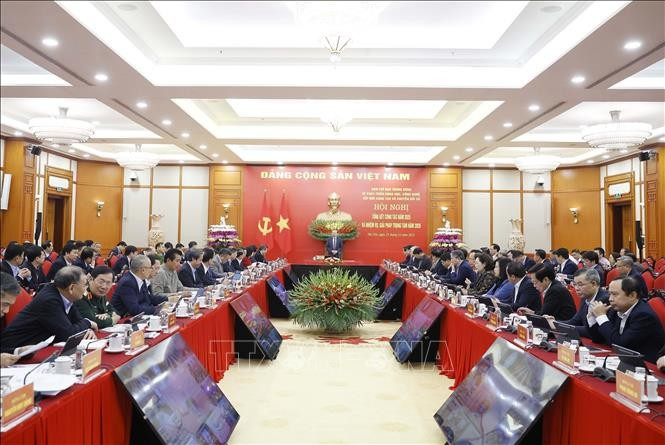
Hanoi (VNA) – The standing agency of the Central Steering Committee for Science and Technology Development, Innovation and Digital Transformation has released the conclusion of Party General Secretary To Lam at a conference reviewing the committee’s 2025 performance and outlining key tasks and solutions for 2026.
Accordingly, the Steering Committee concurred with the assessment of the one-year implementation of Resolution 57 in the standing agency’s report and praised determined efforts of its members, ministries, sectors, localities and the business community.
After one year, both awareness and action across the political system have improved, underscoring the Resolution’s timeliness and effectiveness in removing bottlenecks and driving development.
Institutional and policy bottlenecks have largely been removed through the issuance of a wide range of laws, decrees and circulars, establishing a solid legal framework.
Financial resources have been prioritised and allocated, accounting for 3% of total state budget expenditure.
Digital transformation across the entire political system has seen positive progress, particularly through the implementation of Plan No. 02-KH/BCDTW, Regulation No. 05-QD/BCDTW, the Steering Committee’s conclusions, and digital transformation programmes and projects across the four institutional blocs.
Science, technology and innovation have followed a structured approach and a clear development path aligned with global trends, prioritising the triple-helix cooperation model, high-tech parks, smart cities, innovation centres and strategic technologies. Initial results in the implementation of Resolution No. 57 has helped raise the contribution of science, technology, innovation and digital transformation to the national GDP to over 16.4%.
Regarding tasks for 2026, the conclusion said early in the term, the Party Central Committee will issue strategic resolutions on transforming the national development model based on science and technology and strategic solutions, and on mobilising resources for double-digit growth. This highlights the essential role of science, technology, innovation and digital transformation, now a compulsory foundation for rapid and sustainable development.
The Steering Committee endorsed the standing agency’s proposed key tasks and solutions for implementing Resolution 57 in 2026. Party committees and organisations, and agencies are required to fully understand and strictly implement these measures, guided by key orientations and principles.
The unified 2026 motto is "breakthrough action, widespread impact". Ministries, agencies, organisations, and localities must proactively propose their own tasks rather than wait for instructions from the Steering Committee. They should clearly define their responsibilities and organise assignments accordingly.
The conclusion stressed the need to strengthen the role of Party committees and heads, especially the heads of ministries, agencies, localities, and units. They must clearly recognise their personal responsibility for progress and outcomes, and results should be incorporated into performance evaluations, awards, and accountability measures for delays.
The Party chief demanded clearly identifying and prioritising core tasks and allocating resources for their implementation, especially for concretising the national digital architecture framework and the national data architecture framework; completing infrastructure; building platforms and databases; developing strategic technologies; and training high-tech personnel. Each task should have a clear timeline and proportional resources.
The conclusion also emphasised the urgency of developing applications and concrete products that serve socio-economic development and benefit the people and business, noting that users’ satisfaction is the key measure of performance, and efforts should be substantive and effective.
Digital transformation should be closely linked with administrative reform and streamlining the administrative apparatus, ensuring the effective operation of the two-tier local administration model, reducing administrative procedures, and expanding online public services.
Innovation in the public sector should be promoted through decentralisation, process standardisation, full digitalisation, enabling ministries, agencies, and localities to efficiently utilise data and operate shared digital platforms.
The Party leader requested concentrating resources on strategic technologies and product commercialisation; promoting science, technology, and innovation through strong state-education establishment-enterprise linkages as the core of an innovation ecosystem.
Priority must be given to developing high-tech parks, innovation centres, and smart cities as testing, application, and demonstration hubs; strongly pouring investment into and deploying strategic technologies to create long-term competitiveness; and mobilising social resources to make science, technology, innovation, and digital transformation a key driver of double-digit growth.
The State must play the role as a facilitator, removing barriers while acting as an initial “customer” for science, technology, innovation, and digital transformation products and solutions, creating an initial market for research, inventions, and new technologies.
Meanwhile, large enterprises must think big, do big, take the lead, and pave the way, creating opportunities and space for other businesses to join the value chain. Small- and medium-sized enterprises should focus on tasks suited to their capacities, thereby enhancing their position and contributing to the nation’s development.
The conclusion emphasised that information security, cybersecurity, and digital sovereignty are prerequisites for sustainable development. Agencies, units, and localities are required to thoroughly implement the Secretariat’s Directive and the Steering Committee’s master plan to ensure cybersecurity, information protection, and data security across the political system.
It also stressed the need for a firm stance against wastefulness, noting that risks of wastefulness must be identified and prevented from the investment planning stage.
The Party chief ordered developing performance indicators and ranking mechanisms, with periodic public disclosure of agencies’ and localities’ Resolution 57 implementation, ensuring data is objective, transparent, and verifiable. All progress and results must be measured and monitored in real time via a monitoring and evaluation system, with selected information made public for oversight by society, citizens, and businesses./.
VNA