France-based expert suggests elevating parliamentary diplomacy to support national development

Inter-parliamentary cooperation should be closely aligned with the country’s development priorities, including institutional reform, trade and investment, digital transformation, green transition, energy security, high-quality human resources development and the implementation of international commitments, said Le Van Tranh, a Vietnamese doctoral researcher in law at Paris Panthéon-Assas University in France.

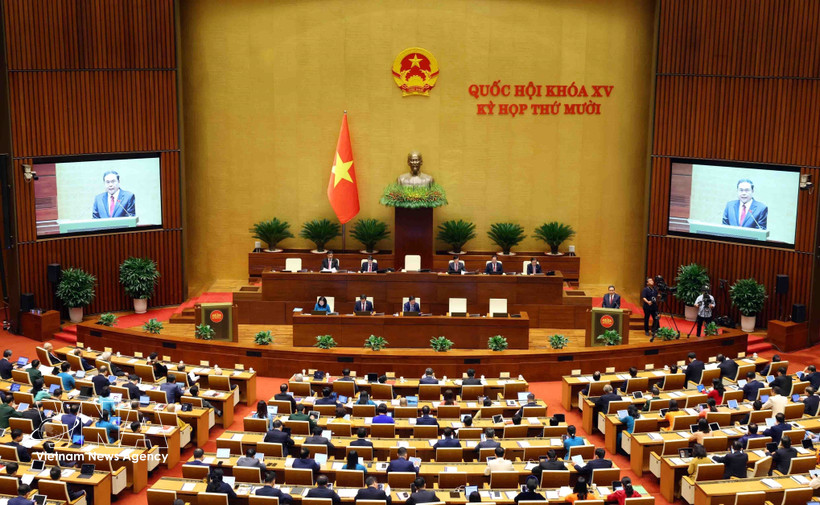
An overview of the 10th session of the 15th National Assembly which opens on October 20, 2025. (Illustrative photo: VNA)

Paris (VNA) – Vietnam’s 15th National Assembly and People’s Councils at all levels for the 2021–2026 term have left clear marks through their intensive activities, legislative innovation and improved oversight. However, in the country’s new stage of development, their performance needs to be further enhanced to become more solid, in-depth and effective.

This assessment was shared Le Van Tranh, a Vietnamese doctoral researcher in law at Paris Panthéon-Assas University in France.

Tranh, who is also a lecturer at the Ho Chi Minh City University of Law, said that deputies in the new term will need to meet several key requirements, including strong political integrity, sound institutional thinking and the capacity to translate policies into feasible laws and resolutions. They should also enhance oversight by closely monitoring the implementation of commitments, remain closely connected with the public and businesses, and develop an open and adaptive mindset toward emerging issues such as the digital economy, artificial intelligence and data security.

With regard to People’s Councils, the requirements are particularly specific, notably improving the quality of policy decisions at the local level and strengthening oversight in key areas such as public investment, land management, budgeting, administrative reform and the accountability of the administrative apparatus.

Beyond domestic legislative and supervisory functions, he emphasised that inter-parliamentary cooperation should be elevated to a new level. With relations established with more than 140 parliaments worldwide and over 50 friendship parliamentarians’ groups, Vietnam now has a solid foundation to deepen collaboration. The key challenge, he said, is to ensure that parliamentary diplomacy moves beyond delegation exchanges to become a practical channel that directly contributes to national development.

Accordingly, inter-parliamentary cooperation should be closely aligned with the country’s development priorities, including institutional reform, trade and investment, digital transformation, green transition, energy security, high-quality human resources development and the implementation of international commitments. At the same time, there should be a stronger shift from general exchanges to in-depth sharing of legislative experience among specialised committees, advisory bodies and friendship parliamentarians’ groups, thereby drawing lessons that can be translated into concrete policies and laws.

Another important requirement is to strengthen the capacity to monitor and supervise the implementation of signed agreements and commitments, ensuring that parliamentary diplomacy does not stop at declarations or formal agreements but produces tangible outcomes that contribute to development.

According to Tranh, legislative diplomacy becomes more effective when it enables Vietnam to learn from good practices, mobilise resources, safeguard national interests and enhance its voice at multilateral forums. The key is to move from a mindset of “participating for presence” to “participating for making contributions,” thereby helping shape cooperative norms while directly serving the country’s development goals.

Vietnam can also learn valuable lessons in organising legislative and parliamentary activities from France, he stressed, adding that what should be learned is not the replication of institutional models, but rather the organisation of a rigorous, professional lawmaking process that ensures accountability throughout. Developing parliamentary diplomacy in a more substantive manner, closely linked with learning legislative experience and sharing technical expertise, is also an important direction for directly supporting the country’s development./.

VNA
See more

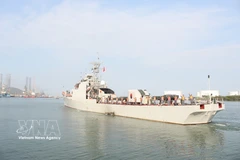
Ship 17 of Brigade 171 under Naval Region 2 of the Vietnam People’s Navy. (Photo: VNA)

Navy ship completes Milan 2026 multinational exercise in India

Over a journey covering more than 5,000 nautical miles, the ship’s officers and crew combined operational participation with extended sea training aimed at enhancing command coordination capabilities, combat readiness, mastery of weapons and technical equipment, and overall physical endurance.

Professor Mi Liang, Director of the Centre for Southeast Asian Studies at Beijing Foreign Studies University of China. (Photo: VNA)

14th National Party Congress opens new stage in Vietnam’s growth: Chinese scholar

The professor noted that summarising four decades of experience with Doi Moi is essential for further refining Vietnam’s development model in the coming period. He also suggested that Vietnam should continue strengthening anti-corruption efforts and preventing negative practices and moral degradation among officials to ensure the sustainability of the reform process.

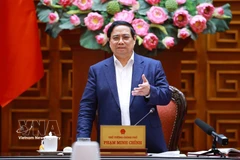
Prime Minister Pham Minh Chinh speaks at a meeting with ministries, agencies and the energy security task force in Hanoi on March 10, 2026. (Photo: VNA)

PM orders no energy shortages under any circumstances

Pham Minh Chinh chaired a meeting with ministries, agencies and the national energy security task force to discuss measures to ensure a proactive energy supply for socio-economic development and support double-digit growth targets amid mounting tensions in the Middle East affecting global energy supply chains.

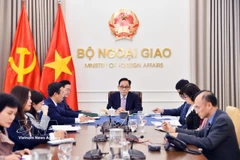
Vietnamese Minister of Foreign Affairs Le Hoai Trung (C) holds phone talks with his Korean counterpart Cho Hyun on March 10 (Photo: VNA)

Vietnam, RoK seek to boost all-around cooperation

Vietnam consistently attaches great importance to its relationship with the RoK and wishes to further deepen bilateral cooperation in a substantive and effective manner across fields, Minister of Foreign Affairs Le Hoai Trung stated.

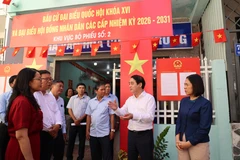
Khanh Hoa Party Secretary Nghiem Xuan Thanh inspects election preparations at Polling Station No. 2 in Bac Nha Trang ward. (Photo: VNA)

Khanh Hoa gears up for elections, facilitates voting for tourists

Thanh requested a thorough review of voter lists to ensure all eligible voters can exercise their rights. Polling teams were asked to establish advisory groups to assist voters when needed. He also stressed the need to make arrangements so that tourists visiting Nha Trang can cast their ballots in accordance with regulations.

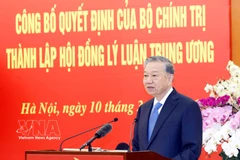
Party General Secretary To Lam speaks at the conference to announce the Politburo’s decision to establish the Central Theoretical Council for the 2026–2031 tenure. (Photo: VNA)

Central Theoretical Council for 2026-2031 term established

The Party chief noted that in recent years the council has made significant contributions to the Party’s theoretical research and development, particularly in clarifying the path toward socialism in Vietnam and contributing to the preparation of major Party documents, including those presented at national Party congresses.