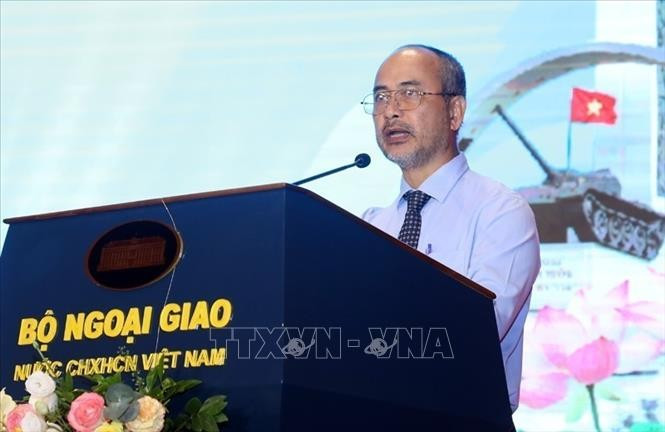
Hanoi (VNA) – Nguyen Trung Kien, Chairman of the State Committee for Overseas Vietnamese (SCOV) under the Ministry of Foreign Affairs has emphasised that the intellectual and science – technology resources of the overseas Vietnamese (OV) community are a strategic advantage for Vietnam in the global race in the new era.
Overseas Vietnamese – strategic resource for national development
In his recent article, Kien stressed the particularly important role played by Vietnamese intellectuals and experts abroad in both trying times and pivotal moments of the country.
During the resistance period and the early state-building years, many OV intellectuals returned to directly lay the cornerstones for the country’s science, technology, health care, and national defence.
He cited exemplary cases such as Professor Tran Dai Nghia, who laid the foundation for Vietnam’s defence industry; and Luong Dinh Cua, an outstanding agricultural scientist who helped improve productivity and ensure food security under extremely challenging conditions. During the period of embargo and isolation, many OV intellectuals and entrepreneurs continued to return home, bringing along scientific mindset, modern governance skills, and international experience, thus helping unlock development resources and laying the groundwork for later reform and deeper integration into the world.
The OV community now numbers nearly 6.5 million in over 130 countries and territories, deeply integrating into and gaining recognition in their host nations. Within this community, intellectuals continue to grow in both quality and quantity, securing success and reputation in many areas, including science, technology, and innovation.
Preliminary statistics show that intellectuals holding Bachelor's or higher degrees account for some 10–15%, equivalent to 650,000 people, of the OV community. Their associations and networks have been growing, with 10 innovation networks gathering 2,000 experts in many countries and more than 30 associations of OV experts and intellectuals. Leveraging their knowledge, international experience, and wide relationship networks, OVs have become a bridge bringing advanced technology, expertise, and governance practices to Vietnam.
Many Vietnamese expats have come back to the homeland or contributed remotely to support the country. Notable examples include Jonathan Hanh Nguyen, a pioneer in international trade and services, and Pham Nhat Vuong, who has developed industrial and high-tech complexes to help Vietnam engage more in global value chains, Kien noted.
Each year, he went on, around 300–400 OVs return home to contribute to teaching, research, and technology transfer in various areas, including strategic and advanced technology fields. Many have taken part in key national projects, thereby enhancing Vietnam’s expertise and standing in the global arena. Besides, SCOV-organised programmes and conferences have offered channels via which OV intellectuals can contribute policy ideas and development proposals.
Amid the 4th Industrial Revolution and intensifying global competition, the strategic role of OV intellectual and science – technology resources becomes even clear. Aside from having access to advanced research centres, innovation ecosystems, expert networks, and global capital, they hold key positions in the international scientist community, from professors to senior managers of tech corporations. Their strength lies in both expertise and experience, including those trained in Vietnam and working abroad, and younger generations born and educated overseas.
Once properly harnessed, intellectal and sci-tech resources of the OV community can both help narrow development gaps and serve as a strategic advantage for enhancing Vietnam’s competitiveness and global engagement in the new era, according to Kien.
During meetings with high-ranking leaders, OVs have expressed their delight at the country’s strong progress, particularly the major development policies and the laws on identity, land, housing, nationality, science – technology, and innovation. They wish to actively engage with the homeland’s development and hope for continued opportunities to make more contributions.
Driving breakthroughs by mobilising OV expertise
With the consistent view that OVs are an integral and crucial resource for the nation, the Party and State have always supported the community by ensuring their legal status, stable livelihoods, and integration into host societies; strengthening the great national solidarity bloc; and encouraging and facilitating their active contributions to national construction and defence, the article noted.
Recognising the contribution potential of OV experts and intellectuals, particularly their substantial role in implementing Party resolutions and supporting national development, the Party and State have continuously issued and refined policies to attract and harness their resources.
Resolution No. 57 has delivered a strong institutional boost, creating greater space and mechanisms for OV intellectuals to optimise their potential. Amendments to the Law on Nationality have eased conditions for acquiring or restoring Vietnamese citizenship while allowing the retention of foreign nationality. Meanwhile, the newly enacted Law on Science, Technology and Innovation provides fresh momentum for attracting OV scientists and experts in science, technology, and innovation.
Vietnam is well positioned to advance science and technology as its growing, highly qualified OV intellectual community shows strong willingness to contribute to the homeland, Kien opined.
To better tap the intellectual and science – technology resources of the OV community, the SCOV has identified attracting OV intellectuals to support national socio-economic development as a focal task of OV affairs.
Key priorities include removing institutional and policy bottlenecks and improving enforcement to create a supportive environment for experts and scientists to make contributions. At the same time, an integrated ecosystem linking businesses, research institutes, universities, and authorities will be developed, supported by a flexible and independent financial mechanism aligned with international practices.
In parallel, ministries and sectors will play a clearer leading role in professional management and OV connection to boost cooperation in science – technology, innovation, and digital transformation. Meanwhile, greater autonomy will be granted to local authorities and research and training institutions, aiming to better align expert attraction with local demand, thus generating sustainable momentum for mobilising OV intellectual resources, the Chairman elaborated.
He affirmed that OV experts and intellectuals remain an important resource for realising Vietnam’s aspiration to become a strong and prosperous nation. With the Party’s and State’s attention and coordinated efforts by ministries, sectors, and localities, the timely and comprehensive implementation of measures to mobilise OV resources will enable Vietnam to turn OV expertise into a strategic driver, supporting the successful realisation of Resolution 57 and breakthroughs in the science – technology era./.
VNA