National Data Centre No.1 to help accelerate digital transformation: Party chief

The National Data Centre No.1 has been positioned as a core and pivotal facility, serving as the “brain” and “heart” of the national digital transformation process, said Party General Secretary To Lam.

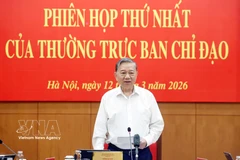
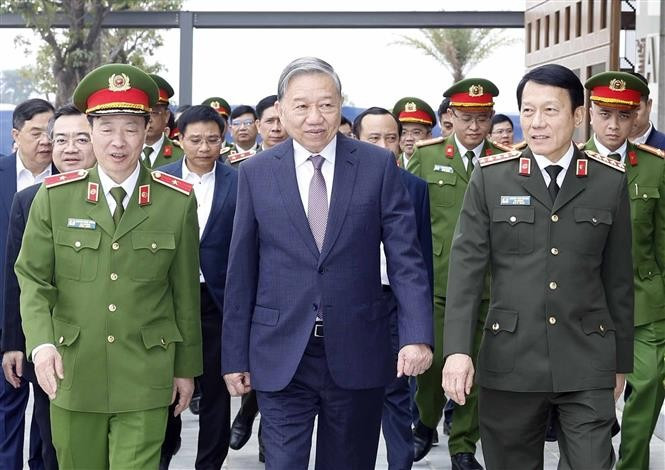
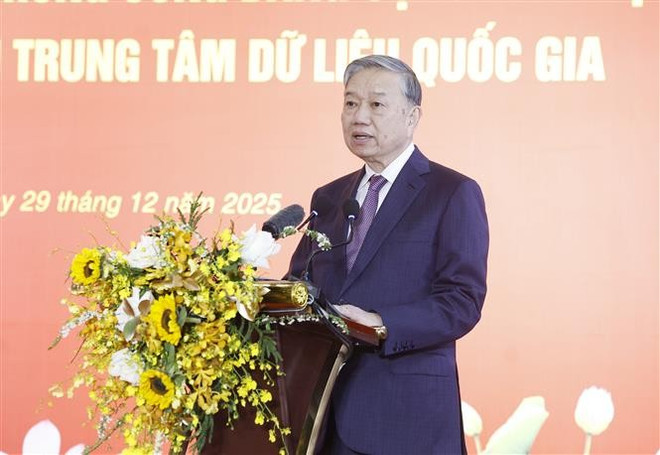
Party General Secretary To Lam (centre) during a working visit to the National Data Centre No.1 at Hanoi's Hoa Lac Hi-Tech Park on December 29. (Photo: VNA)

Hanoi (VNA) – The completion and commissioning of the National Data Centre No.1 have laid an important foundation for the country’s data infrastructure and will make a significant contribution to accelerating national digital transformation in the coming period, Party General Secretary To Lam said during a working visit to the facility at Hanoi's Hoa Lac Hi-Tech Park on December 29.

As reported at the event, the centre – the first specialised unit directly under the Ministry of Public Security tasked with state management and coordination of data – was officially launched on February 25, and inaugurated on August 18. It has been positioned as a core and pivotal facility, serving as the “brain” and “heart” of the national digital transformation process.

In terms of national data creation and integration, the centre has synchronously consolidated a large volume of data into an integrated repository, including 157 million datasets from 16 national and sectoral databases.

It has coordinated with the Government Office to restructure procedures for 82 groups of administrative services. It has also deployed a modern ten-layer physical security system and a 24/7 cyber security monitoring system (SOC/SIEM) to safeguard national digital data sovereignty. In addition, an innovation centre for data exploitation and research into strategic platforms has been launched, with readiness to roll out in 2026 initiatives such as the national data exchange, blockchain technology and a national virtual assistant.

Addressing the meeting, the Party General Secretary noted that in order to realise the country’s two centennial development goals, there is no alternative but to accelerate, achieve strong breakthroughs and pursue sustainable development, driven primarily by science, technology, innovation and digital transformation.

“In this new development model, data has become a strategic resource and a new type of asset, of particularly important significance to national governance capacity, the competitiveness of the economy and the quality of life of the people,” he stressed.

He further underlined that building infrastructure and collecting and storing data are only necessary conditions. More importantly, data must be utilised, analysed and transformed into value – turning data into knowledge, into sound policy decisions, and into concrete products and services that bring practical benefits to society and the people.

The Party leader also pointed to three major difficulties that must be overcome: data quality has yet to meet requirements; a data-driven innovation ecosystem has not been developed in a comprehensive manner; and autonomy in core technologies as well as the availability of high-quality human resources remain limited.

Building on the results achieved with the centre, he called for the continued implementation of subsequent ones as planned, in order to complete the national trusted data infrastructure network.

Emphasising that this is a task of national importance, General Secretary Lam said it is a shared responsibility of the entire political system, rather than that of any single agency or force. The Ministry of Public Security has been assigned responsibility for state management of data and for assisting the Government in managing and operating the centre.

He directed that the national integrated database be established in the first quarter of 2026, connecting relevant data repositories. Alongside data creation, efforts must be accelerated to utilise data and generate value from it. He also stressed the need to ensure that 100% of eligible fully online public services are implemented, maximising convenience for citizens and businesses.
data-centre-party-general-secretary-to-lam-working-visit-hoa-lac-hi-tech-park-vna.jpg
Party General Secretary To Lam speaks during his working visit to the National Data Centre No.1 at Hanoi's Hoa Lac Hi-Tech Park on December 29. (Photo: VNA)

In addition, the national data exchange must be urgently put into operation in the second quarter of next year. Meanwhile, priority should be given to mastering core and strategic technologies, particularly cloud computing, artificial intelligence, blockchain and shared data platforms, thereby gradually enhancing technological self-reliance, reducing dependence on foreign providers and safeguarding national digital sovereignty.

The leader also underscored that data security and safety must be ensured at the highest level. He called for particular attention to be paid to human factors, with special mechanisms and policies to attract and retain high-quality personnel, especially those in key and core operational roles such as chief engineers and chief architects.

General Secretary Lam also urged stronger international cooperation and collaboration with major corporations to facilitate the transfer of core technologies and the development of comprehensive personnel training plans./.

VNA

See more

A biotechnology laboratory of the International University at Vietnam National University-Ho Chi Minh City. (Photo: VNA)

Resolution 57: Role of intellectuals in advancing science and technology research

Prof. Dr. Tran Dai Lam, Director of the Institute of Materials Science at the Vietnam Academy of Science and Technology (VAST), emphasised that intellectuals should nurture national responsibility and ambition, be ready to take on challenges, evaluate research outcomes by international standards, and engage in collaboration across different sectors.

Professor Vu Minh Khuong, of the Lee Kuan Yew School of Public Policy (right), talks to a Vietnam News Agency correspondent in Singapore. (Photo: VNA)

Resolution 57 - catalyst for scientific and technological breakthroughs

The resolution also seeks to create stronger mechanisms to mobilise social and private resources and support an innovation ecosystem; link digital transformation in the public sector with the modernisation of national governance; and prioritise the development of elite human resources and internationally-standard research infrastructure.

Workers produce electronic components (Photo: VNA)

Science, technology drive Vietnam’s rising global profile: expert

Assoc. Prof. Le Duc Anh from Tokyo University held that for fast and sustainable development, Vietnam should prioritise science – technology and innovation as the main driver of productivity, focusing on sectors with high spillover effects such as semiconductors, AI, data, new energy and materials, biomedical technology, automation – robotics, and cybersecurity.

An overview of the workshop. (Photo: nafosted.gov.vn)

National portal expected to transform innovation into reality

The portal, which can be accessed at sangkien.gov.vn, was built to address the urgent need to mobilise collective intelligence and unlock the creativity of the entire population, in accordance with the directives of the steering committee for the implementation of the Politburo’s Resolution No. 57-NQ/TW on creating breakthroughs in science, technology, innovation and national digital transformation.

Sucker-mouthed minnow (Supradiscus varidiscus). (Photo: researchgate.net)

Vietnamese fish, bee named among 70 species newly identified in 2025

One of the most notable “hidden” finds is a small sucker-mouthed minnow endemic to Vietnam’s highlands, discovered in the Lo River. Scientifically named Supradiscus varidiscus, the specimen was collected and shelved some 25 years ago but has only now been studied and formally described.

The Ministry of Science and Technology launches a centralised one-stop-shop unit on December 19. (Photo: VNA)

Vietnam pushes sci-tech, innovation as growth drivers under Resolution 57

The Ministry of Science and Technology (MoST) bears the responsibility of “paving the way”, guided by a consistent spirit of transitioning from a management-oriented mindset to a facilitative one, from “input-based management” to “output-based evaluation”, and from fragmented investment to a focused approach centred on strategic technologies.

Prime Minister Pham Minh Chinh visits a display of science and technology development, innovation and digital transformation. (Photo: VNA)

Gov't leader requests greater efforts to step up development of sci-tech, innovation

Emphasising three strategic digital breakthroughs - digital institutions, digital infrastructure and digital human resources - PM Chinh called for close integration of science and technology development, innovation, administrative reforms, digital transformation and Project 06 with efforts to streamline the organisational apparatus and modernise leadership, management and working styles.

Doctors from Cho Ray Hospital (Ho Chi Minh City) and Vinh Long General Hospital (Vinh Long province) test the operation of a linear accelerator radiotherapy system for cancer treatment (Photo: VNA)

Vietnam sets orientations for applying nuclear energy across sectors

The plan aims to ensure the effective implementation of Decision No. 245/QD-TTg dated February 5, 2025, which approved the national master plan, while concretising objectives, orientations, solutions and resources for applying radiation and radioisotopes across sectors. It also assigns responsibilities to ministries, sectors and localities, and sets roadmaps and priorities for key programmes and projects.