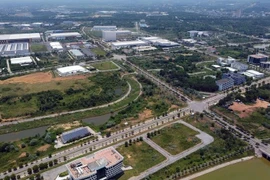
Hanoi (VNA) – Armed with a new legal framework under the revised Law on the Capital and Politburo Resolution No. 57, Hanoi’s Hoa Lac Hi-Tech Park is entering what officials describe as a once-in-a-generation opportunity to reposition itself as Vietnam’s national innovation hub and a domestic version of “Silicon Valley”.
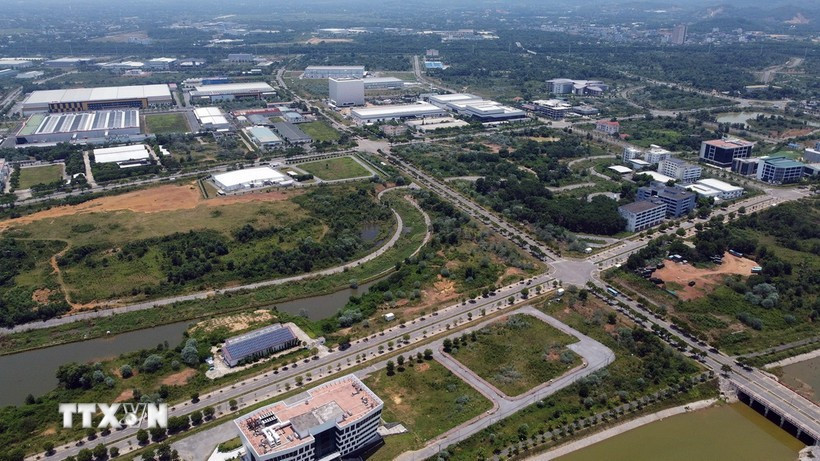
Located about 30 kilometres west of central Hanoi and close to major transport arteries, Hoa Lac currently hosts 109 investment projects with total registered capital of roughly 121 trillion VND (4.59 billion USD). Of which, the Viettel Military Industry and Telecoms Group is a strategic partner, committing 12 trillion VND, including a 10-trillion-VND research and development centre - the largest of its kind in the country - along with full 5G and Internet of Things coverage across the park.
Hanoi is the first locality nationwide to issue six resolutions concretising Politburo’s Resolution No. 57, which affirms that developing science, technology, innovation and national digital transformation is the core growth driver. Meanwhile, under the revised Law on the Capital, Hoa Lac is set to benefit from special mechanisms, aimed at addressing long-standing infrastructure bottlenecks, strengthening regional linkages and mobilising financial resources.
To attract investors, the park is offering the highest incentives permitted under current tax and land-lease regulations. Land rental costs range from 105 USD to 120 USD per square metre for a 50-year term, well below Hanoi’s average of about 250 USD, according to Vu Xuan Hung, head of the Hanoi Hi-Tech and Industrial Park Management Board.
Talent attraction is another key pillar. Hanoi has adopted preferential policies for high-tech human resources and is restructuring its higher-education network, inviting universities specialising in engineering and advanced technologies to establish laboratories, research centres and postgraduate training facilities at Hoa Lac, with the aim of building a stable, on-site supply of highly skilled labour.
The city is also pouring capital into high-quality housing for professionals, international schools, and hospitals, aiming to increase the number of permanent residents to 230,000 by 2030. Viettel Deputy General Director Vu Tuan Anh said Hoa Lac’s modern infrastructure and stable geological conditions make it well suited for developing core technologies.
Selective investment
Rather than pursuing broad-based investment, Hanoi is shifting towards a selective approach, prioritising investors with strategic technologies such as artificial intelligence, semiconductors and biomedical technology. A master plan for Hoa Lac Hi-tech Park development to 2030, with a vision to 2045 is being finalised, said Vice Chairman of the municipal People’s Committee Truong Viet Dung. He stated that the city aims to build Hoa Lac into the country’s leading centre for innovation, research and development and high-tech manufacturing.
To support this vision, the city is rolling out coordinated measures, including restructuring innovation spaces, reforming institutions to build “soft infrastructure” for innovation, expanding transport, digital and smart urban infrastructure, and strengthening collaboration among government, academia and businesses.
The city is committed to allocating substantial resources and the highest political determination to the project, the official noted.
Next year, Hanoi plans to earmark up to 4% of its total budget expenditure —around 9 trillion VND a year— for science, technology, innovation and digital transformation with the goal of attaining full disbursement and positioning the sector as a key growth engine in its push for double-digit economic expansion./.