Applying the Internet of Things in smart transport

The project aims to build a unified, safe and efficient IoT platform to support the management, operation and exploitation of smart transport systems under the Ministry of Construction, with data shared across ministries and localities.

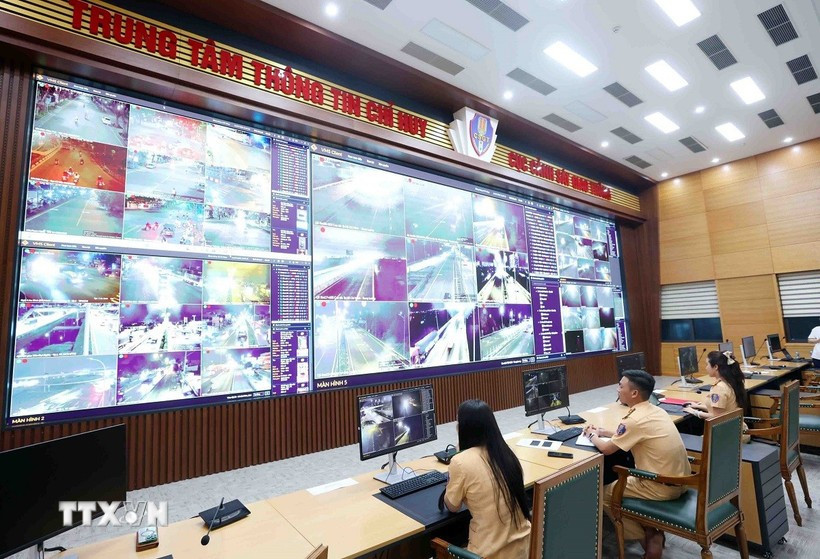
Police offiers mornitor the traffic through AI camera (Photo: VNA)

Hanoi (VNA) – Deputy Prime Minister Tran Hong Ha on December 11 signed Decision No. 2692/QD-TTg approving a project on applying the Internet of Things (IoT) in smart transport.

The project aims to build a unified, safe and efficient IoT platform to support the management, operation and exploitation of smart transport systems under the Ministry of Construction, with data shared across ministries and localities.

For 2026–2028, at least two cities will pilot smart operation centres integrating IoT transport data. All eastern sections of the North–South Expressway will complete non-stop electronic toll collection (ETC), with 100% ETC data incorporated into the national smart transport data-sharing system. About 90% of legal documents, standards and technical regulations on IoT in transport will be completed or submitted for issuance.

Between 2029 and 2035, at least five cities and 10 provinces will operate integrated smart transport operation centres. All IoT transport data will be standardised and ready for interconnection among the Ministry of Construction, the Ministry of Public Security and localities. IoT sensor infrastructure will be installed on at least 50% of major routes, including expressways and ring roads, supporting monitoring and maintenance.

To achieve these goals, the project sets out tasks for ministries and localities.

The Ministry of Construction will coordinate with the Ministry of Public Security and relevant ministries to finalise regulations, including a decree on controlled testing of IoT applications in smart transport. It will review legal documents on digital transformation and IoT, and propose mechanisms for upgrading or developing interoperable IoT infrastructure.

The Ministry of Construction, together with key ministries, will complete national technical standards for IoT in smart transport in line with international practices.
camera-ai.jpg
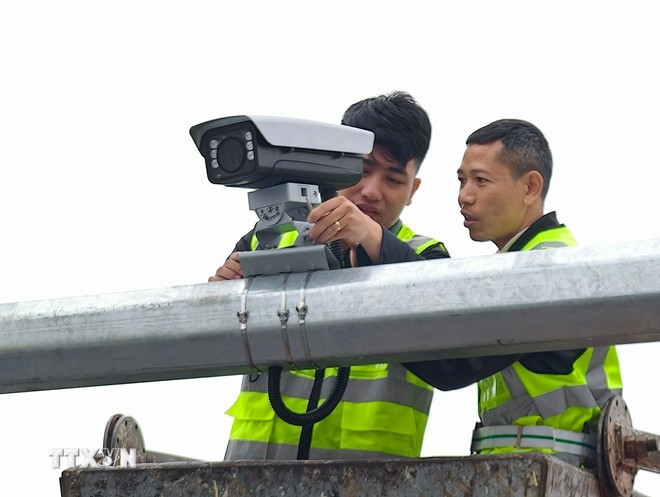
Hanoi installs AI camera at all intersections (Photo: VNA)

From 2026 to 2030, the Ministry of Science and Technology will work with telecommunications and IT enterprises to upgrade connectivity infrastructure, expand high-speed, low-latency networks using 5G and optical fibre, and strengthen dedicated communication networks for transport. Urban areas, expressways and bus stations will be prioritised.

The Ministry of Construction will lead IoT application in managing transport infrastructure, including roads, bridges, tunnels and environmental conditions.

Local authorities will upgrade smart operation centres to integrate IoT and connect with national smart transport platforms, ensuring compliance with sectoral and smart urban database standards.

The Ministry of Science and Technology will develop data integration platforms linked to the North–South Expressway’s smart transport system, while the Ministry of Public Security will build data centres for monitoring, violation handling and traffic operations.

The Ministry of Construction will coordinate with ministries, technology firms, universities and localities to apply IoT in infrastructure management, tolling, load control, traffic safety, multimodal transport, public services, green mobility and autonomous vehicles. Localities will apply IoT in their traffic operations.

The ministry will also develop economic, social, environmental and technological indicators to assess the project’s effectiveness.

The project promotes diversified funding sources combining State budget, private investment, ODA and international cooperation. It encourages domestic enterprises to develop IoT devices, platforms and services, and provides incentives for R&D in IoT, AI, big data and cybersecurity./.

VNA

See more

Through long-term commitment, Viettel has brought millions of Burundians into the mobile era and become the first operator to roll out 5G in the country, Viettel Burundi CEO Phan Truong Son noted. (Illustrative photo: VNA)

Viettel secures three prestigious international awards

Viettel has won honours in the “People & Culture” and “Best Operator in a Growth Market” categories at the 2025 World Communication Awards (WCA), alongside the “Best Digital Transformation Project” at the 2025 Global Telecoms Awards (Glotel).

A view of the Can Gio sea-encroaching urban area project (Photo: VNA)

Green-tech push for Can Gio

Vietnam has the capacity, ambition and technological foundation to join the group of leading sustainable coastal urban nations in the coming decade, experts said at a dialogue on "advancing to the sea with ESG++ megacities: breakthroughs through green technology", held on December 9 in Hanoi by the Vietnam Institute for Real Estate Studies (VIRES).

Minister of Science and Technology Nguyen Manh Hung speaks at the meeting (Photo: VNA)

Vietnam turns intellectual property into bankable assets in new law

About AI-generated content, the law draws a clear line: purely autonomous AI creations are not eligible for copyright or patent protection. Those who provide substantial creative input, such as ideas, curation, editing, or selection, qualify as authors or inventors.

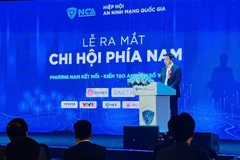
Lieutenant General Nguyen Minh Chinh, NCA Vice Chairman, speaks at the launch ceremony of the southern branch of the National Cybersecurity Association. (Photo: VNA)

National Cybersecurity Association opens branch in HCM City

The southern branch aims to become a coordinating body for cybersecurity tasks, workforce development, awareness-raising and the strengthening of digital defence capabilities across the region, contributing to the safe and sustainable growth of Vietnam’s digital economy.

Viettel exceeds target of 20,000 new 5G stations by more than three weeks. (Illustrative photo: VNA)

Viettel exceeds target of 20,000 new 5G stations by more than three weeks

Viettel plans to continue scaling up its network from now until the end of 2025, with an additional 23,500 stations scheduled for installation, nearly quadruple the number rolled out in 2024. Once completed, Viettel will operate Vietnam’s largest 5G network, with 30,000 stations covering 90% of outdoor areas and 70% of indoor spaces nationwide, from major cities to rural regions.

In Vietnam, demand for infrastructure supporting AI, cloud computing, and digital services is rising at an unprecedented level. (Illustrative photo: VNA)

Vietnam emerges as new hub for data centres

Data centres have surged to become the second most preferred alternative asset class in the region. Vietnam is no exception to this trend as the demand for infrastructure supporting AI, cloud computing, and digital services has risen at an unprecedented level.

Professor Kurt Kremer, from the Max Planck Institute for Polymer Research in Germany, speaks at the event. (Photo: VNA)

Vietnam has advantages to develop versatile humanoid robots: experts

At the symposium, international and Vietnamese experts also discussed the latest trends in robotics, from socially interactive humanoids and collaborative service robots to medical and rehabilitation systems, and examined major challenges surrounding AI safety and ethics to ensure that robotics evolves in a responsible, human-centred and sustainable manner.

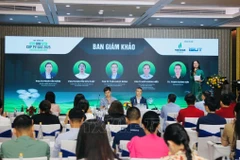
The organisers present members of the judging panel of the UAV Cup PV GAS 2025. (Photo: VNA)

UAV Cup PV GAS 2025 promotes Vietnam’s home-grown UAV technology

Jointly organised by Hanoi University of Science and Technology’s Institute of Space and Underwater Technology (ISUT) and Petrovietnam Gas JSC (PV GAS), the competition aims to foster innovation among young people, enhance capabilities in UAV research, design and application, and seek practical technological solutions for smart agriculture, environmental monitoring, logistics, and emergency rescue.

Assoc. Prof. Luu Anh Tuan, Executive Director of the Centre for Artificial Intelligence Research at VinUni University, speaks at the seminar. (Photo: VNA)

Vietnam advances people-centred AI development

The event brought together scientists, policymakers, and inventors to discuss responsible AI development with a focus on human-centred values. Participants explored practical applications of ethical frameworks, ensuring transparency and human oversight in AI, and promoting international cooperation to strengthen global AI governance.

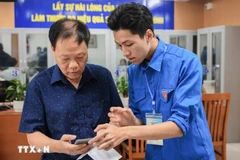
Guiding a local how to apply for administrative procedures on a mobile phone (Photo: VNA)

2030 digital government blueprint with AI at core approved

By 2030, Vietnam targets completing the establishment of a digital government, forming a smart government powered by big data and artificial intelligence (AI), delivering proactive, predictive, and citizen-centric governance models.

Deputy Minister of Science and Technology Le Xuan Dinh (standing, left) speaks at the working session with INIR Mission in Hanoi on December 1. (Photo: VNA)

Vietnam, IAEA review national nuclear power infrastructure

From December 1–11, the Ministry of Science and Technology (MoST) through the Vietnam Agency for Radiation and Nuclear Safety is coordinating with relevant ministries and agencies to host an Integrated Nuclear Infrastructure Review (INIR) Mission in Hanoi. The delegation consists of seven IAEA experts, three international specialists invited by the agency from the UK, Brazil and Bulgaria, and one observer from Egypt.