Hanoi (VNA) – Vietnam is moving beyond its long-standing focus on assembly and testing to integrate more deeply into the global semiconductor value chain, as AI accelerates demand for advanced chips and transforms how smart factories are designed, manufactured and managed.
Paving way for semiconductor development
AI is emerging as a central force in Vietnam’s shift from an outsourcing-based production model to one built on innovation and higher-value creation. In the semiconductor industry, AI is reshaping the entire production chain, from automating packaging and testing, enhancing chip design through simulation and machine learning, to cutting defect rates using real-time data.
Vietnam has set targets for the digital economy to contribute 20% of GDP by 2025 and 30% by 2030. Investment in science, technology, innovation and digital transformation is expected to reach at least 3% of GDP and help the country progress into the top 40 of the Global Innovation Index (GII).
To support these ambitions, the Government has introduced a series of major policy frameworks, including Politburo Resolution No. 57 dated on December 22, 2024 on breakthroughs in science, technology, innovation and national digital transformation; the Law on Science, Technology and Innovation; the Law on the Digital Technology Industry; and the national strategy for semiconductor industry development through 2030 with a vision toward 2050.
Deputy Minister of Science and Technology Bui Hoang Phuong noted that the semiconductor industry has been designated a strategic technology essential to boosting competitiveness, driving economic expansion and strengthening national positioning. As of November 2025, Vietnam had hosted more than 170 foreign-invested semiconductor projects worth nearly 11.6 billion USD, primarily in chip design and assembly-testing. The country is home to about 60 design firms, eight assembly-testing projects and over 20 material and equipment suppliers, including major corporations such as Intel, Amkor, Hana Micron, Coherent and VDL.
The new Law on Science, Technology and Innovation introduces sandbox mechanisms, strengthens intellectual property protection, improves international standards and measurement systems, and encourages conditional FDI linked with technology transfer and domestic capacity building, creating a comprehensive legal foundation for industry expansion.
Meanwhile, the Law on the Digital Technology Industry, approved in June 2025, provides a regulatory framework for advancing the digital technology and semiconductor sectors. It incentivises investment in breakthrough chip technologies and aims to move Vietnam toward mastering chip design and production. Key incentives include a 5% corporate income tax rate for 37 years for semiconductor manufacturing projects worth at least 6 trillion VND (nearly 227.7 million USD), alongside a 6-year tax holiday followed by a 50% tax reduction for the subsequent 13 years.
Interdisciplinary talent critical for progress
With more than 1.9 million IT workers, including 7,000 semiconductor design engineers, Vietnam benefits from a large and youthful tech workforce. To meet rising industry demand, the Government has launched the Semiconductor Workforce Development Programme, which aims to train more than 50,000 semiconductor engineers and graduates by 2030 and develop key laboratories, research hubs and enterprise-linked training models.
Despite these efforts, annual demand sits at roughly 10,000 engineers, while the current supply covers less than 20%. A particular shortage exists in engineers skilled across AI, chip design, control systems and data, expertise essential for next-generation chip development and smart semiconductor manufacturing.
Professor Usagawa Tsuyoshi, a leading Japanese expert and special adviser to the Vietnam-Japan University (VJU) under Vietnam National University, Hanoi, assessed that Vietnam could become a regional talent hub if State agencies, universities and enterprises work in concert. He stressed that semiconductor engineers must possess strong foundations in mathematics, physics, computer science and electronics, analytical problem-solving abilities and a commitment to lifelong learning.
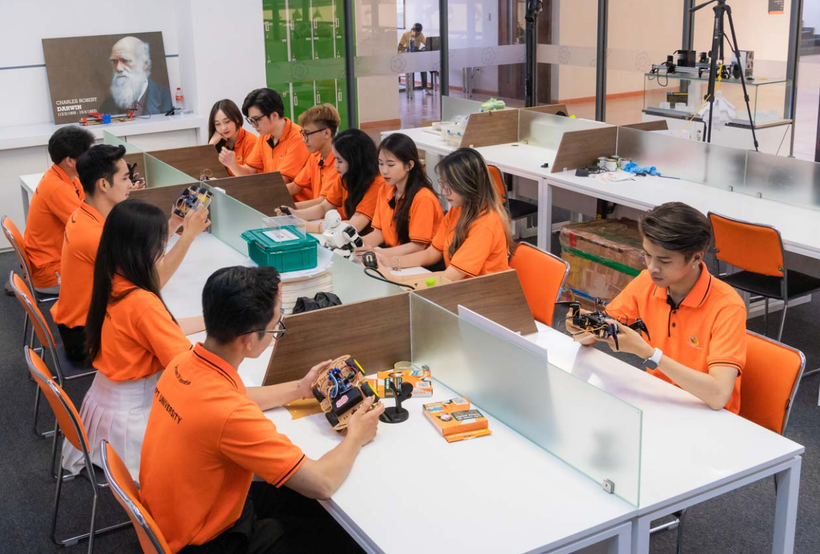
VJU’s semiconductor engineering programme, co-developed with top Japanese institutions such as the University of Tokyo and Kumamoto University, aims to align training with international standards. New models of collaboration among enterprises, research institutes and universities are helping build more practical and globally consistent training pathways. Experts also advocate for expanding order-based training, enabling companies like Intel, Samsung, FPT Semiconductor and Viettel to participate directly in curriculum design and internship programmes.
Ho Duc Thang, Director of the National Institute for Digital Technology and Digital Transformation under the Ministry of Science and Technology, announced that the ministry is drafting an AI law and building a national cloud computing and big data centre to secure computing autonomy for AI and semiconductor applications. The National Innovation Centre (NIC) has identified AI and semiconductors as strategic pillars, focusing on developing high-performance computing infrastructure, training interdisciplinary engineers, standardising chip production data and attracting international experts with preferential incentives.
A notable development is Viettel’s construction of Vietnam’s first chip fabrication plant, alongside its work on 5G, IoT and cybersecurity chips aimed at mastering core technologies. The project is expected to play a key role in achieving the national goal of establishing 100 chip design firms and a workforce of 15,000 engineers by 2030./.