Green-tech push for Can Gio

Vietnam has the capacity, ambition and technological foundation to join the group of leading sustainable coastal urban nations in the coming decade, experts said at a dialogue on "advancing to the sea with ESG++ megacities: breakthroughs through green technology", held on December 9 in Hanoi by the Vietnam Institute for Real Estate Studies (VIRES).

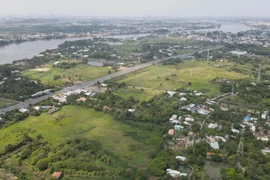
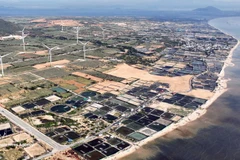
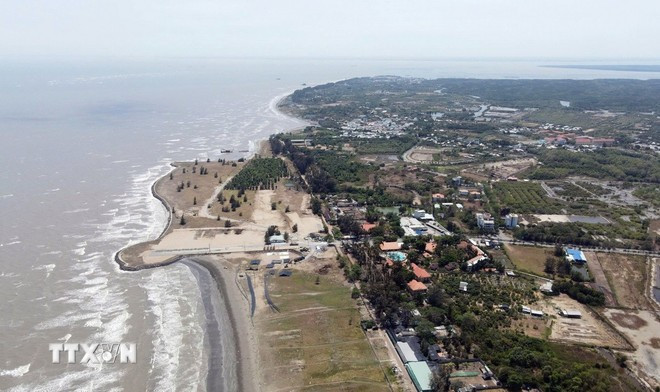
A view of the Can Gio sea-encroaching urban area project (Photo: VNA)

Hanoi (VNA) – Vietnam has the capacity, ambition and technological foundation to join the group of leading sustainable coastal urban nations in the coming decade, experts said at a dialogue on "advancing to the sea with ESG++ megacities: breakthroughs through green technology", held on December 9 in Hanoi by the Vietnam Institute for Real Estate Studies (VIRES).

VIRES Director Bui Van Doanh highlighted that global successes from New York, Tokyo Bay, Singapore Marina Bay to Dubai and Incheon show that advancing to the sea is a future-shaping strategy rooted in science, technology, planning and environmental governance, not experimentation.

According to Doanh, Can Gio possesses distinctive advantages with unique mangrove ecology, rich biodiversity, strategic coastal location of Ho Chi Minh City and a large land reserve. These factors give Can Gio the potential to become an exemplary ESG++ coastal megacity of Asia in the next decade.

Vietnam Real Estate Association Vice Chairman Pham Nguyen Toan noted that for coastal reclamation aimed at urbanisation to succeed, it must meet three requirements: proper technology for durable foundations, proper planning for environmental regeneration, and proper vision for transformational national value.

He emphasised that advancing to the sea not only creates land but unlocks new growth space, new business hubs and new value chains in tourism, services and technology areas where inland development is increasingly constrained.

Experts cited the geological characteristics of Can Gio, where soft mud requires advanced foundational solutions. The Japanese K-DPM in-situ solidification technology was presented as the optimal method to reinforce ground load capacity, reduce subsidence, lower environmental impact and optimise lifecycle costs.

The technology has been applied in Tokyo Bay and in disaster-prevention works in Japan. In Can Gio, AOMI Japan and MCIC Vietnam are collaborating to transfer, standardise and localise K-DPM.

AOMI representative Okori Katsumi explained that Japan began land reclamation centuries ago, first using cement-soil mixing but later shifting to K-DPM due to its ability to handle large volumes, deliver material over long distances and reduce ecological impact.

MCIC Vietnam Chairman Tran Thanh Trung confirmed that K-DPM mixes mud and additives using compressed air inside pipelines, producing light, solid, homogeneous and waterproof material. The solution shortens construction time, reduces load and subsidence, and enables long-term operational safety under tidal and sea-level rise conditions.

He said the choice of K-DPM reflects Vingroup’s ESG++ orientation for Vinhomes Green Paradise, prioritising sustainability despite higher upfront costs.

Can Gio is undergoing large-scale regional infrastructure development such as the Ben Thanh–Can Gio high-speed rail (13-minute travel time), Can Gio Bridge (from 2026), the Can Gio–Vung Tau sea-crossing route (from 2029) and international port–logistics linkages.

Experts likened such infrastructure to runways enabling the city to take off. With high-speed rail integrated with transit-oriented development (TOD), Can Gio would transform from a peripheral area into an international destination, comparable with leading coastal cities in the region.

Under this scenario, travel time from Ho Chi Minh City to Can Gio will be reduced to around 13 minutes, reshaping perceptions, boosting economic flows and elevating the area into a natural extension of the city’s urban core, with strong impacts on economy, population and real-estate value./.
VNA

See more

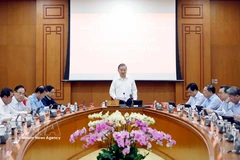
Minister of Science and Technology Nguyen Manh Hung speaks at the meeting (Photo: VNA)

Vietnam turns intellectual property into bankable assets in new law

About AI-generated content, the law draws a clear line: purely autonomous AI creations are not eligible for copyright or patent protection. Those who provide substantial creative input, such as ideas, curation, editing, or selection, qualify as authors or inventors.

Lieutenant General Nguyen Minh Chinh, NCA Vice Chairman, speaks at the launch ceremony of the southern branch of the National Cybersecurity Association. (Photo: VNA)

National Cybersecurity Association opens branch in HCM City

The southern branch aims to become a coordinating body for cybersecurity tasks, workforce development, awareness-raising and the strengthening of digital defence capabilities across the region, contributing to the safe and sustainable growth of Vietnam’s digital economy.

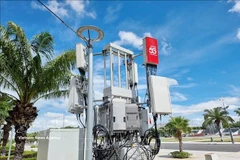
Viettel exceeds target of 20,000 new 5G stations by more than three weeks. (Illustrative photo: VNA)

Viettel exceeds target of 20,000 new 5G stations by more than three weeks

Viettel plans to continue scaling up its network from now until the end of 2025, with an additional 23,500 stations scheduled for installation, nearly quadruple the number rolled out in 2024. Once completed, Viettel will operate Vietnam’s largest 5G network, with 30,000 stations covering 90% of outdoor areas and 70% of indoor spaces nationwide, from major cities to rural regions.

In Vietnam, demand for infrastructure supporting AI, cloud computing, and digital services is rising at an unprecedented level. (Illustrative photo: VNA)

Vietnam emerges as new hub for data centres

Data centres have surged to become the second most preferred alternative asset class in the region. Vietnam is no exception to this trend as the demand for infrastructure supporting AI, cloud computing, and digital services has risen at an unprecedented level.

Professor Kurt Kremer, from the Max Planck Institute for Polymer Research in Germany, speaks at the event. (Photo: VNA)

Vietnam has advantages to develop versatile humanoid robots: experts

At the symposium, international and Vietnamese experts also discussed the latest trends in robotics, from socially interactive humanoids and collaborative service robots to medical and rehabilitation systems, and examined major challenges surrounding AI safety and ethics to ensure that robotics evolves in a responsible, human-centred and sustainable manner.

The organisers present members of the judging panel of the UAV Cup PV GAS 2025. (Photo: VNA)

UAV Cup PV GAS 2025 promotes Vietnam’s home-grown UAV technology

Jointly organised by Hanoi University of Science and Technology’s Institute of Space and Underwater Technology (ISUT) and Petrovietnam Gas JSC (PV GAS), the competition aims to foster innovation among young people, enhance capabilities in UAV research, design and application, and seek practical technological solutions for smart agriculture, environmental monitoring, logistics, and emergency rescue.

Assoc. Prof. Luu Anh Tuan, Executive Director of the Centre for Artificial Intelligence Research at VinUni University, speaks at the seminar. (Photo: VNA)

Vietnam advances people-centred AI development

The event brought together scientists, policymakers, and inventors to discuss responsible AI development with a focus on human-centred values. Participants explored practical applications of ethical frameworks, ensuring transparency and human oversight in AI, and promoting international cooperation to strengthen global AI governance.

Guiding a local how to apply for administrative procedures on a mobile phone (Photo: VNA)

2030 digital government blueprint with AI at core approved

By 2030, Vietnam targets completing the establishment of a digital government, forming a smart government powered by big data and artificial intelligence (AI), delivering proactive, predictive, and citizen-centric governance models.

Deputy Minister of Science and Technology Le Xuan Dinh (standing, left) speaks at the working session with INIR Mission in Hanoi on December 1. (Photo: VNA)

Vietnam, IAEA review national nuclear power infrastructure

From December 1–11, the Ministry of Science and Technology (MoST) through the Vietnam Agency for Radiation and Nuclear Safety is coordinating with relevant ministries and agencies to host an Integrated Nuclear Infrastructure Review (INIR) Mission in Hanoi. The delegation consists of seven IAEA experts, three international specialists invited by the agency from the UK, Brazil and Bulgaria, and one observer from Egypt.