Vietnam has advantages to develop versatile humanoid robots: experts

At the symposium, international and Vietnamese experts also discussed the latest trends in robotics, from socially interactive humanoids and collaborative service robots to medical and rehabilitation systems, and examined major challenges surrounding AI safety and ethics to ensure that robotics evolves in a responsible, human-centred and sustainable manner.

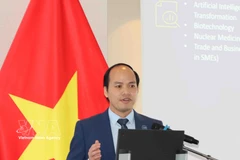
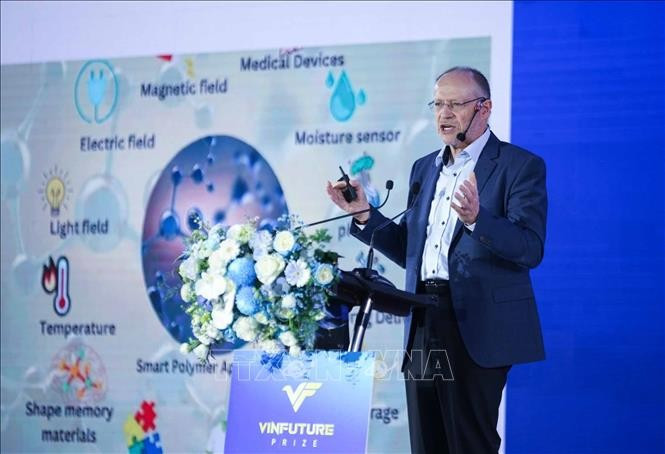
Professor Kurt Kremer, from the Max Planck Institute for Polymer Research in Germany, speaks at the event. (Photo: VNA)

Hanoi (VNA) – Vietnam sees growing advantages in the global race to develop versatile humanoid robots - machines which are capable of performing complicated physical tasks, interacting naturally with humans and operating safely in a real-world environment.

Speaking at a symposium themed “Intelligent Robotics & Automation” held on December 4 by the VinFuture Foundation as part of the VinFuture Science and Technology Week 2025, Dr. Nguyen Trung Quan of the University of Southern California and VinMotion said that Vietnam is emerging with strengths across all three pillars crucial to humanoid robot development: high-quality hardware manufacturing, strong software and AI capabilities, and a safe, reliable deployment environment. With these conditions, the country has the foundation to join the global competition in humanoid robotics, he said.

The world is witnessing a rapid acceleration in robotics, automation and artificial intelligence (AI), underpinned by breakthroughs in advanced sensing and intelligent interactive systems. These technologies are not only reshaping industrial production, services and healthcare, but also improving productivity, enhancing quality of life and contributing to more sustainable development pathways.

At the symposium, international and Vietnamese experts also discussed the latest trends in robotics, from socially interactive humanoids and collaborative service robots to medical and rehabilitation systems, and examined major challenges surrounding AI safety and ethics to ensure that robotics evolves in a responsible, human-centred and sustainable manner.

Prof. Kurt Kremer of the Max Planck Institute for Polymer Research (Germany) outlined the transformative potential of soft materials, including advanced polymers, for next-generation robotics and electronics. Soft materials are abundant, lightweight, flexible, durable and inexpensive, and can be easily engineered into diverse shapes or combined with sensors, he explained.

Their rapid responsiveness, especially when integrated with gels or corrosive agents, allows robots to achieve high levels of adaptability and precision. Soft conductive polymers also hold promise for future electronics, being cheaper than silicon and not dependent on rare-earth supplies. Potential applications include solar cells, organic semiconductors, displays and neuromorphic computing systems that mimic the human brain.

However, he noted that improving mechanical strength, recyclability and biodegradability remains essential to unlocking their full potential.
ho-young-kim-041225.jpg
Prof. Ho-Young Kim of Seoul National University speaks at the event. (Photo: VNA)

Challenge of robotics in soft-material manipulation

Addressing the difficulties of robotic control, Prof. Ho-Young Kim of Seoul National University (Republic of Korea) highlighted that while industrial robots excel at handling rigid objects with fixed shapes, manipulating soft items such as fabric, plastic bags or clothing - remains one of the hardest problems in automation.

Tasks that seem simple to humans, like lifting a T-shirt or folding laundry, require advanced perception and dexterity. Robots must understand constantly changing shapes in real time, avoid deforming soft materials or reverse unwanted deformations. Success will require major improvements in hardware (grippers) and software (control algorithms, machine learning).

Toward a future of one billion robots

Prof. Tan Yap Peng, President of VinUni (Vietnam), predicted that by 2050 nearly one billion robots could coexist with humans. While millions of robots are already deployed—such as those used by Amazon in warehouses—the majority remain limited to simple, pre-programmed tasks.

He emphasised the need for robotics models with broader purpose and flexible intelligence. New foundation models such as large language models (LLMs), vision-language models (VLMs) and vision-language-action models (VLAs) allow robots to understand images, videos and natural language and convert that understanding into precise physical actions.

As these models mature, robots will evolve from single-purpose to multi-purpose systems—more dexterous, more autonomous, easier to maintain and capable of working seamlessly with humans. They will use energy more efficiently and operate safely in shared environments.

Humanoid robots and the rise of “physical AI”

Dr. Quan described “physical AI”—the fusion of artificial intelligence with physical robotic systems - as one of the fastest-growing global industries, projected to reach 10 trillion USD within the next decade. Developing humanoid robots, however, requires vast quantities of high-quality real-world data. Yet robots cannot be deployed at scale for data collection until they are sufficiently safe and capable - a paradox the industry must overcome.

Vietnam, he stressed, has the rare ability to address this challenge thanks to its combined strengths in hardware production, algorithm development and safe operational environments, which together enable simultaneous progress across the entire robotics value chain./.

VNA

See more

The organisers present members of the judging panel of the UAV Cup PV GAS 2025. (Photo: VNA)

UAV Cup PV GAS 2025 promotes Vietnam’s home-grown UAV technology

Jointly organised by Hanoi University of Science and Technology’s Institute of Space and Underwater Technology (ISUT) and Petrovietnam Gas JSC (PV GAS), the competition aims to foster innovation among young people, enhance capabilities in UAV research, design and application, and seek practical technological solutions for smart agriculture, environmental monitoring, logistics, and emergency rescue.

Assoc. Prof. Luu Anh Tuan, Executive Director of the Centre for Artificial Intelligence Research at VinUni University, speaks at the seminar. (Photo: VNA)

Vietnam advances people-centred AI development

The event brought together scientists, policymakers, and inventors to discuss responsible AI development with a focus on human-centred values. Participants explored practical applications of ethical frameworks, ensuring transparency and human oversight in AI, and promoting international cooperation to strengthen global AI governance.

Guiding a local how to apply for administrative procedures on a mobile phone (Photo: VNA)

2030 digital government blueprint with AI at core approved

By 2030, Vietnam targets completing the establishment of a digital government, forming a smart government powered by big data and artificial intelligence (AI), delivering proactive, predictive, and citizen-centric governance models.

Deputy Minister of Science and Technology Le Xuan Dinh (standing, left) speaks at the working session with INIR Mission in Hanoi on December 1. (Photo: VNA)

Vietnam, IAEA review national nuclear power infrastructure

From December 1–11, the Ministry of Science and Technology (MoST) through the Vietnam Agency for Radiation and Nuclear Safety is coordinating with relevant ministries and agencies to host an Integrated Nuclear Infrastructure Review (INIR) Mission in Hanoi. The delegation consists of seven IAEA experts, three international specialists invited by the agency from the UK, Brazil and Bulgaria, and one observer from Egypt.

Delegates pose for a photo at the launch ceremony of the semiconductor alliance in Hanoi on November 27, 2025. (Photo: the organising board)

Alliance launched to strengthen high-quality semiconductor workforce training

Building on the coalition of five universities to develop high-quality human resources for the semiconductor industry initiated by the Ministry of Education and Training in Da Nang in 2023, VNU-Hanoi launched the semiconductor alliance to link education, research, and industry; foster an open ecosystem and develop high-quality human resources and “Make in Vietnam” semiconductor products.

Nguyen Thi Thanh Hoa, Chairwoman of the Vietnam Association for Protection of Child Rights, presents gifts to students at the ceremony (Photo: VNA)

Children’s views gathered to shape online cyber security policies

The survey found that 27.1% of children use the Internet for less than 1 hour per day, 50% for 1–3 hours, 18.8% for 4–6 hours, and 2.3% for more than 10 hours, he said, noting that the findings provide a comprehensive view of children’s Internet usage and risks related to personal safety on cyberspace.

Minister of Public Security General Luong Tam Quang hosts a reception for Jens Rubbert, Chairman of the EU–ASEAN Business Council, on November 27 (Photo: VNA)

Vietnam seeks to strengthen cybersecurity cooperation with European business community

Minister of Public Security General Luong Tam Quang met with Jens Rubbert, Chairman of the EU–ASEAN Business Council (EU–ABC), in Hanoi on November 27, during which he proposed enhanced coordination in detecting and addressing counterfeit, imitation and substandard goods, in order to safeguard the lawful rights and interests of businesses and consumers.

Three modern UAV models developed by Viettel (Photo: vietnamnet.vn)

Vietnam positioned to tap hundreds-billion-dollar UAV industry

As Vietnam’s e-commerce market is forecast to reach 63 billion USD by 2030, UAVs are emerging as highly effective last-mile delivery tools. Pilot programmes in Thai Nguyen, Tuyen Quang, and Lang Son provinces have proven their ability to reduce delivery times and overcome difficult terrain.

Illustrative image (Photo: Internet)

Vietnam works hard to accelerate full IPv6 transition

IPv6-only is an inevitable trend to support the development of the Internet of Things, industrial Internet, 5G/6G deployment, AI, and other emerging technologies. Since 2021, Vietnam has maintained steady growth in IPv6 adoption and has consistently ranked among the leading countries in the transition.