VinFuture 2025 Grand Prize honours scientists for discoveries, development of HPV vaccines

The 2025 VinFuture Grand Prize valued at 3 million USD has been awarded to four scientists for their discoveries and development of HPV vaccines for prevention of tumors caused by human papillomaviruses.

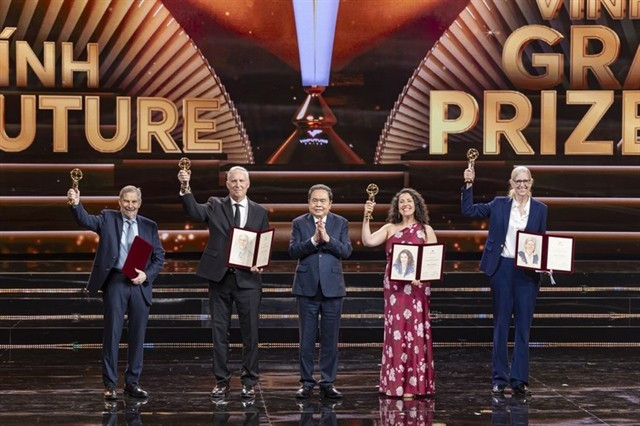
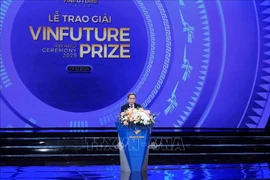
National Assembly Chairman Tran Thanh Man presents the 2025 VinFuture Grand Prize to four scientists for their discoveries and development of HPV vaccines. (Photo courtesy of the organiser)

Hanoi (VNA) – The VinFuture Foundation officially announced the laureates of the VinFuture Prizes 2025 at a ceremony in Hanoi on December 5.

Four outstanding scientific and technological breakthroughs have been honoured, reflecting this year’s theme “Rising and Thriving”, and highlighting the role of cross-border scientific collaboration in addressing global challenges in health, environment, and human livelihood.

The 2025 VinFuture Grand Prize valued at 3 million USD has been awarded to four scientists, including Dr. Douglas R. Lowy, Dr. John T. Schiller, Dr. Aimée R. Kreimer and Prof. Maura L. Gillison (the US), for their discoveries and development of HPV vaccines for prevention of tumors caused by human papillomaviruses.

Foundational studies on HPV capsid proteins by Drs. Douglas Lowy and John Schiller led to the development of highly effective HPV vaccines, preventing millions of cervical cancer cases, especially in developing countries. Furthermore, the single-dose vaccination regimen developed by Dr. Aimée Kreimer, now recommended by the World Health Organisation (WHO), has significantly expanded vaccine access for populations worldwide.

In parallel, laboratory and epidemiological studies by Prof. Maura Gillison and Dr. Aimée Kreimer established the link between HPV and head-and-neck cancers, which represent an emerging cancer threat expected to be mitigated by HPV vaccination efforts. The achievements of Dr. Douglas Lowy, Dr. John Schiller, Dr. Aimée Kreimer, and Prof. Maura Gillison have already saved millions of lives and will keep lowering the global cancer burden for decades to come.

In addition to the Grand Prize, the 2025 VinFuture Prizes will also present three Special Prizes, each valued at 500,000 USD, recognising Innovators from Developing Countries, Women Innovators, and Innovators with Outstanding Achievements in Emerging Fields.

The 2025 VinFuture Special Prize for Innovators from Developing Countries is awarded to Prof. María Esperanza Martínez-Romero (Mexico) for advances in microbial ecology and symbiotic nitrogen fixation in the tropics.

Prof. Martínez-Romero has discovered and described numerous new Rhizobium species, significantly expanding scientific understanding of microbial taxonomy and plant-microbe interactions in agriculture. Her work has opened new directions in the study of bacterial-plant symbiosis, with profound implications for sustainable agriculture in resource-limited settings.

The 2025 VinFuture Special Prize for Women Innovators is awarded to Prof. Mary-Claire King (USA) for identification of the breast and ovarian cancer susceptibility gene BRCA1, laying the foundation for genetic testing, screening programmes, and personalised treatment. Her landmark identification of the BRCA1 locus on chromosome 17q21 in 1990, before the human genome was sequenced, is considered a historic milestone, demonstrating the genetic basis of cancer risk and transforming prevention and treatment strategies worldwide.

The 2025 VinFuture Special Prize for Innovators with Outstanding Achievements in Emerging Fields has honoured Prof. Venkatesan Sundaresan (the US), Prof. Raphaël Mercier (Germany), Dr. Emmanuel Guiderdoni (France), Dr. Imtiyaz Khanday (the US) and Dr. Delphine Mieulet (France) for their innovations in the development of clonal hybrid crops.

Hybrid seed production for rice, the staple food for more than half of humankind, is a laborious and costly procedure resulting in a high seed cost. The team’s work has enabled rice plants to produce seeds that retain all the superior traits of the parent plant through self-pollination, grounded in new insights into developmental biology and genetics. This groundbreaking research improves yields, reduces seed production costs, and advances sustainable global food security.

Sharing his reflections on this year’s honoured works, Prof. Sir. Richard Friend, Chair of the VinFuture Prize Council, said: “The 2025 VinFuture Prize Laureates have made big advances in science that have brought direct benefits to human health and to global sustainable food crop production. From new vaccines and new understanding of genetic susceptibility to disease to new approaches for plant breeding and new protocols for healthy crop growth, these achievements exemplify the power of science driven by compassion and cross-border collaboration – showing that when knowledge serves humanity, it not only deepens our understanding of the world but also strengthens and sustains the very foundations of life itself.”

The VinFuture Prize 2025 received 1,705 nominations from scientists, research institutions, and technology enterprises worldwide, representing an almost threefold increase relative to the inaugural year. These submissions highlight impactful cross-border research efforts focused on protecting public health, advancing next-generation intelligent materials, addressing climate change, accelerating novel energy solutions, and strengthening global food security frameworks.

After five consecutive and widely acclaimed award cycles, the VinFuture Prize has been securing recognition among the world’s most prestigious science and technology awards, receiving 6,132 nominations from nearly 110 countries and territories across five continents and honouring 48 outstanding laureates.

The awarded innovations – spanning clean energy, artificial intelligence, biomedical technologies, and transformative advances in agriculture – are elevating quality of life, strengthening human well-being, and shaping strategic pathways for the future of humanity./.

VNA
See more

In Vietnam, demand for infrastructure supporting AI, cloud computing, and digital services is rising at an unprecedented level. (Illustrative photo: VNA)

Vietnam emerges as new hub for data centres

Data centres have surged to become the second most preferred alternative asset class in the region. Vietnam is no exception to this trend as the demand for infrastructure supporting AI, cloud computing, and digital services has risen at an unprecedented level.

Professor Kurt Kremer, from the Max Planck Institute for Polymer Research in Germany, speaks at the event. (Photo: VNA)

Vietnam has advantages to develop versatile humanoid robots: experts

At the symposium, international and Vietnamese experts also discussed the latest trends in robotics, from socially interactive humanoids and collaborative service robots to medical and rehabilitation systems, and examined major challenges surrounding AI safety and ethics to ensure that robotics evolves in a responsible, human-centred and sustainable manner.

The organisers present members of the judging panel of the UAV Cup PV GAS 2025. (Photo: VNA)

UAV Cup PV GAS 2025 promotes Vietnam’s home-grown UAV technology

Jointly organised by Hanoi University of Science and Technology’s Institute of Space and Underwater Technology (ISUT) and Petrovietnam Gas JSC (PV GAS), the competition aims to foster innovation among young people, enhance capabilities in UAV research, design and application, and seek practical technological solutions for smart agriculture, environmental monitoring, logistics, and emergency rescue.

Assoc. Prof. Luu Anh Tuan, Executive Director of the Centre for Artificial Intelligence Research at VinUni University, speaks at the seminar. (Photo: VNA)

Vietnam advances people-centred AI development

The event brought together scientists, policymakers, and inventors to discuss responsible AI development with a focus on human-centred values. Participants explored practical applications of ethical frameworks, ensuring transparency and human oversight in AI, and promoting international cooperation to strengthen global AI governance.

Guiding a local how to apply for administrative procedures on a mobile phone (Photo: VNA)

2030 digital government blueprint with AI at core approved

By 2030, Vietnam targets completing the establishment of a digital government, forming a smart government powered by big data and artificial intelligence (AI), delivering proactive, predictive, and citizen-centric governance models.

Deputy Minister of Science and Technology Le Xuan Dinh (standing, left) speaks at the working session with INIR Mission in Hanoi on December 1. (Photo: VNA)

Vietnam, IAEA review national nuclear power infrastructure

From December 1–11, the Ministry of Science and Technology (MoST) through the Vietnam Agency for Radiation and Nuclear Safety is coordinating with relevant ministries and agencies to host an Integrated Nuclear Infrastructure Review (INIR) Mission in Hanoi. The delegation consists of seven IAEA experts, three international specialists invited by the agency from the UK, Brazil and Bulgaria, and one observer from Egypt.

Delegates pose for a photo at the launch ceremony of the semiconductor alliance in Hanoi on November 27, 2025. (Photo: the organising board)

Alliance launched to strengthen high-quality semiconductor workforce training

Building on the coalition of five universities to develop high-quality human resources for the semiconductor industry initiated by the Ministry of Education and Training in Da Nang in 2023, VNU-Hanoi launched the semiconductor alliance to link education, research, and industry; foster an open ecosystem and develop high-quality human resources and “Make in Vietnam” semiconductor products.

Nguyen Thi Thanh Hoa, Chairwoman of the Vietnam Association for Protection of Child Rights, presents gifts to students at the ceremony (Photo: VNA)

Children’s views gathered to shape online cyber security policies

The survey found that 27.1% of children use the Internet for less than 1 hour per day, 50% for 1–3 hours, 18.8% for 4–6 hours, and 2.3% for more than 10 hours, he said, noting that the findings provide a comprehensive view of children’s Internet usage and risks related to personal safety on cyberspace.

Minister of Public Security General Luong Tam Quang hosts a reception for Jens Rubbert, Chairman of the EU–ASEAN Business Council, on November 27 (Photo: VNA)

Vietnam seeks to strengthen cybersecurity cooperation with European business community

Minister of Public Security General Luong Tam Quang met with Jens Rubbert, Chairman of the EU–ASEAN Business Council (EU–ABC), in Hanoi on November 27, during which he proposed enhanced coordination in detecting and addressing counterfeit, imitation and substandard goods, in order to safeguard the lawful rights and interests of businesses and consumers.

Three modern UAV models developed by Viettel (Photo: vietnamnet.vn)

Vietnam positioned to tap hundreds-billion-dollar UAV industry

As Vietnam’s e-commerce market is forecast to reach 63 billion USD by 2030, UAVs are emerging as highly effective last-mile delivery tools. Pilot programmes in Thai Nguyen, Tuyen Quang, and Lang Son provinces have proven their ability to reduce delivery times and overcome difficult terrain.